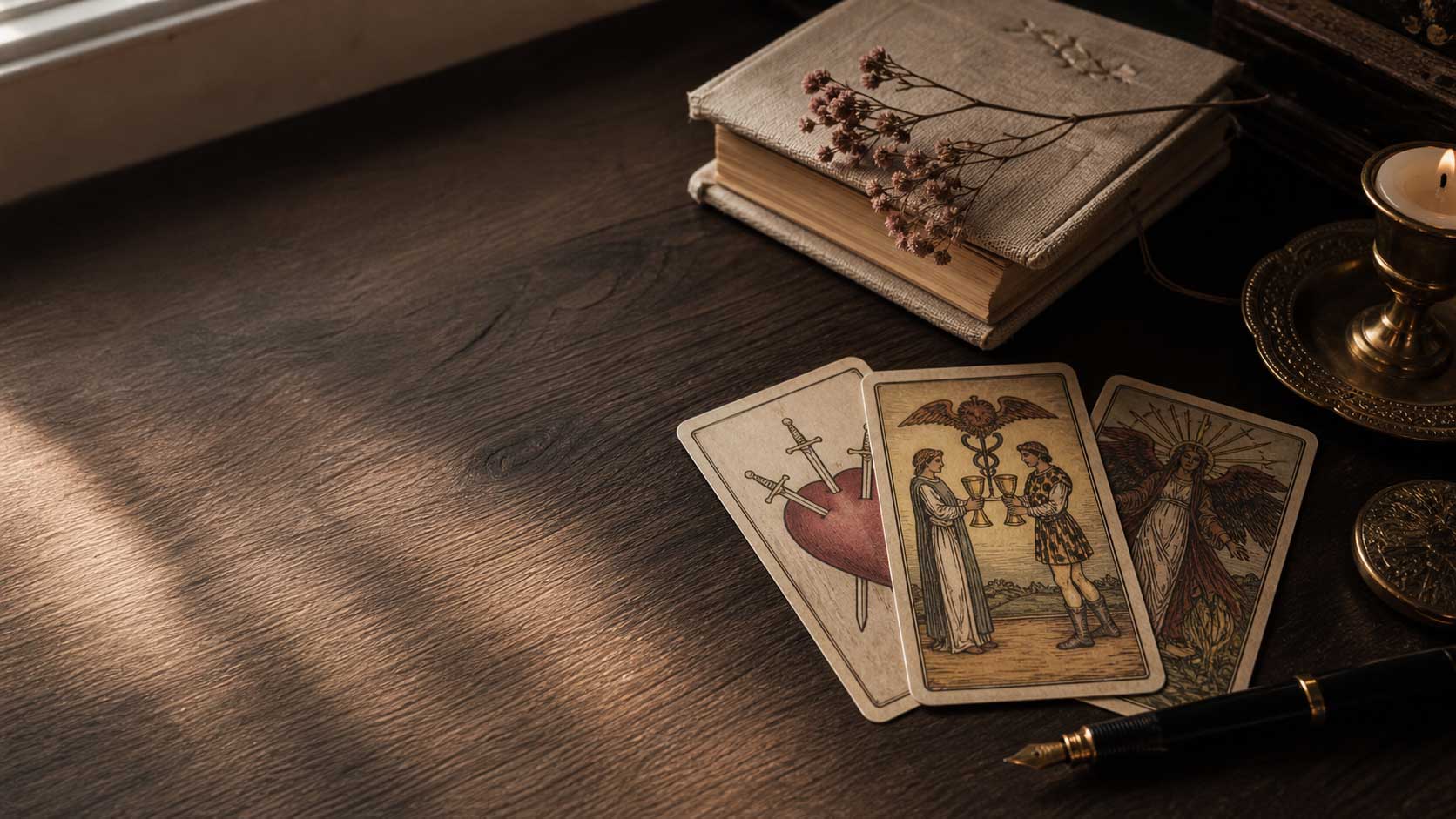
The short answer: A reversed tarot card is upside down relative to the viewpoint you chose for the reading. You can use the reader’s or the querent’s view, but choose before drawing and keep it consistent. Turning a card to show someone does not require a new interpretation.
Why the same card looks different across a table
You lay down the Star. It is upright to you and upside down to the person sitting opposite. The artwork has not changed; your viewpoints differ. This is a practical orientation question before it is an interpretation question.
Choose whose view will define upright and reversed for this reading. A simple beginner convention is to use the reader’s view, because that person will be connecting the cards and positions. Using the querent’s view is also a possible convention. Neither choice establishes better access to the future.
Explain the rule before you draw
Try saying: “I will read the cards as they face me. I may turn them to show you the picture, but I will keep their original orientation in my notes.” If you use the other person’s viewpoint, say that instead. Choose whether you use reversals at all before starting.
You can sit side by side if that is comfortable. You can also place a small note at the reader’s edge of the table to keep the chosen viewpoint clear. The aim is a method everyone can follow, without requiring anyone to guess which way a card was meant to be seen.
Keep display movement separate from the draw
Suppose the Star is upright from your chosen reference point in a position called “support.” You might explore hope, renewal, or what helps you regain perspective. Turning the card toward your guest to show the image does not require interpreting it as a blocked form of hope.
If the Star was reversed at the original draw and you use reversals, record that fact. You could explore difficulty accessing encouragement, while keeping other interpretations open. This is an example of a reading lens, not a prediction. The movement used to share an image is separate from the orientation used in your method.
Record the positions when taking a photo
Before moving the spread, write down the card names, spread positions, and any reversals using the original reference point. A photo taken from the other side can make every card appear to have switched orientation. A short note prevents that confusion.
If you cannot reconstruct the original orientation, say so. You can discuss the imagery without reversals or redo the exercise later with a clearer method. There is no need to invent a second message to explain a rotated photograph.
Do not change the viewpoint to get a preferred answer
A difficult card can make the opposite seat look tempting. If you find yourself switching reference points until the reading feels reassuring, pause. Keep the first method, consider the broader context, and leave room for an uncertain answer.
Your useful takeaway is a repeatable convention: one question, named positions, and one reference point. The cards can then support a conversation without a seating arrangement becoming a claim about anyone’s fate.
Tarot clarity
Turn the card meaning into a useful next question
Use Eldrin to connect the symbolism to your real situation without turning one card into a fixed verdict.
Ask about your cards->Best when you want interpretation with context.
Questions people ask
Is a card reversed for me but upright for the person across the table?
Visually, yes. For interpretation, use the single viewpoint agreed before the draw. Opposite seats do not require two competing readings.
Does turning a card around to show someone change its meaning?
You can preserve the original reading orientation while turning the card for display. Explain that convention and record the original position if needed.
For a related perspective, learn how card backs affect visible orientation, or return to the Eldrin blog.