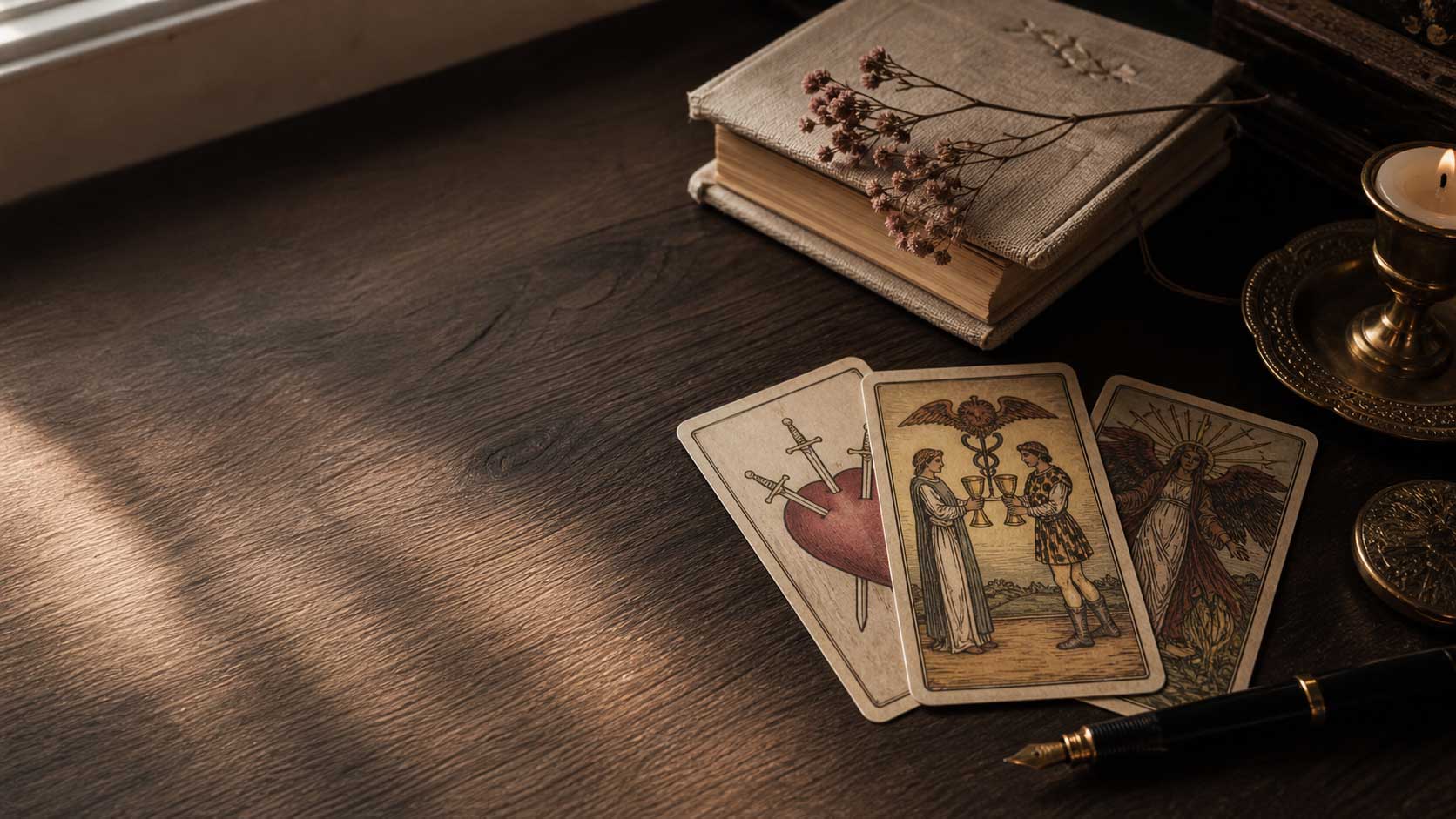
The short answer: A directional tarot card back can reveal a card’s orientation before you turn it over; a rotationally symmetrical back conceals that visual cue. Neither design requires reversals. Choose your method before drawing and avoid changing cards because you can recognize their orientation.
Check the design before assigning it meaning
You turn a deck face down and notice that the birds on the back all point toward one edge. Suddenly you can tell which way a card is facing before seeing its name. This is a useful thing to understand about the deck, not a mistake in your reading.
Rotate one card halfway around beside another. If the two backs look the same after that half-turn, the design conceals this particular orientation cue. If a sun, label, or other detail moves noticeably, you have a directional design. Wear or printing differences may still make individual cards recognizable.
Keep two kinds of orientation separate
Face up or face down describes whether you can see the card image. Upright or reversed describes its orientation under the rule you selected for the reading. A face-down card can still have an obvious top because of its back design.
You do not need to read reversals just because the back has a direction. If you use an upright-only method, turn each revealed card upright and interpret it through its position. A directional back can remain simply part of the artwork.
Choose a method that does not depend on avoiding a card
If you read reversals and notice yourself skipping a card that looks reversed, simplify the draw. You could shuffle face down, cut once, and deal from the top without sorting by the back. This is a consistency rule, not a claim that a particular shuffle guarantees randomness.
When revealing a card, turn it over like a book page rather than flipping it end over end if you want to preserve its table orientation. Set the reader’s viewpoint first, especially when sitting opposite someone else. Record uncertainty if the orientation becomes unclear; you do not need a replacement card.
Try one small exercise
Write a question such as “What would help me organize my study time?” Choose one card and decide in advance whether you will use reversals. Record the question, the method, the revealed card, and its orientation. Only then interpret it.
Suppose the Eight of Pentacles appears reversed. You might consider disrupted practice, overly demanding standards, or effort without useful feedback. Check which, if any, fits your study week. Seeing a reversed back before the reveal would not itself supply any of these conclusions.
Let the front and the question do the reading
A symmetrical back does not make a deck more truthful, and a directional one does not spoil it. You may prefer one for ease of handling. You can also keep a deck you enjoy and use a clear dealing rule.
If noticing the back keeps distracting you, practice upright-only for a while or use another deck you already own. Finish with a note about your method rather than buying something to correct a supposed spiritual problem.
Tarot clarity
Turn the card meaning into a useful next question
Use Eldrin to connect the symbolism to your real situation without turning one card into a fixed verdict.
Ask about your cards->Best when you want interpretation with context.
For a related reflection, read whether beginners need to read reversals.
Questions people ask
Can I read reversals with directional card backs?
Yes. Decide your method before drawing and deal consistently rather than selecting or rejecting cards by the visible orientation. Knowing the orientation cue is there does not invalidate the reading.
Do symmetrical backs guarantee a random draw?
No. They conceal a visual orientation cue. How cards are mixed and selected is a separate question; back symmetry alone does not establish randomness or accuracy.