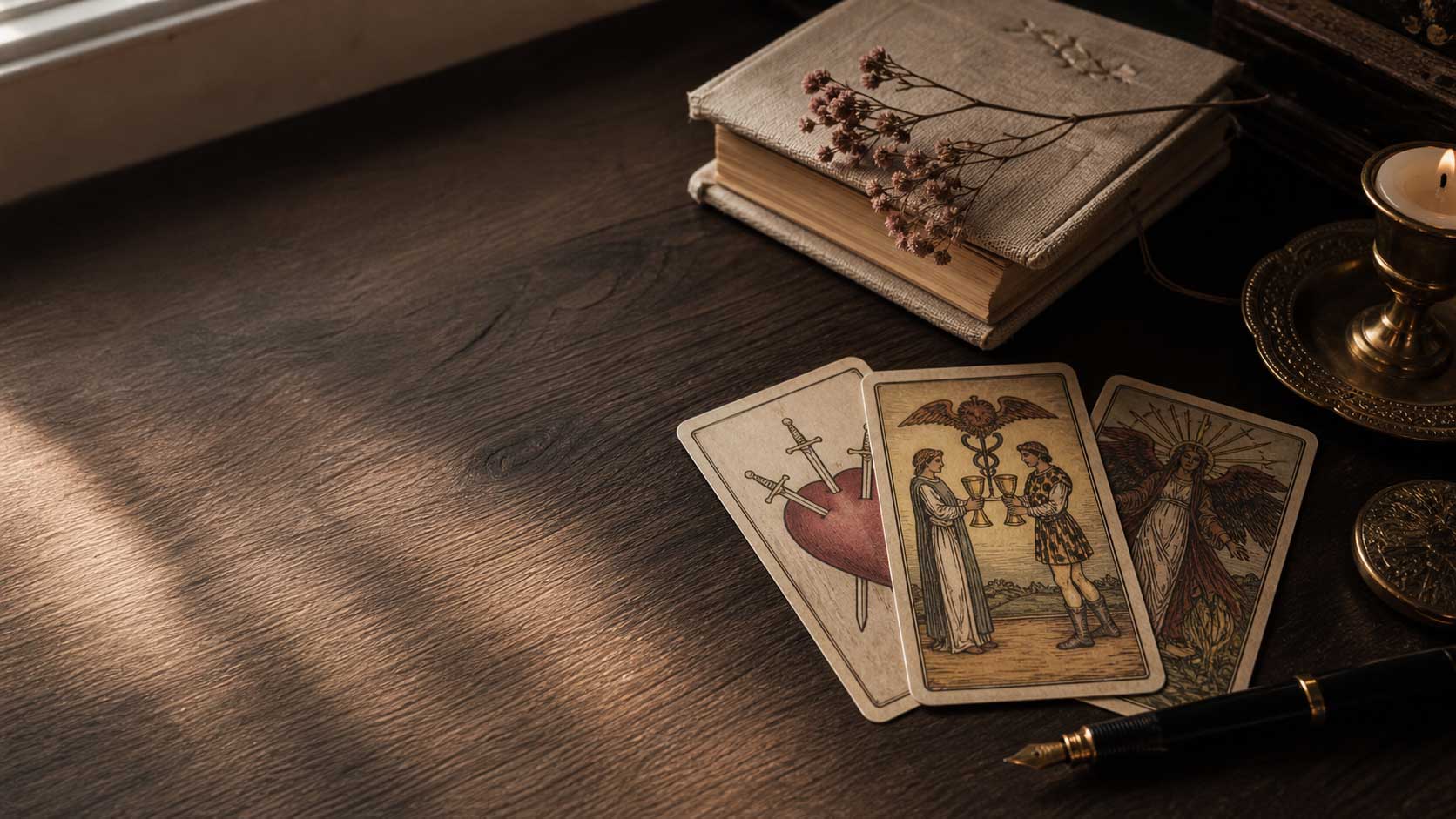
The short answer: There is no universal time a tarot reading must last. For a small personal question, you can try a ten-minute limit: two minutes to frame it, five to read a small spread, and three to write one useful note and close. This is a practical experiment, not a rule about accuracy or spiritual readiness.
You sit down for one question and look up forty minutes later. Several extra cards are on the table, and the original question is harder to remember. A time limit can make the practice easier to use when you tend to keep searching for a clearer ending.
It is also fine to enjoy a slower study session. The useful distinction is what the time is for: learning a card, reflecting on a question, or trying to make uncertainty disappear.
Choose the purpose before the duration
A one-card journal entry, a conversation with another reader, and studying a new deck need different amounts of time. You do not need to make them fit one ideal session length.
For personal reflection, begin with the time you actually have. If you have ten minutes, choose a question small enough for that space. “What should I notice before tomorrow’s conversation?” is more workable than “What will happen in every area of my life?”
Try a ten-minute structure
- Two minutes: frame the question. Write what you know and what you are asking. Decide on one to three cards and their positions before drawing.
- Five minutes: interpret what is there. Connect each card to its position. Check one guidebook entry if needed. Extra cards are optional, and you can choose not to use them today.
- Three minutes: write and close. Note one observation, one unanswered question, and one action or information source that could help.
These timings are an experiment. A quiet timer or an ordinary clock can help; neither determines when the deck is ready. If an alarm feels distracting, write the finish time on your page instead.
Use the last minutes to narrow the note
Suppose you asked what to consider before volunteering for an extra task and drew the Two of Pentacles. A useful closing note might be: “My schedule is already full. I will ask how many hours the task needs before agreeing.”
That note does not establish what the card objectively knows about your workload. It connects a familiar symbolic theme with a fact you can check. You can finish with that question still open.
Avoid using the final minute to start a new spread. If a new topic appears, write it down separately rather than forcing it into the same session.
If you need to stop before the answer feels complete
Record the question, cards, positions, and the point where you stopped. You can close the session with “I do not know yet.” If the issue needs information from another person, that conversation may help more than another interpretation.
If you were interrupted, see how to pause a tarot reading. A planned time limit differs from an interruption: you are building the closing step into the practice from the start.
Keep a timer from becoming another rule to worry about
Going a minute over does not spoil a reading. Finishing early does not make it shallow. Review whether the limit helped you keep the question clear and leave with something you could use.
With another reader, agree on the session length and scope before starting. This article does not set a professional standard or promise an outcome for a paid session.
If you use Eldrin for a short reflection, prepare one bounded question and reserve time to write your own note afterward. A timer can support a stopping point; it cannot guarantee emotional relief or turn tarot into evidence for a high-stakes decision.
Tarot clarity
Turn the card meaning into a useful next question
Use Eldrin to connect the symbolism to your real situation without turning one card into a fixed verdict.
Ask about your cards->Best when you want interpretation with context.
Questions people ask
Does a longer tarot reading give a more accurate answer?
More time can allow more discussion, but duration does not establish accuracy. Check whether you understand the interpretation and have a useful question or next step rather than simply adding cards.
What should I do when the timer ends and I still feel uncertain?
Record the unresolved question and close the reading. Decide whether you need information, a conversation, or rest before returning. You do not have to draw again to finish with certainty.