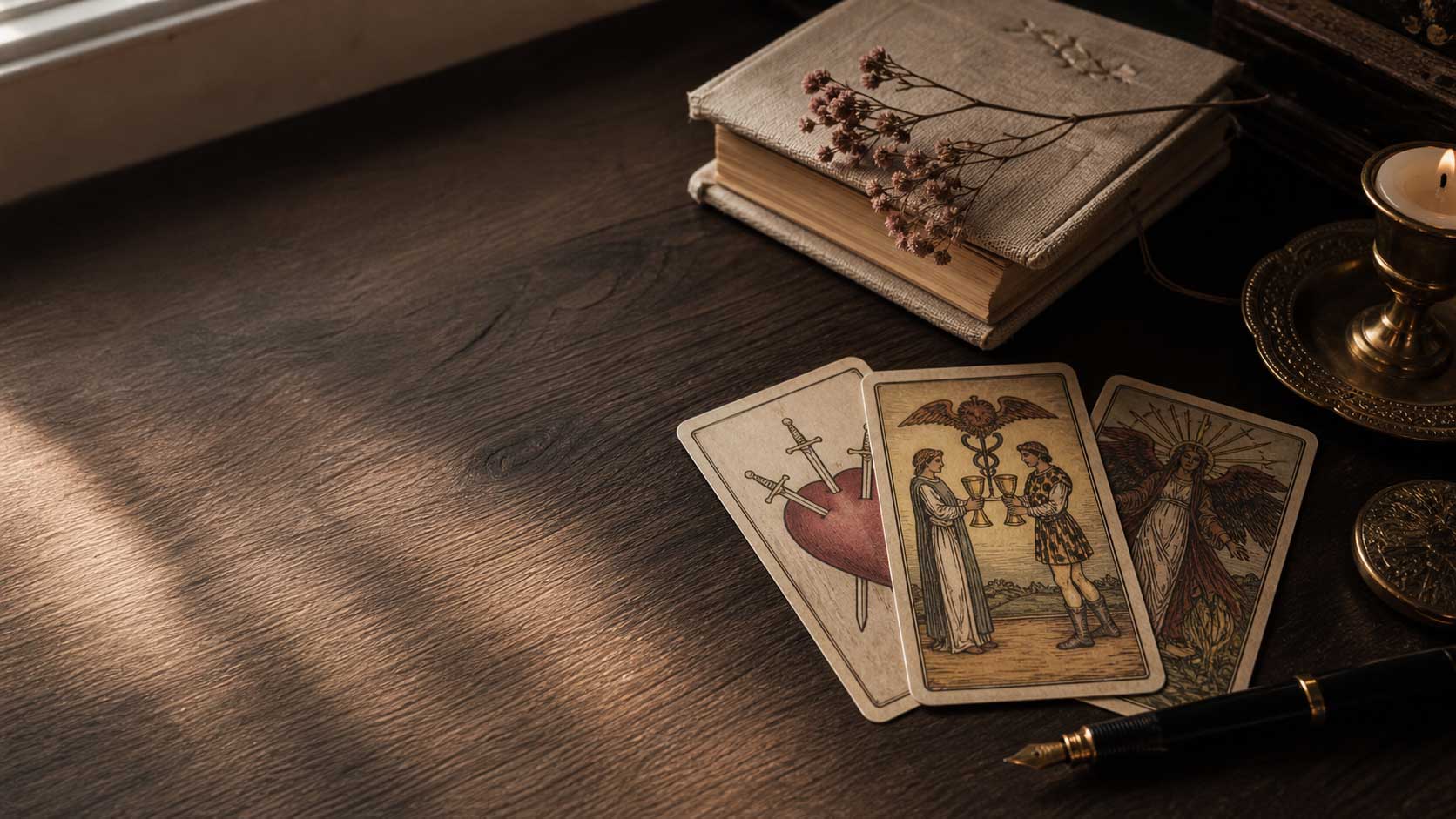
You can enjoy a deck’s artwork and still struggle with its tiny title. A card can look clear on a product page and be hard to read across your own table. That mismatch is a practical obstacle. You do not have to turn it into a test of intuition or keep guessing because you think a reader should know every image by heart.
The short answer: If your tarot cards are too small to read comfortably, change the viewing setup before questioning your ability. Try even lighting, a magnifier or enlarged photo, and a clear written card key. Preserve the original spread order and orientation; difficulty seeing a detail is not an omen.
Tarot clarity
Turn the card meaning into a useful next question
Use Eldrin to connect the symbolism to your real situation without turning one card into a fixed verdict.
Ask about your cards->Best when you want interpretation with context.
Find which part is difficult
Check one card at a comfortable distance. Is it the small title, the contrast between ink and background, a crowded scene, or the distance across the spread? Different problems need different adjustments. More cards on the table may make a distant label harder to read even when an individual card is manageable.
Try a steady lamp that lights the table evenly. Move it if a glossy finish catches glare. Bring the card toward you rather than spending the reading bent over the spread. These are options to try, not promises that one setup will work for everyone.
Enlarge the information without changing the draw
A handheld magnifier, a larger guidebook image, or a zoomed photograph may help you inspect the card you already drew. If you photograph a spread, note which edge faced you and keep each card in its numbered position. Do not let an automatic image rotation change which cards you recorded as reversed.
A photo also contains whatever is around the cards. Before sharing one, check for names, documents, faces, or other details you did not mean to include. You can inspect a photo locally without uploading it anywhere.
Make a readable key for repeated use
- Write each card’s name in a size you can read comfortably.
- Add one visible identifying detail from your own deck.
- Keep the guidebook page number beside the name if helpful.
- For each draw, record position, title, and orientation before interpreting.
A note such as “Card 2, Four of Cups, upright, what needs attention” is enough to hold the reading together. If you cannot identify a card, check the guidebook. Guessing confidently adds confusion that a reference can prevent.
Choose the smallest useful layout
A one-card reflection can be a complete practice: “What deserves my attention today?” Write the observation, one possible meaning, and one action. A three-card spread can wait until you can comfortably identify and revisit every position. Fewer cards do not make the reflection less legitimate.
If you eventually choose another deck, consider readable sample images, label contrast, and how it will sit on your table. Larger artwork can help some readers, but larger cards also change handling; our large-card shuffling guide addresses that separate issue. You can decide after trying the deck you have with an adapted setup.
These are reading-workflow suggestions, not vision care. The cards cannot assess eyesight. You can set the deck aside whenever reading it becomes uncomfortable, without drawing again to ask whether you are allowed to stop.
Keep reading
Explore the related guide for the neighboring question, or browse the reading room.
Questions people ask
Does needing a magnifier weaken a tarot reading?
A magnifier changes how you see the printed information. You can still identify the card, preserve its position, and reflect on it using your chosen method.
Should I redraw a card if I misread its title?
You can correct the title in your notes and interpret the original card in its original position. A reading mistake does not require a replacement draw.