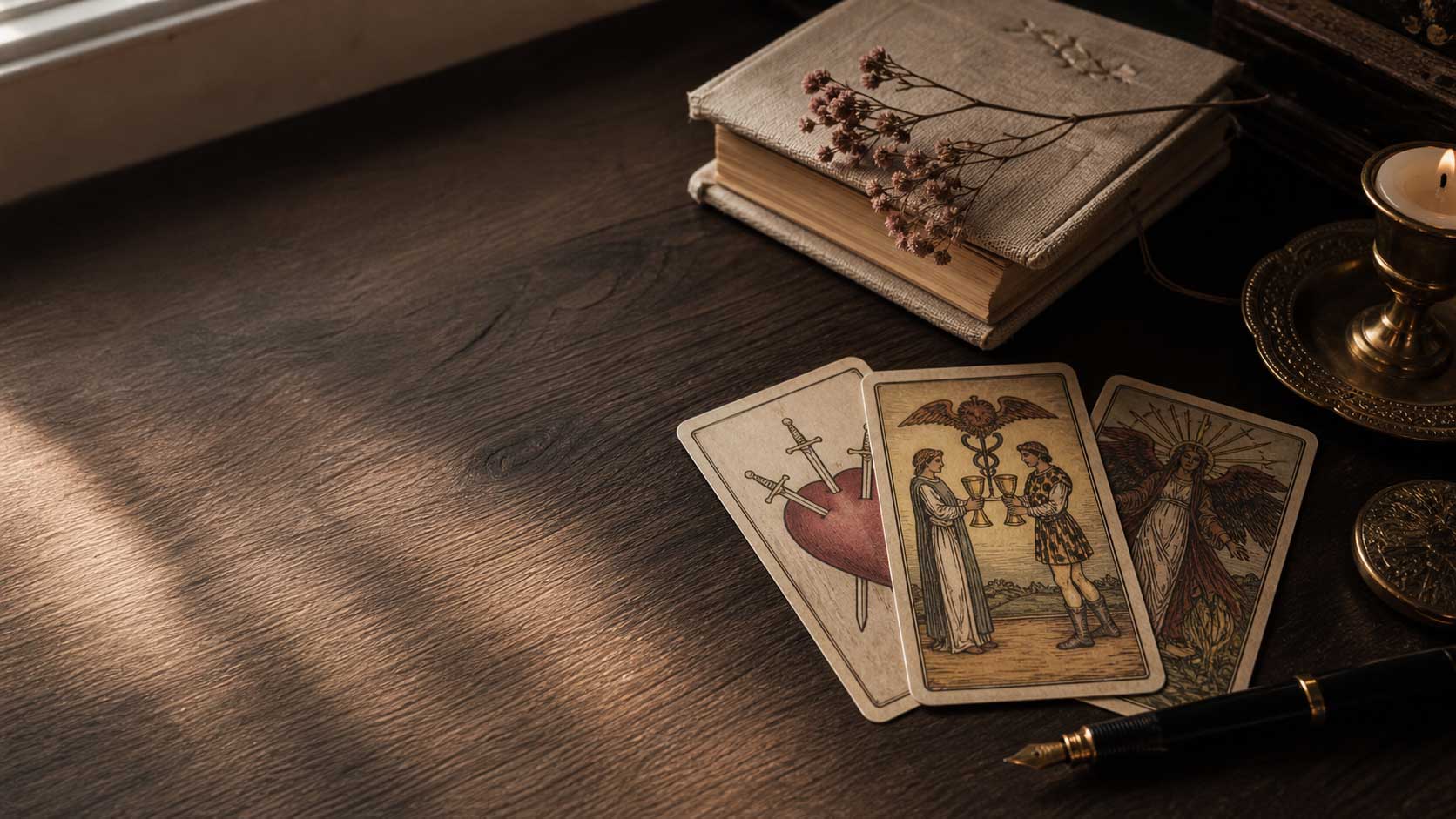
The short answer: If tarot cards are too big to shuffle comfortably, use a clean table to mix them gently or work with smaller packets. Decide beforehand whether you use reversals and how you will draw. Difficulty handling a deck is a practical issue, not evidence that it rejects you.
Start with comfort and the card stock
A deck can be beautiful and awkward to hold. Wide cards, stiff stock, slippery finishes, and small hands can make a familiar overhand shuffle difficult. There is no need to prove your connection with a deck by bending it or gripping harder.
Clear a dry, smooth space away from drinks. Check the deck maker’s handling guidance if available, especially for delicate edges or unusual finishes. Stop if a movement hurts or damages the cards. A smaller deck is also a reasonable choice; using one does not make your practice less serious.
Method one: mix gently on a table
Place the cards face down in a loose group. With light pressure, move small groups around the surface, letting the cards change places. Avoid grinding edges together. Gather them slowly into a stack when you are ready to draw.
This method can change orientation. If you do not read reversals, turn the cards upright as you gather or before interpreting, according to the rule you chose. If you do read reversals, keep the orientations that result. Choose once instead of deciding after seeing whether you like a card.
Method two: handle smaller packets
Divide the deck into portions you can hold easily. Gently mix each portion with a comfortable motion, then exchange small groups between portions and recombine them in a different order. Do this without looking at the card faces.
This is a practical handling option, not a claim of mathematically uniform randomization. One cut alone mostly preserves the order of the deck. If the cards arrived in sequence, take time to mix across packets instead of only rearranging intact piles. Tarot reflection does not require a performance of perfect shuffling.
Choose the draw before seeing the cards
For a simple reading, gather the deck and draw the top three cards into positions you have already named. Another option is to spread the cards face down on the table and select three. Keep the method consistent for this reading so you do not keep searching for a more reassuring answer.
For practice, try “What am I noticing? What assumption should I examine? What small step can I take?” Write down the cards and the positions. Your ability to explain the interpretation will tell you more about the exercise than whether your shuffle looked smooth.
A dropped card does not need a bigger story
Large cards can slip. If one falls while you are struggling to hold the deck, you can simply return it and continue. Decide in advance whether fallen cards count in your practice. You do not need to assign urgency to an ordinary handling accident.
If table mixing is still uncomfortable, pause and use another deck or another form of reflection. The purpose is to make space to think. There is no requirement to persist through strain, and a difficult shuffle does not predict a difficult day.
For one reflection, bring the facts you know and ask: what can I clarify or do next? Keep the answer beside your own judgment.
Tarot clarity
Turn the card meaning into a useful next question
Use Eldrin to connect the symbolism to your real situation without turning one card into a fixed verdict.
Ask about your cards->Best when you want interpretation with context.
Questions people ask
Can I shuffle tarot cards on a table?
Yes. Gently mix face-down cards on a clean, dry surface and gather them carefully. Decide in advance how you will handle reversals and draw the spread.
Do I need to riffle shuffle a tarot deck?
No. Riffle shuffling is one option, but it may be uncomfortable or unsuitable for some decks. Use a method that lets you mix the cards without strain or damage.