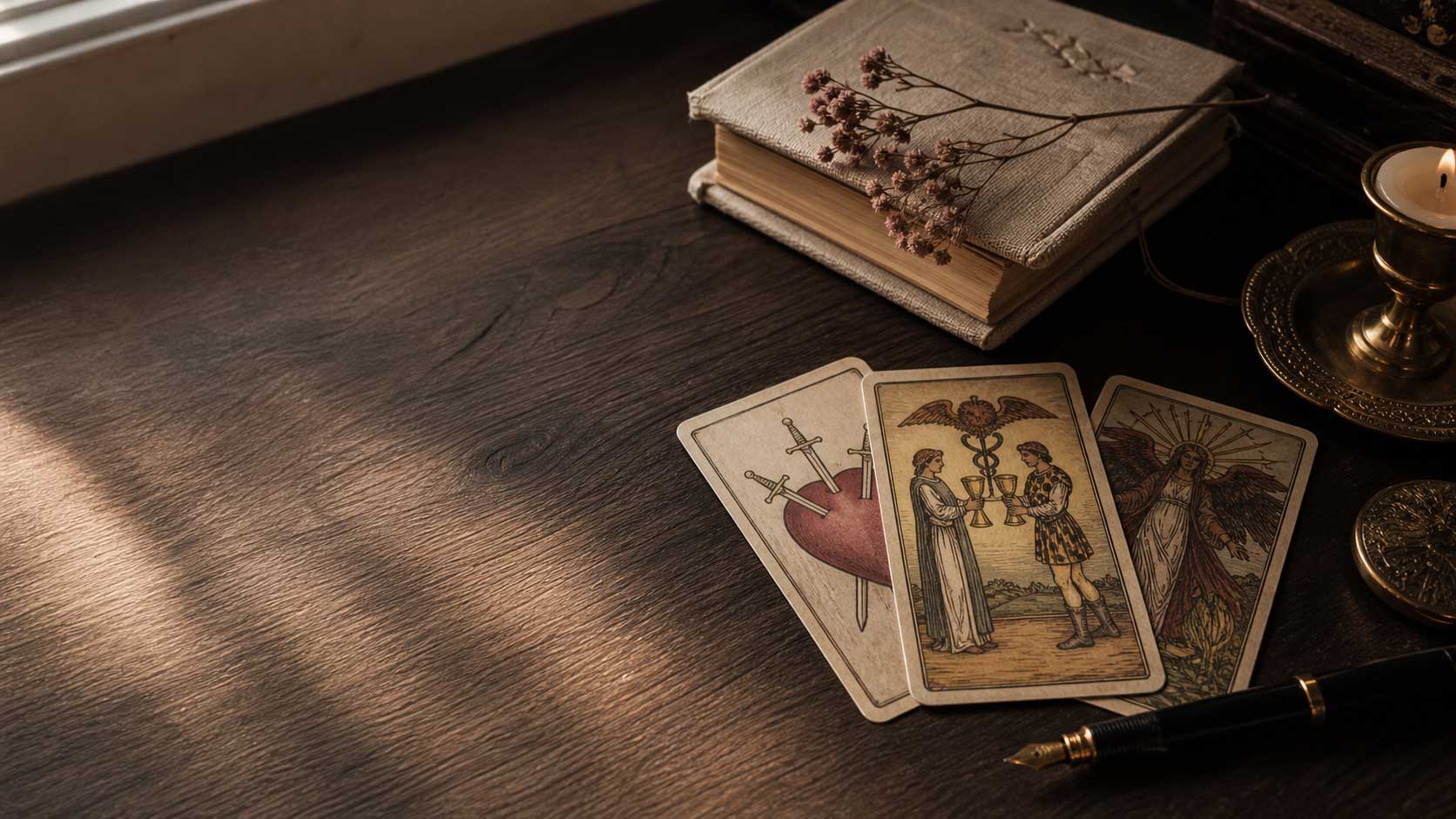
You turn over a card, recognize the picture, and forget every meaning you have read. The guidebook is beside you, but reaching for it feels like admitting you are not really doing tarot. You are allowed to reach for it.
The short answer: it is not cheating to use a tarot guidebook for personal reflection. A reference can help you learn the deck and check an interpretation. Read the meaning alongside the artwork, your question, and the spread position. Knowing a definition from memory does not make a prediction more reliable.
This page is about the pressure to read without help and how to use a book thoughtfully. You do not need to earn permission to begin by memorizing the entire deck.
Tarot clarity
Turn the card meaning into a useful next question
Use Eldrin to connect the symbolism to your real situation without turning one card into a fixed verdict.
Ask about your cards->Best when you want interpretation with context.
Let observation and reference do different jobs
Your observation can tell you which part of the picture catches your attention. The guidebook can explain what its author intended or how that deck approaches a card. Your context helps you decide whether an interpretation is useful to the question you asked.
For example, you notice a person turning away in the artwork. That is an observation. “This person feels disappointed” is an interpretation. “My friend will reject me” adds a claim about someone and an event the picture cannot establish. Keeping those steps separate makes the reading easier to check.
You can consult the book first if that helps you learn. Looking at the image before the text is an exercise you may try, not a test of whether your intuition is authentic.
A four-step way to look up a card
- Keep the question visible. Write the question and position so a broad paragraph in the book does not replace what you asked.
- Notice one detail. Record an object, gesture, color, or contrast without deciding what it proves.
- Read one reference. Choose a relevant theme from your deck’s book. Note a short idea in your own words rather than copying a whole entry.
- Make one contextual sentence. Try: “In this position, this theme invites me to consider…” End with a question or action you can evaluate.
If the result still feels unclear, “I don’t know how this fits yet” is a complete note. You can return to the reading later. You do not have to keep opening sources until one supplies a reassuring answer.
An example: the Four of Cups as a study prompt
Suppose your question is “What would help me begin this project?” and the Four of Cups sits in an advice position. You notice the seated figure and the offered cup. Your guidebook emphasizes withdrawal or a missed possibility.
A contextual sentence could be: “I may be dismissing the small, imperfect starting option while waiting to feel interested. What could I try for ten minutes?” That is a possible reflection you can test. It does not establish why you feel flat, and it does not require you to say yes to every offer.
The useful work happened when you connected the reference to the position. See how to read tarot cards as advice for more ways to turn a broad meaning into a practical question.
When the book and your impression disagree
Check whether you are using a guidebook written for this deck. Different artwork and reading systems can emphasize different things. You do not need to combine every interpretation into one complicated story.
Write two possibilities and what each would help you examine. If one depends on facts you do not have, label that gap. If neither helps, set the card aside. A strong emotional reaction can be worth reflecting on without being proof that your first interpretation is correct.
The same approach works with a memory aid such as tarot number themes: use it when it clarifies the card and leave it when it forces the image into a formula.
Keep learning visible when you read with help
If you read for a friend, you can say, “I’m learning this deck, so I’ll check the guidebook as we go.” That gives them an honest picture of the process. Using a reference does not authorize certainty about their private life or future.
If you use Eldrin, bring your question and the context you want to reflect on. Keep any AI interpretation beside your reference and your judgment. For learning with a tool, use AI as a study partner without assuming it has accessed your particular guidebook.
You can keep a book open for as long as it is useful. Progress can mean asking a clearer question, noticing a new detail, or admitting uncertainty more comfortably. It does not have to mean reading faster.
Questions people ask
Is it cheating to use a tarot guidebook during a reading?
No. For personal reflection, looking up a meaning is a reasonable part of learning and using a deck. You can combine a guidebook with your own observations. If reading for someone else, be clear that you are consulting a reference.
What if my first impression differs from the guidebook?
Write down what you noticed, then compare it with the book’s interpretation and your spread position. They may emphasize different details. You can leave the difference unresolved rather than forcing agreement or treating either impression as proof.
Do I need to memorize every tarot card before I begin?
You do not need to memorize every card for a small personal reflection. Begin with a manageable question, a card or small spread, and a reference you can understand. Familiarity can grow through practice without a deadline for putting the book away.