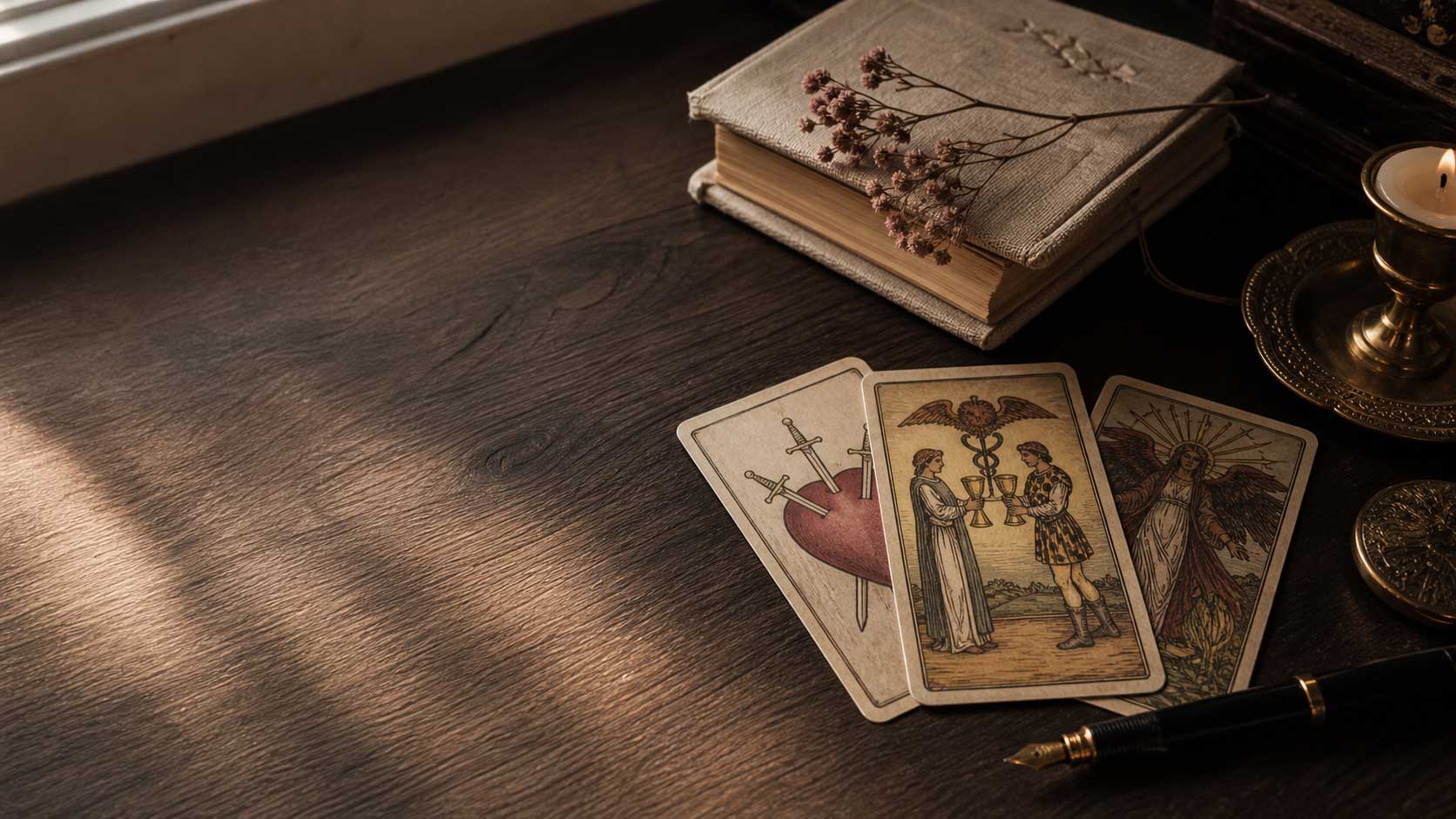
You remember that Fives can suggest difficulty, then draw the Five of Cups and the Five of Wands. Does that make them the same card? It does not. The number offers a starting point; the suit and image make the situation more specific.
The short answer: tarot card numbers can be used as an optional memory aid for the numbered Minor Arcana, from Aces through Tens. Combine a number theme with the suit, artwork, and position. There is no single universal number dictionary, and a card’s number cannot establish a date or predict an event.
The table below is a learning framework, not an ancient rule or a replacement for your deck’s guidebook. If a theme does not help you understand the image, set it aside.
Tarot clarity
Turn the card meaning into a useful next question
Use Eldrin to connect the symbolism to your real situation without turning one card into a fixed verdict.
Ask about your cards->Best when you want interpretation with context.
One practical Ace-to-Ten framework
| Number | Optional theme | A question to try |
|---|---|---|
| Ace / 1 | A beginning or an available resource | What is present that I could develop? |
| 2 | A pair, choice, or tension | What needs to be held in relation? |
| 3 | Development or something taking shape | What is becoming visible? |
| 4 | Structure, stability, or a fixed position | What supports me, and what feels rigid? |
| 5 | Disruption, friction, or an adjustment | What has become difficult to ignore? |
| 6 | An adjustment toward connection or balance | What kind of support or movement is possible? |
| 7 | Assessment, a test, or a chosen approach | What deserves a closer look? |
| 8 | Engagement, effort, or a pattern in motion | What am I doing or repeatedly experiencing? |
| 9 | Accumulation or nearing a limit | What has built up, and what does it ask of me? |
| 10 | A culmination or a full expression | What is this pattern like when it fills the room? |
Some cards fit a broad theme easily; others need more attention to their particular imagery. A Nine can hold satisfaction, isolation, or worry depending on the card. “Near completion” does not mean the next thing you want is about to arrive.
Add the suit before you make a sentence
A common starting lens links Cups with feelings and connection, Wands with initiative and activity, Swords with thought and conflict, and Pentacles with practical life and resources. These are broad associations, not rules that restrict a card to one topic.
For example, the Five of Cups can invite reflection on disappointment and what remains available. The Five of Wands can invite reflection on competing efforts or friction. “Five” may help you notice disruption in both; it does not tell you that both cards mean grief, or that either predicts a fight.
Likewise, the Three of Cups and Three of Swords should not become interchangeable because both are Threes. A useful learning aid leaves room for difference. If you are new to the deck’s sections, start with Major versus Minor Arcana.
Let the spread position finish the question
Suppose the Six of Pentacles appears in a “support available” position. You might consider a practical exchange: who could offer help, what you can ask for, and whether the terms work for you. The same card in “a habit to examine” could prompt a look at overgiving or keeping score.
The number and card have not changed. The question has changed what deserves your attention. That is why reading a card in its spread position is more useful than adding a fixed number meaning to every situation.
- Name one detail you can actually see in the artwork.
- Try one number theme and one suit association.
- Make a sentence that answers the position.
- Check it against your context; leave out anything the card cannot establish.
What about repeated numbers, Major Arcana, and dates?
If several Fours appear, you can ask whether structure or stuckness is a useful shared theme. You do not need to add the numbers together or treat the repetition as an urgent message. Each card still has its own image and job in the spread.
This table covers Aces through Tens in the Minor Arcana. It does not explain Major Arcana numbering or turn court cards into a numbered progression. Check the titles and system used by your particular deck.
A Seven does not establish seven days, seven weeks, or the seventh of a month. If timing is your question, keep tarot timing separate from a deadline. Make practical plans using the information you can verify.
Try one card without turning it into a formula
Write: “In this position, this image and number help me consider…” Finish with one possibility and one grounded question. If you use Eldrin, bring the card, its position, and that question. Keep your guidebook nearby when interpreting the response.
A successful exercise gives you a clearer way to think about the card. It does not prove that the number has diagnosed your situation or promised what comes next.
Questions people ask
What do the numbers on tarot cards mean?
For numbered Minor Arcana, readers can use number themes as an optional memory aid: beginnings for Aces, choices for Twos, and so on. These associations vary. Read the number with its suit, artwork, and spread position rather than treating it as a complete card meaning.
Do repeated numbers in tarot predict dates?
Repeated numbers do not establish a date, deadline, or outside message. You may use them to notice a shared theme, then check whether that theme actually fits the cards and the question.
Can I use the same number meanings for Major Arcana and court cards?
Do not assume this Ace-to-Ten learning aid explains those cards. Major Arcana have their own imagery and titles, and court cards are usually approached through roles or qualities. Follow your deck’s system when it differs.