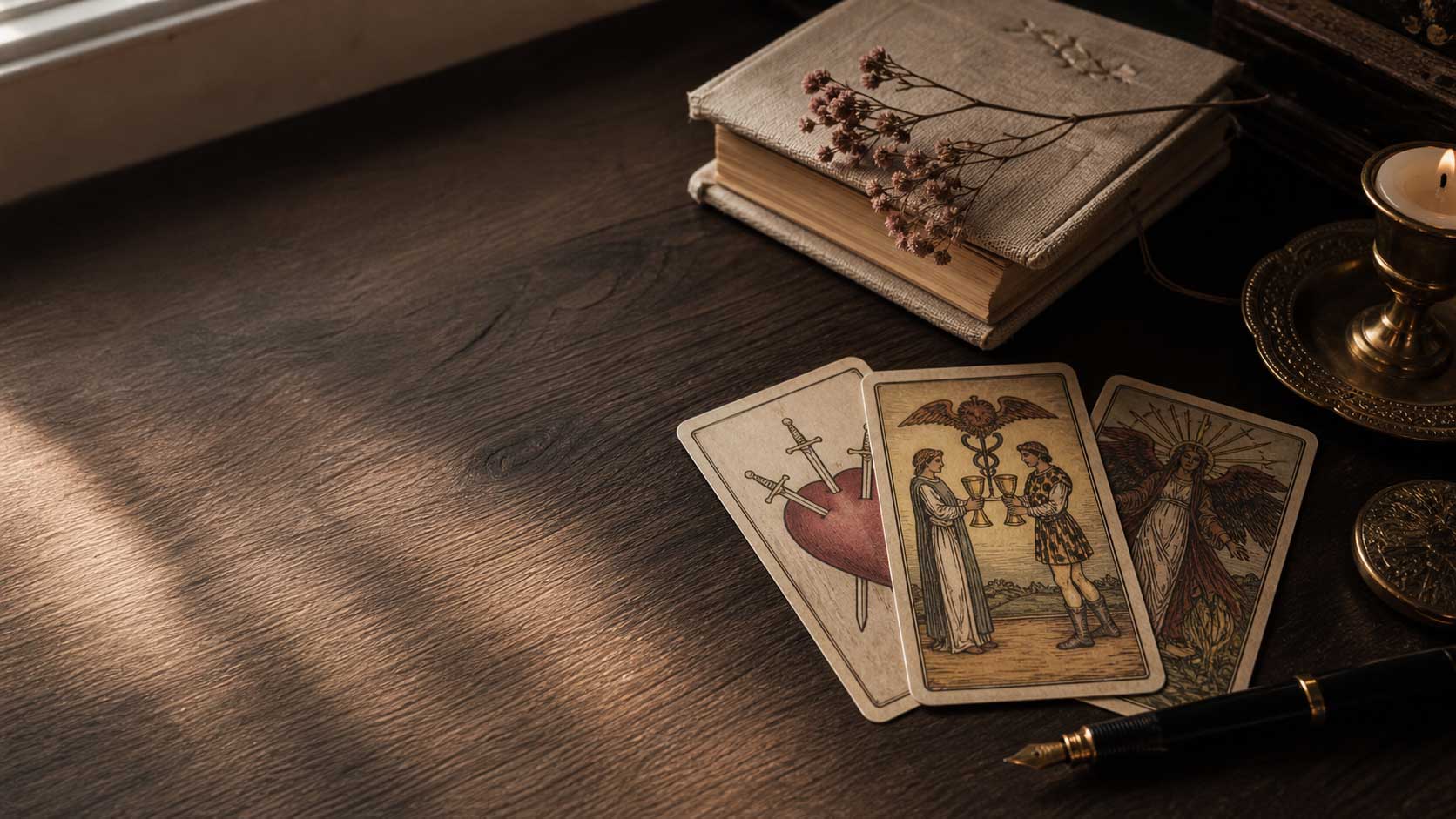
You pull a card with no title. There is a figure, several small symbols, and perhaps a number at the top. Before searching for what the scene means for your life, give yourself a simpler task: establish which card you are looking at.
The short answer: To identify a tarot card without a printed name, check the exact deck and guidebook first, then compare its suit, number, and image with that deck’s card list. If the identity remains uncertain, label it as uncertain and pause interpretation rather than inventing a card name.
Start with the exact deck and edition
Look at the box, booklet, or creator’s card list. Some decks remove titles, rename cards, change imagery, or add cards. A familiar picture from another deck is a clue, not confirmation.
If the deck is borrowed, ask its owner for the name and guide. If you have only a cropped photograph, request the whole card and the deck name. Avoid identifying a card solely from its mood: a solitary figure does not automatically make it the Hermit.
Use a simple identification order
- System: Is this tarot, an oracle deck, or another kind of card set?
- Markings: Note any number, suit symbol, small caption, or court marker.
- Deck reference: Match those details against the exact guide or card list.
- Confidence: Write “confirmed” or “not yet confirmed” before interpreting.
A standard tarot deck commonly has 78 cards, but a count alone cannot identify an individual card or prove that a custom set follows that structure. Let the actual deck reference lead.
Count suit objects carefully
Suppose an unnamed card shows six cup-shaped objects. Six of Cups is a reasonable provisional guess if the deck uses Cups, but check that the objects are suit markers rather than decoration. In a heavily redesigned deck, the guide may be essential.
For a number without a suit, check the Major Arcana list for that edition. Do not assume every deck numbers every Major the same way. If an identity still does not fit, stop before forcing the image into a familiar name.
Keep the identification note separate from the reading
Write two lines: “Card identity: confirmed by the guide as Six of Cups.” Then: “In the advice position, I might reflect on a familiar source of support.” The first is a reference check. The second is your interpretation, which can change with the question.
If you only have a guess, record it as a guess. You can describe the artwork for a journal exercise, but call that an image reflection rather than a confirmed card meaning. There is no need to pull extra cards to solve a labeling problem.
Ask for help without asking for certainty
When seeking help, share the deck name, visible markings, and your tentative identification. If using an AI tool, give the confirmed card name as text when possible. Do not assume image recognition or exact deck knowledge is available. A fluent interpretation is not proof that the card was identified correctly.
Tarot clarity
Turn the card meaning into a useful next question
Use Eldrin to connect the symbolism to your real situation without turning one card into a fixed verdict.
Ask about your cards->Best when you want interpretation with context.
Keep reading
Explore the related guide for a different part of this question, or bring one focused question to Eldrin.
Questions people ask
Can I read tarot cards that have no names printed on them?
Yes, once you can identify the cards through the deck’s system and reference material. You can keep a small lookup sheet nearby; memorizing every card is not a prerequisite.
Can I identify a card just by counting objects?
Counting suit symbols can help, but decorative objects can mislead you. Check the deck guide and do not treat a provisional guess as a confirmed identity.