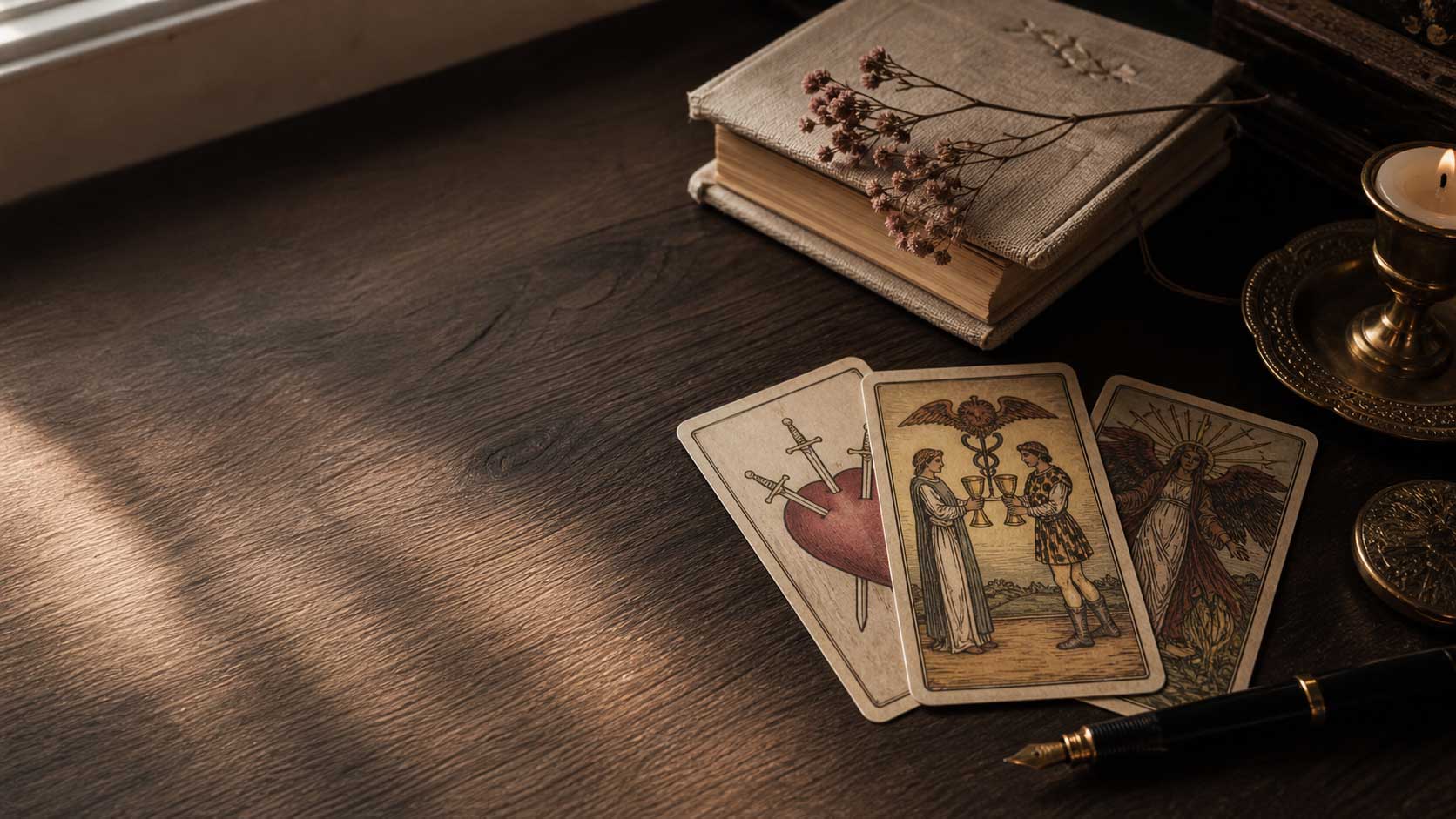
The short answer: In many tarot decks, Chalices corresponds to Cups, Coins or Disks to Pentacles, and Batons or Staves to Wands; Swords often keeps its name. Treat these as common correspondences, then check your deck guidebook before assuming the same structure or meaning.
You open a deck and find the Three of Disks where you expected the Three of Pentacles. Or a guide asks you to look at Batons while the cards you know use Wands. A different label does not automatically mean an extra suit or an entirely new card.
The first job is identification. Once you know which part of the deck you are looking at, you can explore what its creator intended. You do not need to memorize every naming variation before using one deck.
A small reference for common correspondences
| Familiar suit | Names you may encounter | What to check |
|---|---|---|
| Cups | Chalices | Guidebook title and numbered sequence |
| Pentacles | Coins, Disks | The deck's own material and symbolic themes |
| Wands | Batons, Staves | The printed suit key and artwork |
| Swords | Often Swords | Any renamed suit in a themed deck |
This table is an orientation aid, not a universal translation key. A themed deck may rename several suits, change their associations, or use a different structure. Start with its own explanation rather than matching an object by appearance alone.
Identify the card in three steps
- Read the complete label. Record the number or court title as well as the suit. “Three” and “Queen” have different roles.
- Check the contents or suit key. Look for the deck creator's mapping. Keep an uncertain identification marked as uncertain.
- Read the card entry. Notice where the specific deck emphasizes something different from the meaning you remember.
If the guidebook is missing, look for the publisher's or creator's description of that edition. Similar artwork on another deck is not enough to establish the intended title.
A worked example: the Three of Disks
Suppose the guidebook places Disks in the suit that your other deck calls Pentacles. Write “Three of Disks — this deck's Pentacles correspondence” in your note. Then read the actual entry and image.
If you are accustomed to a teamwork scene on the Three of Pentacles, do not invent that scene on a card that only shows three disks. You can ask what the arrangement suggests while labeling that as your interpretation. A shared suit correspondence does not make all artwork or reading methods interchangeable.
In an advice position, the card might lead you to ask what needs practical coordination. That is a possible reflection, not a definition that every Three of Disks must carry.
Keep the deck's vocabulary with the question
When discussing a reading, include the deck name, the exact card title, and its spread position. If you use Eldrin, type the correspondence you have already checked rather than expecting a tool to identify an unfamiliar deck. Do not assume that uploading or automatic identification is available.
For the larger structure, see Major versus Minor Arcana. For non-scenic numbered cards, use the pip-card reading method. A renamed suit changes the vocabulary you need to check; it does not make your earlier learning useless.
Tarot clarity
Turn the card meaning into a useful next question
Use Eldrin to connect the symbolism to your real situation without turning one card into a fixed verdict.
Ask about your cards->Best when you want interpretation with context.
Questions people ask
Are Coins and Pentacles the same suit?
They are common corresponding suit names across many tarot decks. Check the particular deck, because its artwork, emphasis, and reading method can still differ.
Can I use this table for every themed deck?
No. Unfamiliar suit names need the creator’s own key. If that information is unavailable, keep the mapping provisional rather than presenting a guess as fact.