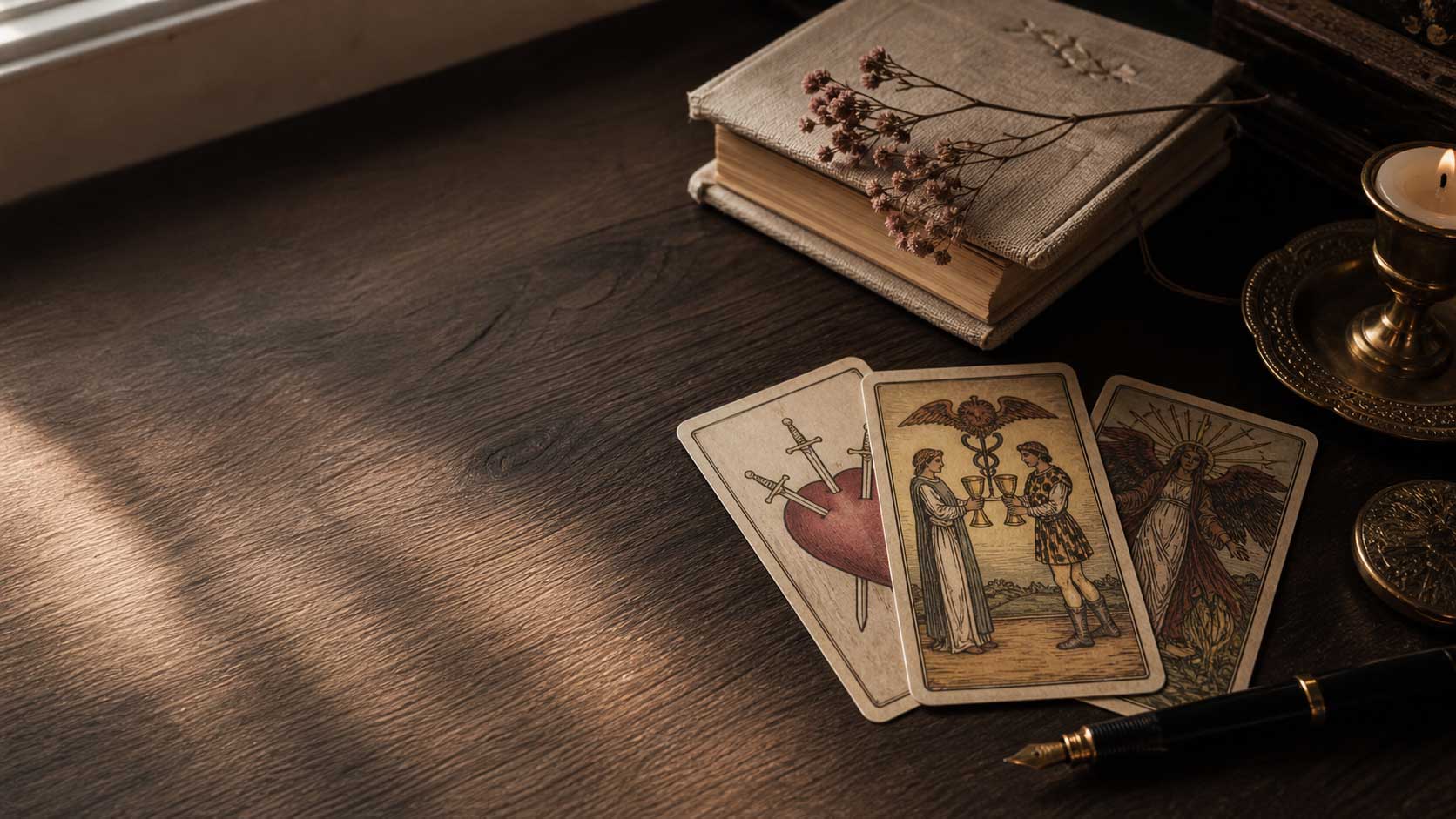
You turn over a numbered card and see cups, coins, swords, or wands arranged on a background. There is no person to identify with and no obvious scene to narrate. That can feel like missing information if you learned with illustrated Minor Arcana. It can also give you a simpler place to begin.
The short answer: To read a pip tarot card, identify the suit and number, check the deck’s guidebook or chosen reading tradition, then connect the symbols and their arrangement to the spread position. Start with one tentative sentence. You do not need to invent an illustrated scene or treat a number association as a prediction.
Tarot clarity
Turn the card meaning into a useful next question
Use Eldrin to connect the symbolism to your real situation without turning one card into a fixed verdict.
Ask about your cards->Best when you want interpretation with context.
What “pip” means in this guide
Here, a pip card means a numbered suit card whose design centers on repeated suit symbols rather than a fully illustrated everyday scene. Decks vary, and decorative details can still matter. A pip deck is not automatically a deck with missing artwork or missing meanings.
Readers describe different experiences with these cards. In a public discussion of pip decks, some welcomed the abstract imagery while others described needing a different way into the reading. Those are personal experiences, not evidence that one kind of deck is better.
Choose the system before combining meanings
Start with the guidebook for the deck in your hands. If you are learning a specific tradition, use that tradition’s instructions alongside it. Number meanings, suit associations, and the treatment of visual arrangement are not identical across all methods.
You can choose a personal reflective method, too. Just label it as your method. If you use twos to explore a pair or an exchange, that is a working association, not a universal law that every Two must obey. Avoid switching systems halfway through because another interpretation sounds more reassuring.
Use a four-part note
- Suit: write the area your guidebook associates with it. Keep this to a few words.
- Number: choose one association from the same method. Leave the rest aside for this reading.
- Arrangement: describe something visible, such as spacing, symmetry, an opening, or a dense center. Separate that observation from the meaning you give it.
- Position: return to the question the card is answering. An obstacle position and a possible next step ask for different sentences.
Finish with: “In this position, this combination could invite me to notice…” That wording gives you room to revise. A blank response is allowed; it is not evidence that the deck rejects you.
A worked example without a borrowed scene
Suppose you draw the Two of Cups for “one thing I can practice in a friendship.” For this exercise, choose Cups as emotional exchange and two as a pair. You notice that the two cups face a shared central space in your particular design.
A tentative sentence could be: “I could make room for a two-way conversation instead of preparing everything I want to say.” One action might be to ask a friend a question and leave time to hear the answer. This is an example of a chosen reflective method, not a required Two of Cups meaning.
You have not inferred a secret admirer, a soulmate, or an event on a particular date. You have connected a small set of symbols to a self-facing position. If your guidebook uses a different association or your card has a different arrangement, let the example change.
When an illustrated meaning still comes to mind
You do not have to erase what you learned from another deck. Write the familiar meaning in a separate note, then decide whether it helps with this card and this method. It should be a comparison, not a scene you claim to see on a card where it is absent.
If different references disagree, the guide to why tarot guidebooks have different meanings can help you keep the sources distinct. For practice, read one card before expanding the spread. The goal is a usable interpretation, not a story large enough to cover every possibility.
Questions people ask
Are pip tarot decks harder for beginners?
They can feel unfamiliar when you learned through illustrated scenes, but difficulty depends on the reader, deck, and method. A guidebook and a small suit-number-position practice can give you a consistent starting point.
Can I use Rider-Waite-Smith meanings with pip cards?
You can deliberately use them as a reference or comparison, but name that choice. Do not assume every pip deck follows the same system or that an illustrated scene is present in its design.