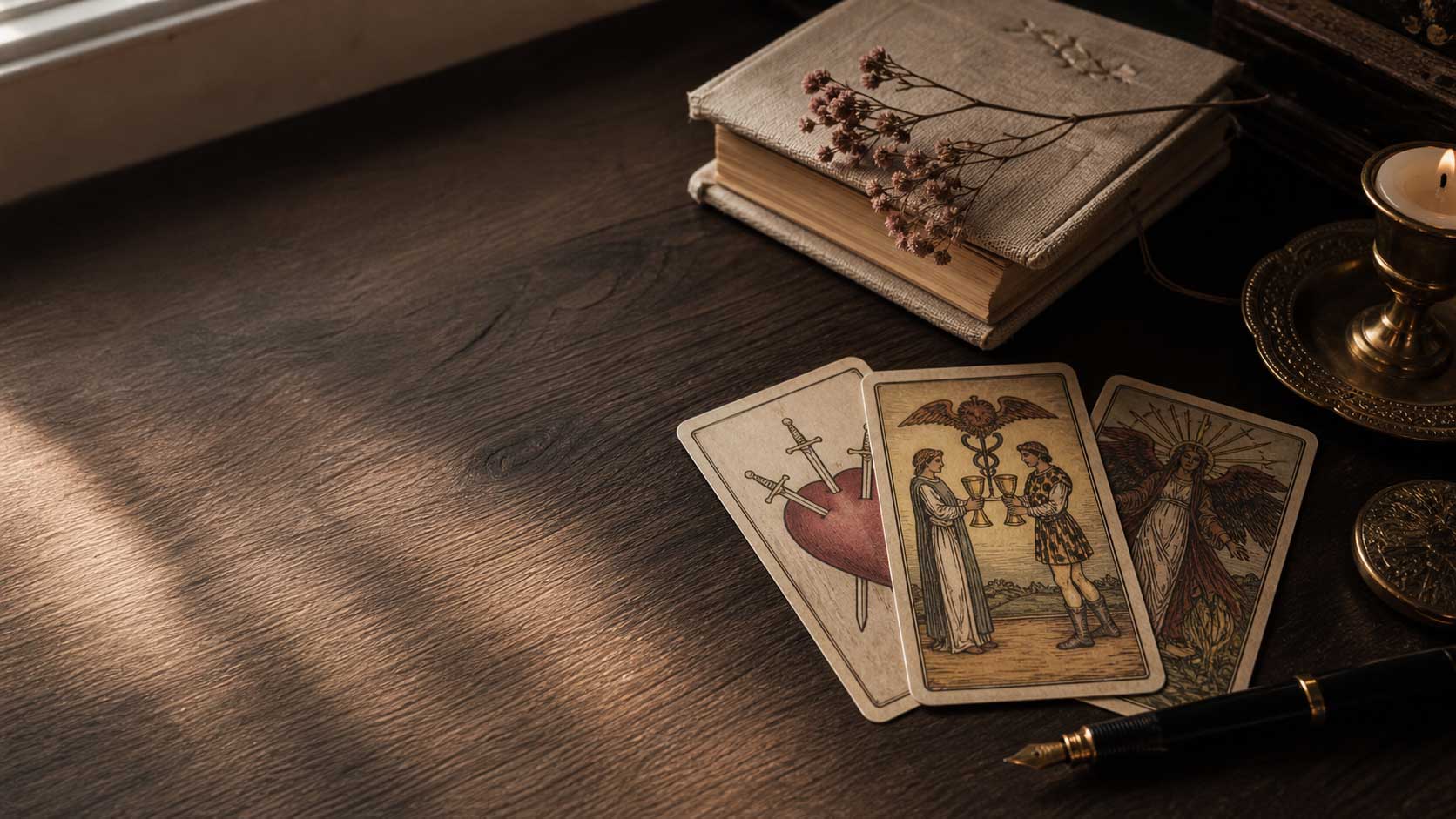
A cloud appears behind a hand, above a figure, or across the sky. It is tempting to give it one permanent translation: uncertainty, a message, or trouble coming. But the same visual detail can play a different role in two different cards.
The short answer: Clouds in tarot have no single compulsory meaning. In some Rider–Waite–Smith images, a hand emerges from a cloud; elsewhere clouds form part of a scene’s atmosphere. Describe the artwork first, then use the card title, position, and deck guidebook to test a possible interpretation.
Begin with what you can actually see
Write one observation without explaining it: “A hand holding a sword extends from a cloud,” or “A cloud surrounds the hand offering a cup.” That is different from “An unseen force is sending me a warning.” The first describes an image. The second adds a claim.
In the Rider–Waite–Smith Ace of Swords and Four of Cups, the cloud belongs to an offered or presented object. That shared feature does not make the cards interchangeable. A sword held upright and a cup offered beside a seated figure give you different scenes to read.
Keep the whole card in view
In an advice position, the Ace of Swords might prompt you to put a thought into clear words. You could treat the emerging hand as a way to notice the arrival of an idea. In the Four of Cups, you might ask what is being offered and whether you have attention for it. These are interpretive possibilities, not messages delivered from outside the reading.
The cloud alone cannot establish that an opportunity is good, that a person is confused, or that something is being concealed. If your deck redraws the scene, follow that artwork and its guidebook instead of importing details it does not contain.
Try a two-sentence reading
First write: “In this card, I see…” Then write: “In this spread position, that makes me wonder…” For a question about an unfinished project, a possible reflection is “What idea needs a clearer first sentence?” You can answer that without claiming the cloud forecasts an event.
If you cannot connect the detail to the question without inventing a long story, leave it aside. You can understand a card through its central action, suit, number, or title. You do not need to interpret every part of the sky.
Check which card system you are using
A card actually titled Clouds may belong to a different system, such as Lenormand, rather than being a tarot card with cloudy artwork. Check the deck’s name and guidebook before borrowing a tarot interpretation. Similar pictures do not establish identical systems.
Clouds cannot predict weather, establish spiritual contact, diagnose a mental state, or verify a hidden event. Keep the reflection small enough to compare with your own experience.
A question to bring to Eldrin
At Eldrin, bring one specific question: "How does this image relate to the position I gave it?" Use the response to find words or a next step, and keep the decision with you.
Tarot clarity
Turn the card meaning into a useful next question
Use Eldrin to connect the symbolism to your real situation without turning one card into a fixed verdict.
Ask about your cards->Best when you want interpretation with context.
Artwork reference
Compare the illustrated cards in A. E. Waite’s The Pictorial Key to the Tarot, with illustrations by Pamela Colman Smith. The exercises here are reflective suggestions, not claims that each cloud has an official definition.
Questions people ask
Do dark clouds always mean something bad in tarot?
No. Color and atmosphere can contribute to an interpretation, but a background detail is not a reliable forecast. Read the whole card and the question.
Should I read clouds the same way in every deck?
No. Artists and deck systems use imagery differently. Start with the specific artwork and the creator’s guidebook, and leave room for uncertainty.