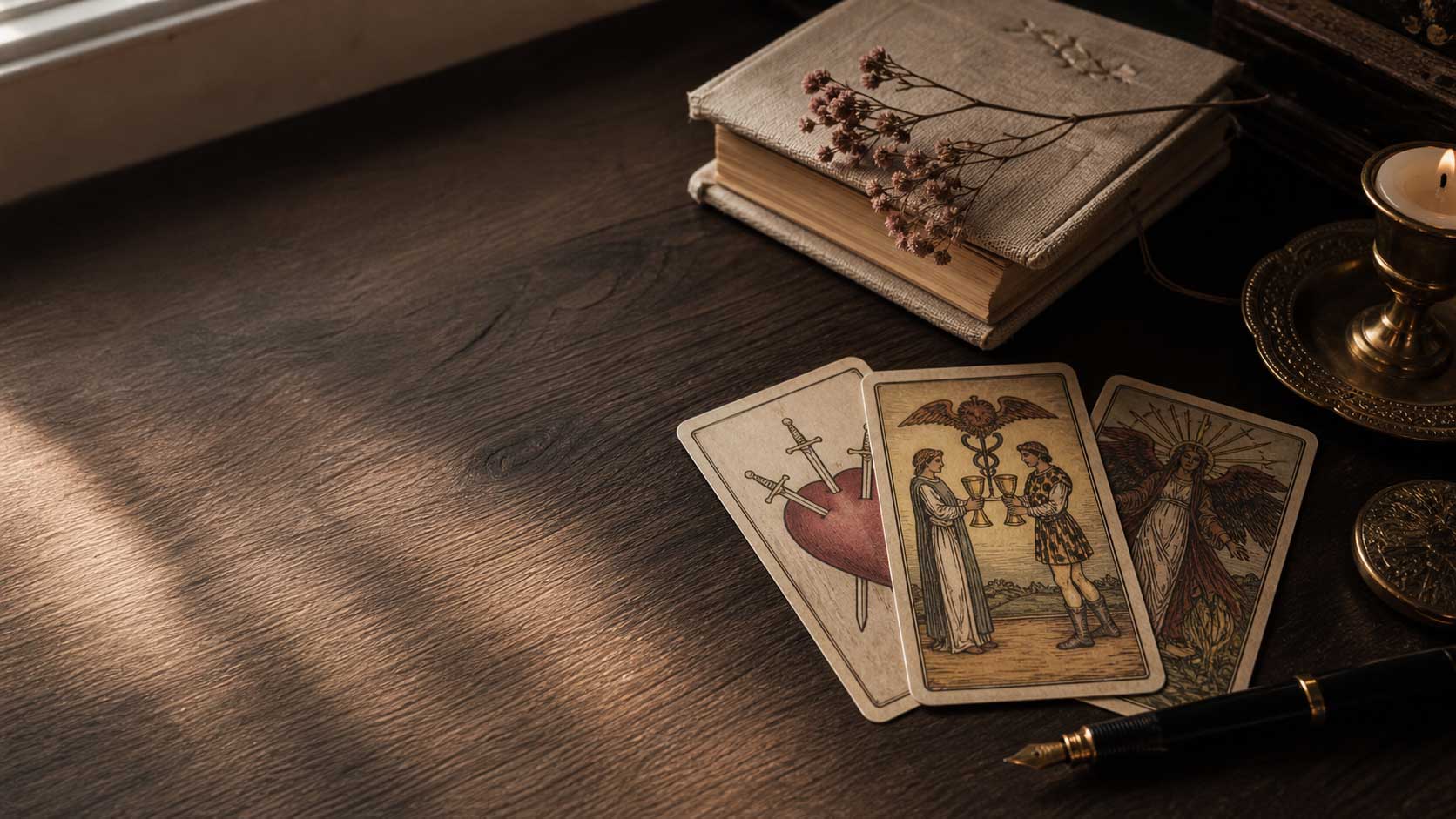
You recognize the person on the card, remember a keyword, and move on. Then you notice the path behind them, the distant buildings, or how little room there seems to be to move. The setting can give you another way into the same image.
The short answer: Tarot landscapes can add context through distance, movement, shelter, and access. Describe what is visible, check the deck’s own explanation, and connect one detail to the spread position. A mountain or river has no single meaning that applies to every card and deck.
Describe the setting before you translate it
Begin with ordinary words: a steep ridge, an open plain, a narrow path, a wall around a garden. Then notice the relationship between the figure and that place. Are they looking toward it, turning away, standing inside it, or separated from it?
“A mountain means an obstacle” is one possible association, not a universal rule. A mountain might also suggest perspective, distance, endurance, or simply the landscape chosen by the artist. Keep the observation separate from the meaning you are considering.
Use three questions for any background
Ask: What is near, and what is far away? Where could movement happen? What appears to provide shelter or a boundary? You do not need to find an answer to all three. A single visible detail can be enough.
For example, a path toward a distant building might prompt a question about the steps between now and a goal. It cannot tell you that you will move house. If the card is in a “support” position, the building might invite reflection on available shelter or structure instead. The position changes the question.
Check an image you actually have
In familiar Rider–Waite–Smith images, the Eight of Cups places a walking figure beside water and uneven terrain. You might notice that movement has a setting and a cost, rather than reading only the act of leaving. That remains an interpretation of this image, not a command to leave a relationship or job.
A redesigned deck may replace that landscape entirely. Read what is present and consult its guidebook. If the artwork is abstract or a pip arrangement, there is no missing landscape you must invent. Suit, number, arrangement, and position can carry the reading.
Tarot clarity
Turn the card meaning into a useful next question
Use Eldrin to connect the symbolism to your real situation without turning one card into a fixed verdict.
Ask about your cards->Best when you want interpretation with context.
Let a background refine a reading, not take it over
Suppose your question is about returning to a creative practice. An enclosed garden could suggest protected time, but you would still ask whether that fits the card, its position, and your actual schedule. “I need a quiet hour” is a usable reflection. “The garden proves I must work alone” goes further than the image supports.
Try writing two sentences: “I can see…” and “In this position, that makes me wonder…” This keeps an observation from quietly becoming a fact about your life. If a detail adds nothing useful, let it remain part of the art.
Keep symbolic and literal claims apart
Landscape reading cannot establish travel plans, property outcomes, danger, or what another person is doing somewhere else. Nor does one barren scene prove emotional coldness. Keep the main card meaning, the deck’s context, and the real question together; no tiny symbol needs to explain the whole spread.
Questions people ask
What do mountains symbolize in tarot?
They can suggest distance, challenge, perspective, or endurance in a particular image. First describe the mountains and their relation to the figure, then check the guidebook and spread position. They do not have one mandatory meaning.
Should I read every background detail?
No. Choose a detail that helps answer the stated question. You can leave others uninterpreted, especially if adding them makes the reading more complicated without making it clearer.