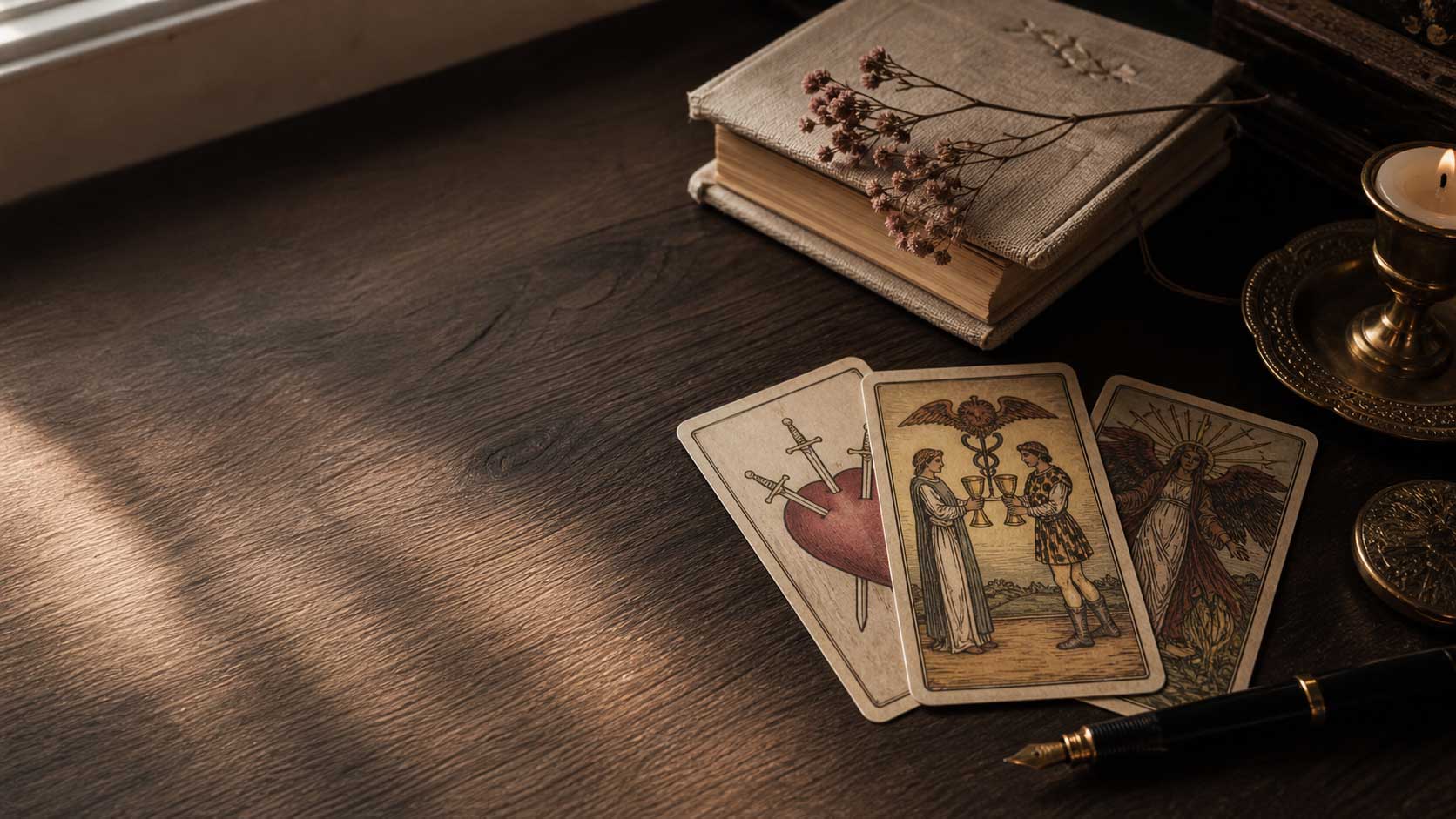
You recognize the picture but forget the name. Or the court titles in this deck are unfamiliar, and checking the book every time interrupts your reading. A few written reminders seem helpful, until you wonder whether marking a tarot card is somehow disrespectful.
The short answer: you can choose to write study notes on a tarot deck you own; tarot practices differ, and there is no single shared rule that requires or forbids it. Ask permission before marking someone else’s cards. Try notes beside the cards first, and keep any keyword as a starting point rather than the card’s only possible meaning.
Decide what the note is meant to help with
A public discussion about writing on cards begins with a reader confusing card titles and wanting to add reminders. That is a specific learning need. It does not require turning the whole surface into a miniature guidebook.
You might want a clearer title, a suit reminder, or two possible themes. Choose the smallest note that solves the difficulty you are having. If you already recognize the card but struggle to apply it, another keyword may be less useful than practicing with a spread position.
Using a book is also a valid option. See using a tarot guidebook while you read if you would prefer to leave the cards as they are.
Try the words beside the card first
Put your proposed note on a separate piece of paper and read with it a few times. You may find that “rest” is a useful reminder for the Four of Swords, but “rest / recovery / a deliberate pause” gives you more room.
Separate notes are easy to revise as your understanding changes. They also leave the artwork visible. This can be enough; you do not have to write directly on the deck to make your learning feel legitimate.
If you do choose ink, consider whether you would mind the permanent change later. A note on paper cannot damage a card’s finish. A mark or adhesive on the card may. There is no need to test a material on a deck you would be upset to alter.
Tarot clarity
Turn the card meaning into a useful next question
Use Eldrin to connect the symbolism to your real situation without turning one card into a fixed verdict.
Ask about your cards->Best when you want interpretation with context.
A keyword should leave room for the position
Imagine you have written “withdrawal” on the Eight of Cups. In a position asking what to leave behind, that may help you consider a habit or situation you are ready to step away from. In a position asking what support you need, it might prompt a question about space, recovery, or having permission to change direction.
The same word is doing different work because the question changed. It is not a command to leave a relationship or job. You can cross-check your note against the image, the deck’s own guidebook, and the actual circumstances.
If a keyword makes every reading end in the same verdict, revise the note. Try writing a question instead: “What am I moving away from, and what am I moving toward?”
Keep consent and visible markings in mind
A borrowed deck belongs to its owner. Even a helpful correction or a removable label should wait for their agreement. Shared and collectible decks may deserve the same conversation before you make a change.
Marks on the backs or edges can make a face-down card recognizable. If you want to draw without knowing which card is which, keep that consequence in mind. You can deliberately select a card for study, but that is a different activity from an unseen draw.
Your study method can change
You might use notes for a month, keep them for years, or stop needing them. None of those outcomes ranks you as a reader. The useful question is whether the note helps you describe what you see while staying open to context.
Tarot cannot verify a claim that ink has damaged a deck’s spiritual power. You can respect your own beliefs and preferences without accepting a fear-based rule from someone else.
Questions people ask
Is writing tarot meanings on cards cheating?
Study notes are a learning choice. Keep them open to revision, and use the image, guidebook, question, and spread position alongside any keyword you write.
Should I write on the backs of my tarot cards?
If a mark identifies a particular face-down card, it changes how you can draw without recognizing it. Separate paper notes let you study without that effect or a permanent change to the deck.