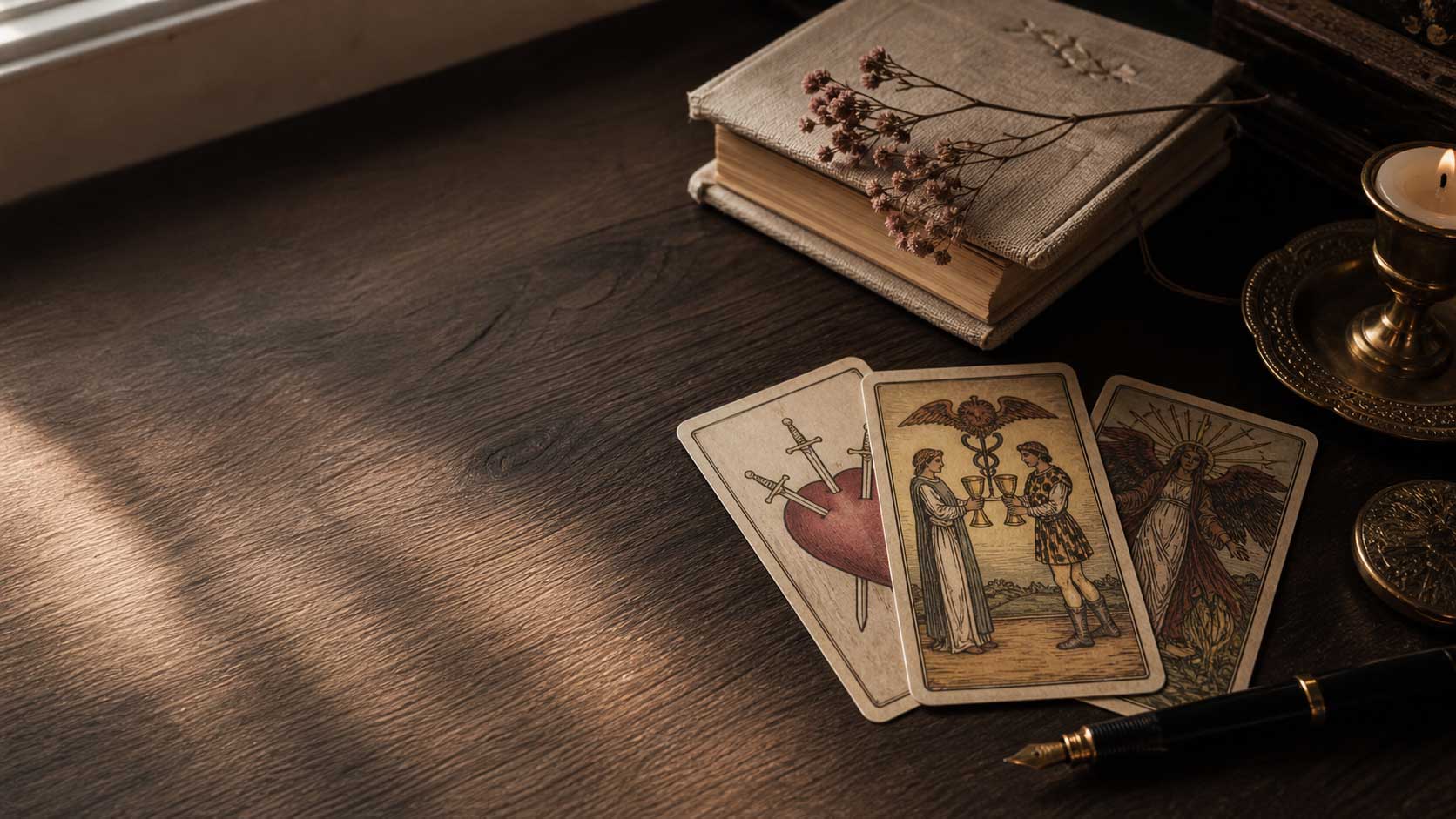
The short answer: You do not have to form mental pictures to use tarot for reflection. You can work with the card in front of you, its name, a guidebook association, and the spread position. Describe one detail, connect it to the question, and choose a practical next step.
An instruction to imagine can be the wrong doorway
A tarot exercise asks you to close your eyes and step into the landscape of a card. You try, but the instruction does not give you anything useful to work with. You may understand the words perfectly and still prefer to keep the card on the table. That is enough reason to choose a different exercise.
For reflective tarot, mental scene-building is optional. You do not have to prove that you can see an inner image before you are allowed to interpret symbols. This article offers a word-based practice; it does not assess why any particular visualization exercise feels easy or difficult for you.
Use four things you can name
Start with the card name, one detail you can observe or read in an available description, one association from your deck guide, and the spread position. Keep these separate at first. For example: “Two of Pentacles; two objects being handled; balancing demands; my next practical step.”
Then make a tentative connection to your real question: “I might need to reduce the number of things I am trying to do this afternoon.” You have moved from a named symbol to a useful possibility without entering an imagined scene. If the connection does not fit, set it aside rather than forcing a vivid story.
Try the method with an ordinary question
Ask: “What would make tomorrow morning easier?” Use one card in a position called “one useful adjustment.” If you draw the Hermit, check your deck’s explanation. An association with solitude might suggest preparing quietly before messages begin. It need not become a claim that you should withdraw from everyone.
Compare that suggestion with the actual morning. If you care for someone or start work early, a long solitary ritual may be unrealistic. A two-minute preparation could fit better, or the card may not offer anything useful today. The quality of the reflection depends on that check, not on how richly you pictured a lantern.
You can skip immersive instructions
Replace “hear what the figure says” with “what question does this image bring up?” Replace “walk into the scene” with “describe one action shown.” If you work better with a spoken sentence, say it; if brief written words help, use those. No particular sensory exercise needs to become a requirement.
Where a card image or description is not accessible to you, choose materials that work for your needs rather than forcing this exact exercise. This page does not promise that every deck or digital service provides suitable descriptions. It offers a method you can adapt with the resources available to you.
Bring clear context into any second interpretation
If you want another interpretation, keep your original question, card name, and position together. Share your own tentative association, then compare suggestions with your circumstances. You do not need an intimate personal history to ask a small practical question.
End with one sentence you can use: “Tomorrow I will prepare my bag before checking messages.” Or end with “this card did not add anything today.” Either is a clearer outcome than judging yourself for not producing a mental picture.
Tarot clarity
Turn the card meaning into a useful next question
Use Eldrin to connect the symbolism to your real situation without turning one card into a fixed verdict.
Ask about your cards->Best when you want interpretation with context.
Questions people ask
Do I need to visualize a card to interpret it?
No mental picture is required for this reflective method. Use words, the visible card or an available description, and the question you are exploring.
Does difficulty visualizing mean my intuition is weak?
A visualization exercise is not a test of your judgment or worth as a reader. You can use observation, language, and deliberate reasoning without grading your inner experience.
For a related perspective, try tarot practice without a written journal, or return to the Eldrin blog.