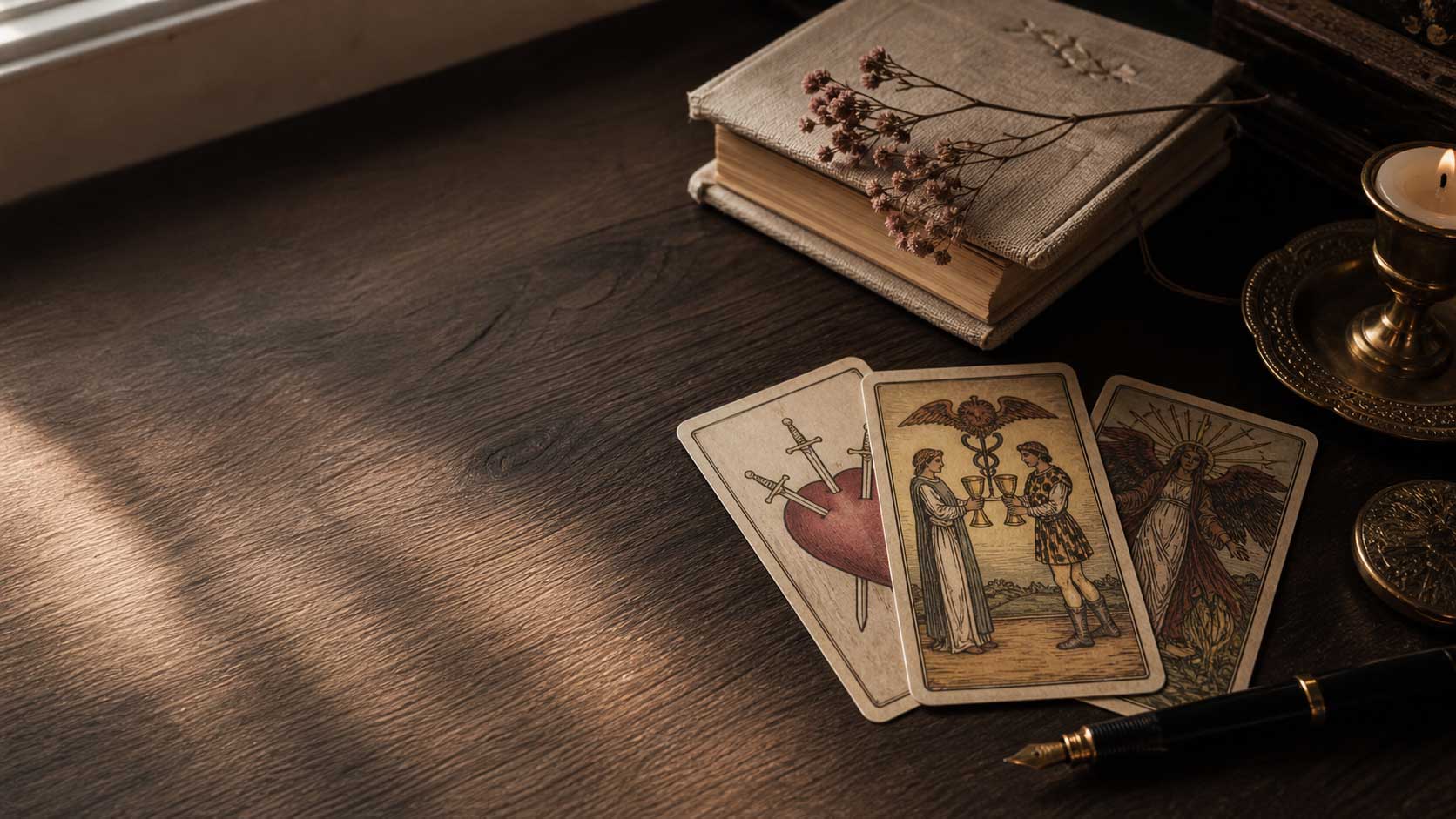
You finish a reading and the blank journal feels like a second assignment. Perhaps writing is tiring, your notes become elaborate, or you simply do not want another record to maintain. A notebook can support practice, but it does not certify that you have reflected properly.
The short answer: Yes, you can practice tarot without journaling. Keep the question and card positions clear, explain one relevant interpretation in your own words, and finish with a practical action or an acknowledged uncertainty. Written records are optional; without them, be cautious about claims that your readings show long-term patterns.
Choose what you want a record to do
A journal can help you remember the original question, compare interpretations over time, or learn a deck. If those benefits matter to you, a short record may help. If you only want to reflect on today’s situation, a full written account may add work without adding clarity.
You can change methods as your needs change. Not writing today does not prevent you from making a small note next week. Equally, you do not need to build a tracking system because another reader finds one useful.
Use a short spoken close
After reading, say three sentences: “I asked about ___. This card in this position makes me consider ___. My next step is ___.” You can speak quietly to yourself; there is no need to record your voice or share the reading.
For example: “I asked how to approach a crowded week. The Two of Pentacles in the advice position makes me consider what can move. I will check one deadline before agreeing to another task.” This links a card to a practical question without turning the card into proof that the week will go a particular way.
Understand what you lose without notes
Memory can leave out the wording and uncertainty of an earlier reading. If you want to claim that one card has appeared unusually often, or that earlier interpretations matched later events, a record matters. Without one, describe an impression rather than a measured pattern.
If learning is the goal, you could keep only the date, question, card, and one sentence. If privacy or effort makes that unhelpful, choose a no-record study exercise: compare a card with its guidebook, explain the difference, and stop. Neither method can establish predictive accuracy by itself.
Let the ending be a real ending
A spoken recap can become another loop if you keep revising it until it sounds reassuring. Choose one useful observation and leave what you cannot know unresolved. You do not need a polished explanation before returning to your day.
If you use an AI tool to explore an interpretation, provide the question and positions you want considered. Do not assume a conversation is a permanent journal or that it can recover past readings. Save only what you want to keep, in a place you understand and control. A reflection can be complete even when there is no artifact at the end.
Bring a smaller question to a reading
Help me connect these cards and positions to one action I can explain in my own words.
If you want to explore that question with the cards, use one reading and keep your own judgment beside the interpretation.
Tarot clarity
Turn the card meaning into a useful next question
Use Eldrin to connect the symbolism to your real situation without turning one card into a fixed verdict.
Ask about your cards->Best when you want interpretation with context.
Questions people ask
Is a tarot journal necessary for beginners?
No. Beginners can learn through card study, spoken interpretation, and bounded practice. A brief record is useful when comparing readings over time, but it is optional.
Can AI remember my readings instead of a journal?
Do not assume it can. Retention and recall depend on the tool and settings. Keep a record you control if you need reliable access to a past question or interpretation.
For a related perspective, read the companion article, or return to the Eldrin blog.