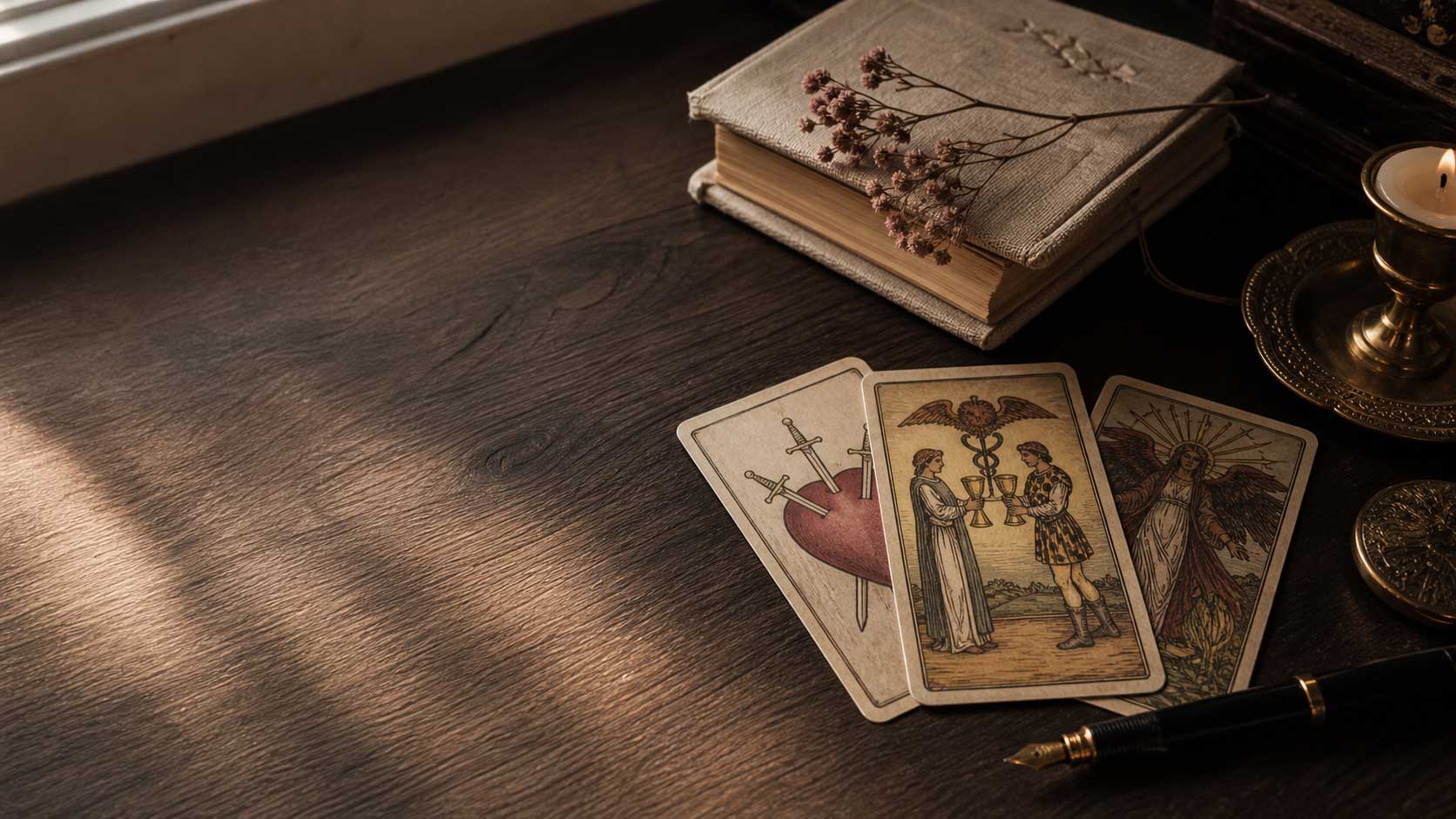
An upsetting tarot reading can feel louder than the room around you. One card lands, your chest tightens, and suddenly the reading is no longer a reflection. It feels like a verdict.
Maybe you asked about someone you love. Maybe the spread showed distance, endings, secrets, or a card you have learned to fear. Maybe the interpretation was not even that dramatic, but it touched the exact place where you were already scared.
The most important thing to know is this: a difficult reading needs integration before interpretation. If you ask again immediately, you may not be seeking clarity anymore. You may be trying to outrun the feeling the first reading brought up.
Reassurance-loop reset
Ask once, then come back to yourself
If you keep asking the same question because the ache keeps returning, use the reading to find one stabilizing next step.
Get a grounded reading->For heartbreak, no contact, and repeated-reading loops.
First, Stop the Reading From Becoming a Loop
The urge to pull more cards makes sense. Your mind wants relief. It wants the scary card softened, contradicted, or explained away. But another spread done from panic usually adds more symbols to an already overloaded nervous system.
Put the cards away for now. Close the reading tab. If you used an AI tarot tool, do not rewrite the same question in three slightly different ways. Let the first answer exist long enough for you to understand what it actually said.
This is not about ignoring the reading. It is about refusing to turn one hard moment into a reassurance loop.
Write What the Reading Said, Not What Your Fear Heard
Fear edits fast. A card that pointed to uncertainty becomes "he does not love me." A card about transition becomes "everything is over." A card about secrecy becomes "I have been betrayed."
Before you decide what the reading means, write down three separate lines:
- The card: what appeared, without drama.
- The plain meaning: what the card can reasonably suggest.
- The fear story: what your mind immediately turned it into.
That third line matters. It is not shameful. It is data. It shows where the reading touched something tender, and it keeps the tender place from pretending to be the whole truth.
Difficult Cards Are Not Always Bad News
Some cards are emotionally intense because they name what you already feel. Nine of Swords may not mean disaster is coming. It may be showing the midnight spiral you are already inside. The Moon may not prove deception. It may say the situation is foggy and you should not force certainty yet.
Three of Swords can hurt because it refuses to pretend pain is not present. Eight of Cups can hurt because part of you already knows something is no longer nourishing you. The Tower can feel terrifying, but sometimes it names the collapse of a story that was costing too much to maintain.
Eldrin's rule is simple: a hard card is a serious message, not a sentence.
Use the Evidence Check Before You Text, Accuse, or Decide
After an upsetting love reading, do not let symbolism replace reality. Ask what has actually happened outside the reading.
- Did they avoid a clear conversation?
- Did their behavior change, or did your fear spike?
- Is there a pattern of silence, secrecy, low effort, or repair?
- Are you reacting to evidence, or to the emotional charge of the card?
If there is real behavior to address, address the behavior. If there is only a scary interpretation, give yourself time before turning it into a confrontation.
Reassurance-loop reset
Ask once, then come back to yourself
If you keep asking the same question because the ache keeps returning, use the reading to find one stabilizing next step.
Get a grounded reading->For heartbreak, no contact, and repeated-reading loops.
A 24-Hour Reset for a Reading That Shook You
Use this reset when the reading made you anxious enough to want another reading immediately.
- Save the reading in writing.
- Do one physical grounding action before you interpret further.
- Do not check their profile, story views, or last seen status as proof.
- Tell one trusted person what you are afraid the reading means.
- Wait until tomorrow before deciding whether you need another question.
Tomorrow's question should not be "was the scary answer wrong?" A better question is: "What does this reading ask me to notice, and what next step protects my clarity?"
When to Step Away From Tarot for a While
Tarot is not helping if it leaves you more frantic, more dependent, or more disconnected from your own life. Step away for a while if every reading makes you want another one, if you are using cards to monitor someone else's feelings, or if you keep ignoring clear behavior because one card gave you hope.
A break does not mean tarot failed you. Sometimes the most respectful thing you can do with a reading is stop asking and start caring for the person who received it.
What to Ask When You Are Ready to Return
If you come back to the cards later, shift from prediction to agency:
- What part of this reading am I resisting?
- What evidence do I need before I act?
- What boundary would help me stop spiraling?
- What is the kindest next step that still respects the truth?
The best follow-up reading does not erase the first one. It helps you meet it with more steadiness.
The Bottom Line
If a tarot reading upset you, do not rush to make it softer. Slow it down. Write it down. Separate the card from the panic. Check the evidence. Choose one real-world action that helps you stay connected to yourself.
Tarot should make you more honest, not more trapped. A hard reading can become useful when it leads you back to reality, self-respect, and the next step you can actually take.
If you need one grounded reading instead of another round of panic, bring the exact question to Eldrin and ask for the pattern, the evidence, and the next step.