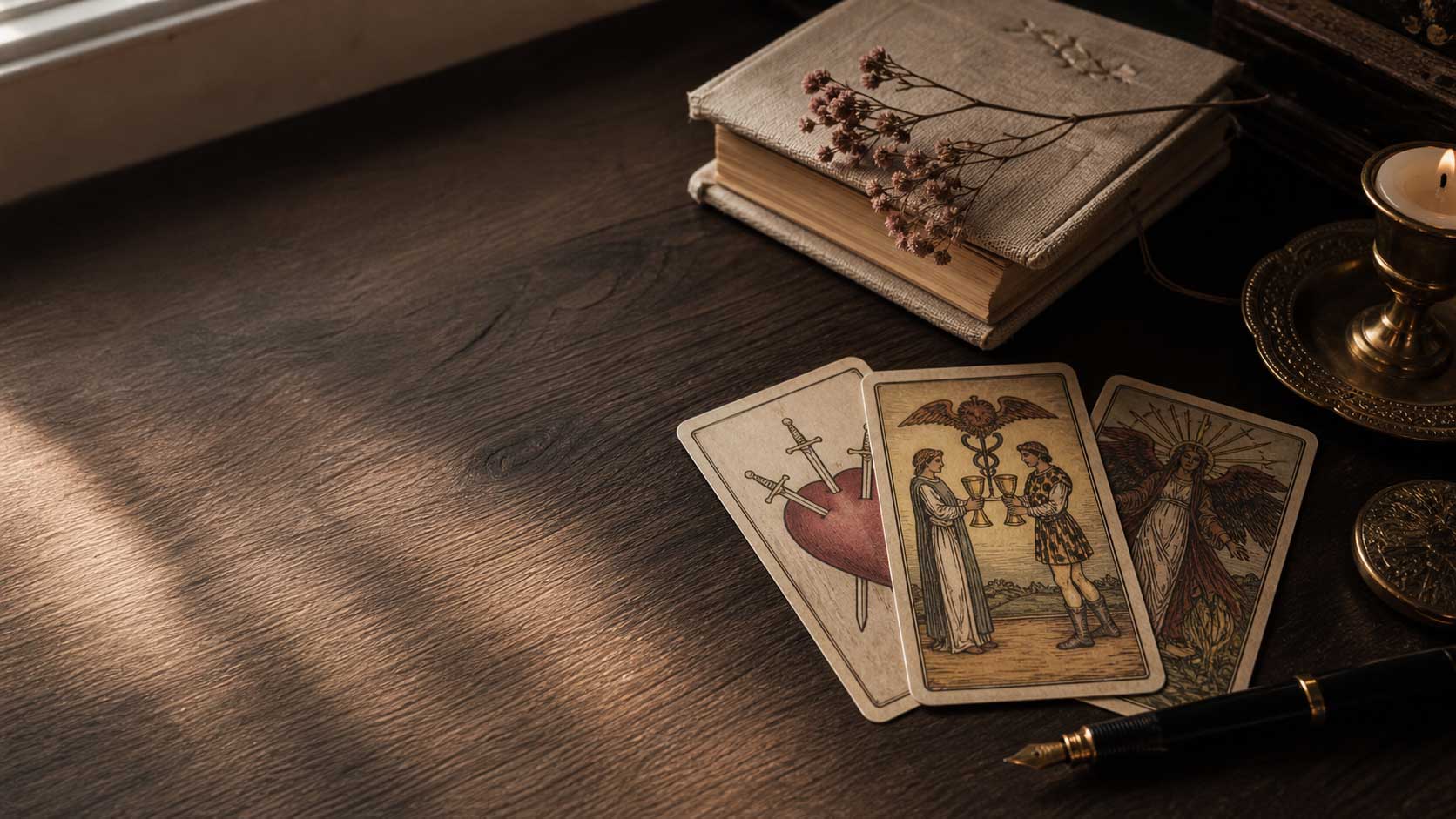
The short answer: For a tarot reading in a shared home, choose a short private window, keep other people’s identifying details out of your notes, and agree that cards or notebooks are left alone. If privacy is unavailable, save the question for later or use a brief neutral note.
Decide what you actually want to keep private
Perhaps you do not mind someone seeing the cards, but you do not want them reading the question beside them. Or you are comfortable talking about tarot and still want ten uninterrupted minutes. Privacy can be a practical preference without becoming a debate about your beliefs.
Name the need before arranging the spread: quiet, a little surface space, or somewhere to keep a notebook. You may need only one of these today. A large ritual is not required for a useful reflection.
Tarot clarity
Turn the card meaning into a useful next question
Use Eldrin to connect the symbolism to your real situation without turning one card into a fixed verdict.
Ask about your cards->Best when you want interpretation with context.
Make a small agreement about time and belongings
If it is comfortable to ask, try: “I am taking ten minutes to write. Could you knock before coming in, and leave this notebook closed?” You can describe it as reflection or journaling if that is what you mean. You do not owe a full explanation of the question.
Use a box or drawer for cards and notes if one is available. Ask before using a shared table, and clear it afterward. Leaving the cards face down may prevent an accidental glance, but it is not a guarantee that the material will stay private.
Write less identifying detail
Instead of copying a private conversation, write the pattern you want to examine: “I agreed before checking my capacity.” Instead of recording someone’s full name and personal history, note the relationship only if it matters to your question.
This makes the reading easier to focus as well as reducing what an accidental reader could learn. It does not make a notebook anonymous if the context is recognizable. Decide what you would be comfortable having on that page.
If you use a digital note or an AI tool, consider who can access the device or account and what appears in previews. Locking a screen and checking sharing settings are practical steps, but they do not establish a service’s retention policy. For that separate issue, read the AI tarot privacy guide and check the service’s current information.
Use one card when space is limited
A useful question is: “What do I need to make room for today?” Draw one card and write two lines: one observation from the image, and one ordinary action you could try. For example, the Four of Swords could invite a scheduled break. It does not establish why a housemate interrupted you.
If someone enters, you can pause without finishing the interpretation. Record the card name and come back later. An interrupted reading does not need a new draw or an explanation about damaged energy.
When the room cannot offer privacy
Save the question, shorten the note, or wait for another setting. You can reflect without displaying a deck or entering personal details into a tool. For a different environment, reading tarot in public covers shared public space.
If privacy requests tend to provoke intimidation, a reading cannot resolve that environment. Choose support and practical options that fit your situation rather than assuming a hidden notebook is safe. The aim is enough room for your own thought, at a pace and in a place you can choose.
Questions people ask
Do I need a private room to read tarot?
No. A short quiet window or a single-card reflection may be enough. If the question is sensitive and the space is not private, it is reasonable to wait.
Does using initials make my tarot journal private?
Initials reduce some identifying detail, but context may still identify people. Think about access to the notebook or device and avoid recording details you do not need.