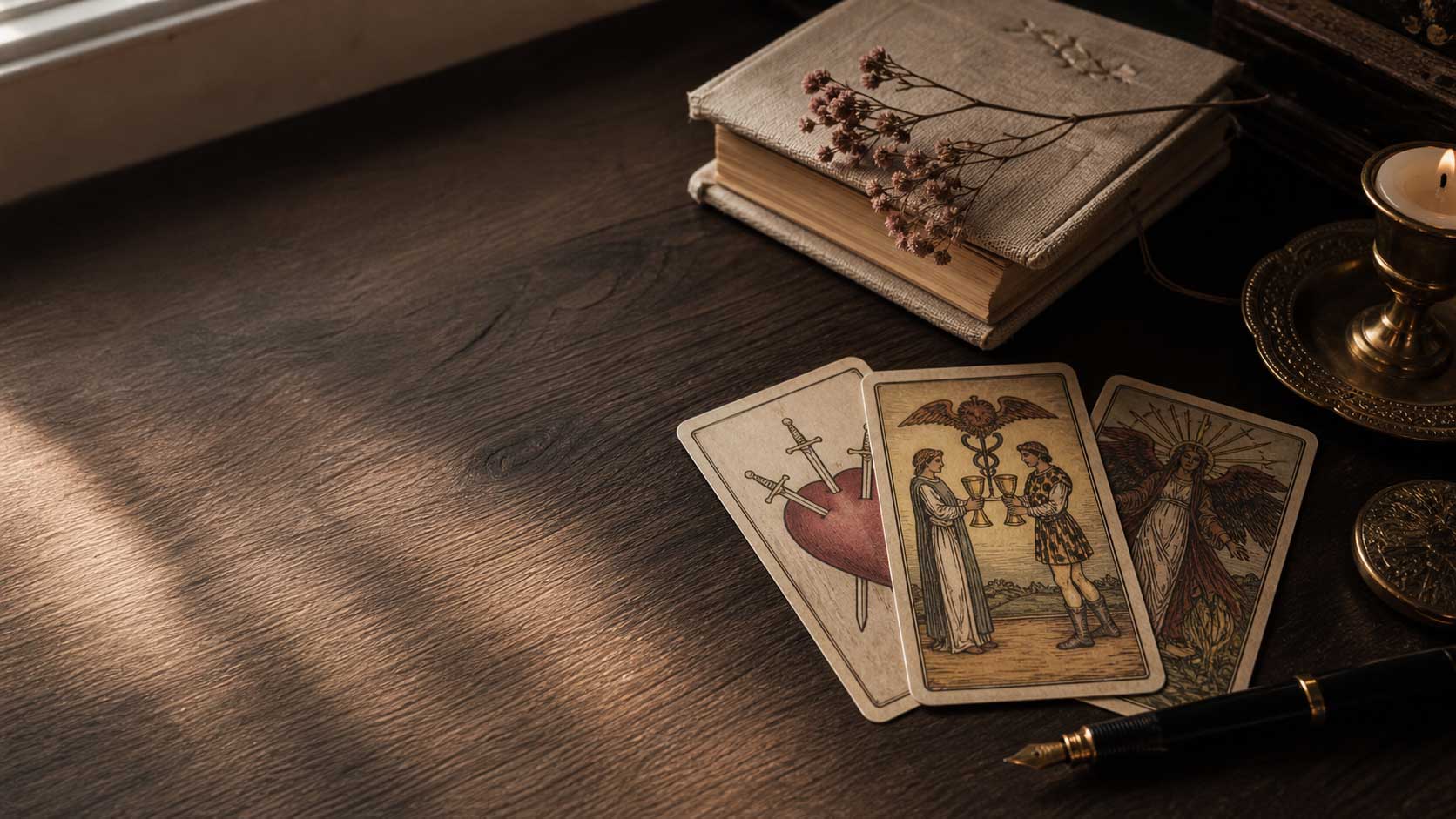
The short answer: If your tarot guidebook is in a language you cannot read, identify the exact deck and edition first. Check the creator or publisher for authorized language support. Use translations as working aids, keep uncertain terms visible, and distinguish the author’s wording from your own interpretation.
Tarot clarity
Turn the card meaning into a useful next question
Use Eldrin to connect the symbolism to your real situation without turning one card into a fixed verdict.
Ask about your cards->Best when you want interpretation with context.
Identify the book you actually have
A familiar card title does not guarantee that another deck’s guide gives the same meaning. Record the deck name, creator, publisher, and edition from the packaging or title page. Look for a language edition or official help through the creator’s or publisher’s own channels.
This is a different problem from losing a guidebook. You have the source, but the wording is difficult to access. Keeping it beside your notes lets you check a term later instead of gradually replacing the deck’s own framework with an unrelated list of keywords.
Translate a small passage with a clear purpose
Start with the card title and a short passage you need for your own study. Keep the original text and your working translation together. A translation tool may flatten a metaphor, miss a negation, or confuse an instruction about the image with a prediction. If a sentence seems odd, leave it unresolved rather than treating the most dramatic wording as correct.
For example, a phrase rendered as “leave behind” might refer to an old habit, a physical movement in the picture, or a relationship, depending on the surrounding passage. Do not jump from that phrase alone to “I must end my relationship.” Read the context and ask a fluent person or the publisher when the distinction matters.
Keep three kinds of notes
Use three labels: source wording, working translation, and my reflection. Under reflection, connect the card with the question and position you chose. If you consult a general tarot reference, label that separately too. This keeps a useful outside association from quietly becoming a claim about what the deck’s author intended.
You do not have to understand the entire book before looking at a card. You can describe visible details and journal what they bring to mind. Just call that an image-based exercise when you cannot yet confirm the intended framework. Uncertainty can be a note in the margin instead of a reason to invent an answer.
Choose a comfortable stopping point
If translation turns a small reflective practice into constant guesswork, pause this deck and use a resource you can read comfortably. That is a practical choice about learning, not proof that the deck rejected you. You can return to it when better language support is available.
An AI-generated paraphrase is not an official translation or a reliable statement of authorial intent. Keep any excerpts you share limited to what is needed, avoid uploading whole copyrighted books, and do not publish a translation without the appropriate rights. For a text reading, give the card’s confirmed name, position, and your question; acknowledge any meaning you are still checking.
A public reader discussion includes the experience of learning with a deck in a less familiar language. That is an individual experience, not evidence that one language changes a deck’s accuracy.
Keep exploring
Read the related Eldrin guide, then keep only the part that helps with your actual question.
Questions people ask
Can I use a general tarot guide instead?
Yes, as a clearly labeled comparison if it fits the deck’s tradition. It may not capture the specific creator’s imagery or intended meanings.
Is an AI translation an official guidebook translation?
No. Treat it as a working aid that may contain errors. Check important ambiguities with the publisher, an authorized edition, or a qualified human translator.