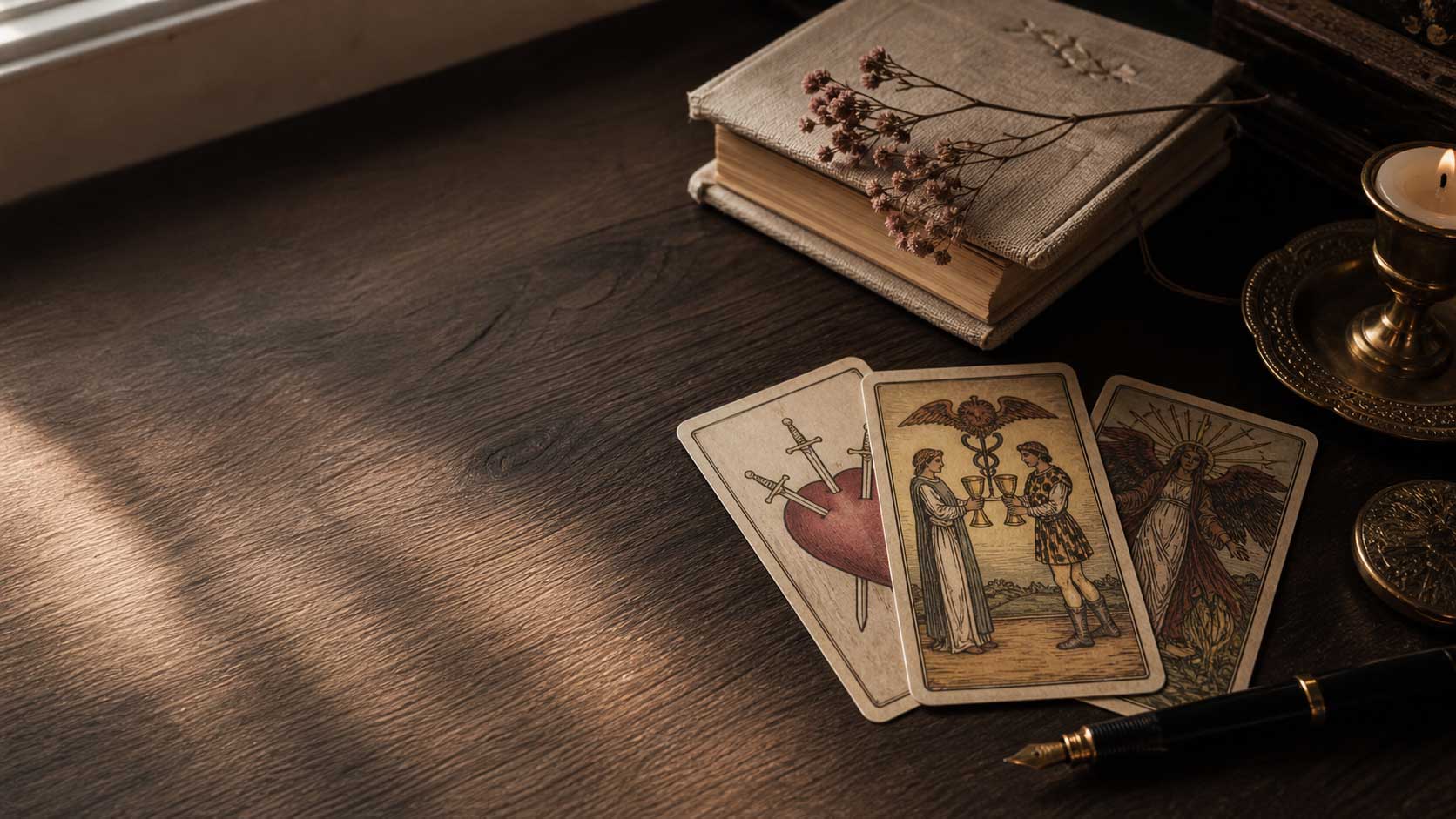
The short answer: In the Golden Dawn-derived tarot correspondence system, decans divide the zodiac into 36 sections of ten degrees, associated with the 36 numbered Minor Arcana cards from Two through Ten. This is an optional symbolic framework. You can read tarot without it, and a card’s decan does not establish when an event will happen.
What the extra symbols are doing
A guidebook may place a planet and zodiac sign beside a numbered card. Those marks can belong to a correspondence system rather than the scene itself. You do not need to understand every mark before you can describe the picture or ask a useful question.
Start with the structure: twelve zodiac signs, three ten-degree sections per sign, and thirty-six sections altogether. Four suits with nine numbered cards each, Two through Ten, also make thirty-six. In this system those numbered cards are mapped to the decans. Aces and court cards are handled differently; do not squeeze them into spare spaces in that map.
Treat the attribution as a tradition
The historical text Liber LXXVIII lists numbered cards with planetary and zodiacal attributions. It is evidence of an interpretive tradition, not evidence that those associations predict personal events. Other decks and astrological approaches may use different conventions.
Check which system your own guidebook uses before comparing charts. Two sources can disagree because they are doing different things. Record the name of the source and the method instead of choosing whichever attribution makes your current reading sound most reassuring.
Tarot clarity
Turn the card meaning into a useful next question
Use Eldrin to connect the symbolism to your real situation without turning one card into a fixed verdict.
Ask about your cards->Best when you want interpretation with context.
Try one correspondence after the ordinary reading
For example, Liber LXXVIII associates the Two of Wands with Mars in Aries. You might use that symbolism as an optional prompt about initiative: where could intention become a deliberate first action? That is an example of reflection, not a diagnosis of anyone born under Aries.
First read the card in its spread position and your actual situation. If the position is “what needs preparation,” the answer might concern checking resources before starting. The extra astrology layer should sharpen that question; it should not erase the position or supply a stranger’s motives.
Keep dates out of the promise
A chart may put calendar dates beside decans because the Sun moves through the zodiac over the year. That convention does not turn a card into a reliable appointment book. Drawing a card associated with a particular part of the zodiac cannot establish a job offer, message, or reunion in that season.
If your question has a real deadline, use the actual deadline. For a decision due Friday, ask what information is missing and who can provide it before Friday. Do not delay a necessary conversation because a symbolic chart suggests another month.
A small study practice
Choose one numbered card you already know. Write its image, its position in a practice spread, and one interpretation in plain language. Then look up its attribution in one named source. Add a single sentence about whether that layer helps. If it adds nothing, leave it out.
You can keep learning with suits, numbers, imagery, and positions alone. Technical vocabulary is useful when it makes your observations more precise. It is not a qualification test, and it does not give an interpretation authority over real evidence.
Keep exploring
Source for the correspondence
Liber LXXVIII, historical card attribution tables (PDF) documents this symbolic system. It does not validate predictive claims.
Questions people ask
Do beginners need tarot decans?
No. Begin with your question, card imagery, guidebook, and spread positions. Decans are an optional study layer.
Are tarot decans the same as birth cards?
No. Decans map sections of the zodiac to numbered cards in a particular system. Birth-card methods typically use a different calculation and should not be mixed in without explanation.