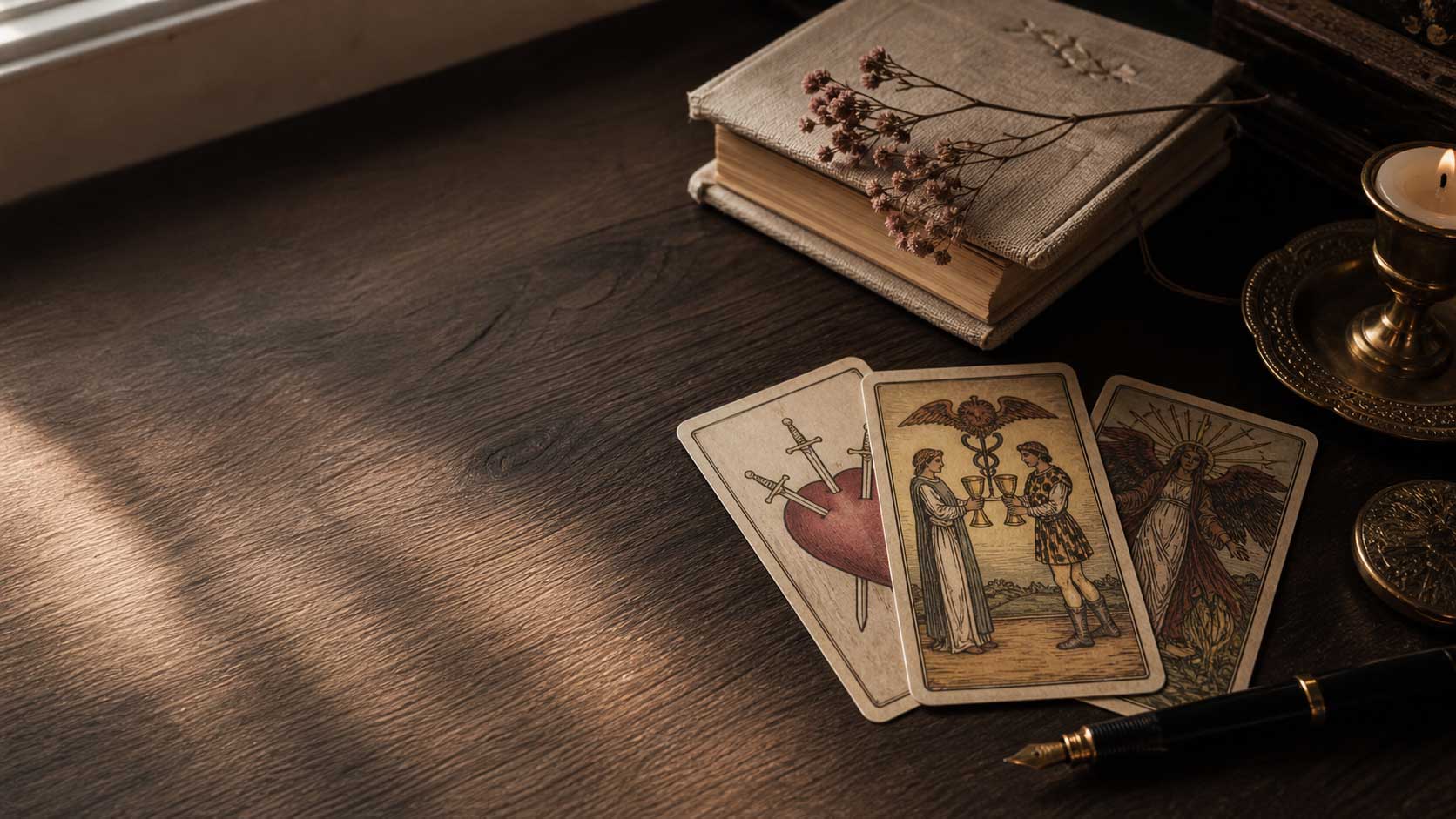
You look up a card and cannot find its title. The book in your hand calls it one thing; a website calls it something else. Before deciding you have misunderstood tarot, check whether you are looking at a renamed card, an alternate suit term, or a deck with a different structure.
The short answer: tarot cards can have different names because decks use different traditions, translations, or creative themes. Find the correspondence in your deck’s guidebook first, then use the title, image, and spread position together. Similar names do not guarantee identical meanings.
Tarot clarity
Turn the card meaning into a useful next question
Use Eldrin to connect the symbolism to your real situation without turning one card into a fixed verdict.
Ask about your cards->Best when you want interpretation with context.
First ask what kind of difference you are seeing
- A suit term: Coins and Pentacles often refer to corresponding suits. Disks is another term you may encounter. This is a useful starting point, not permission to ignore the deck’s artwork.
- A themed title: a creator may rename a familiar archetype or court role. The guidebook should explain the intended relationship.
- A structural change: a deck may include extra cards or organize its system differently. An unfamiliar title may not be a renamed standard card at all.
Do not make the artwork do all the identifying. A person holding a cup could appear in several different cards. Likewise, a card that sounds like a familiar archetype may have a different role in that deck.
Use a three-part correspondence note
Make a short note with the printed title, the guidebook’s stated correspondence, and one detail the creator emphasizes. For example: “Six of Coins → Six of Pentacles correspondence in this deck → the image emphasizes receiving as well as giving.” Keep that final detail specific to the card you actually have.
Then add your spread position. In an advice position, the Six of Coins might invite a question about asking for help or agreeing on fair terms. In an obstacle position, you might explore whether an exchange feels uneven. The alternate suit name does not erase the position’s job.
If the guidebook gives no correspondence, leave the note open. You can describe the image and work with the creator’s explanation without pretending you have identified a standard equivalent.
Do not use a number as the only identifier
A number can help you locate a card in a deck list, but it is not a universal lookup key. For an unfamiliar Major Arcana title, check the number, image, sequence, and guidebook entry together. If those clues disagree with a general website, use the deck’s own explanation as the starting point.
For court cards, check the intended rank as well as the title. A renamed role may be the creator’s way of changing the emphasis. There is no need to infer a person’s gender, age, or identity from that role.
What to include when asking for help
Give the deck’s name, the exact printed card title, the spread position, and a brief description of the image. If the guidebook identifies a correspondence, include that in your own words. Do not assume an AI tool recognizes a renamed card from its title alone.
A useful prompt is: “This deck calls the card [title]. Its guide associates it with [card, if stated]. In my spread it represents [position]. Help me connect these details to [question], and say where the correspondence is uncertain.”
The goal is a working interpretation you can explain. You do not need to buy another deck or memorize every alternate title to begin. For disagreement between sources after you have identified the card, read why tarot guidebooks have different meanings. For its role in a spread, see reading the same card in different positions.
Questions people ask
Why do some tarot cards have different names?
Deck creators may use different suit terms, translate traditional titles, or rename cards to fit an artistic theme or interpretation. Some decks also change structure. Check that deck’s guidebook before assuming a one-to-one correspondence.
Are Coins and Pentacles the same suit?
In many tarot decks, Coins and Pentacles name the corresponding suit. Disks is another term you may encounter. The imagery and interpretation can still differ, so use the guide that belongs to your deck.
Can I identify a renamed Major Arcana card by its number?
The number can be a clue, but it is not enough by itself. Numbering and structure can vary between decks. Check the contents list and the creator’s description alongside the image.