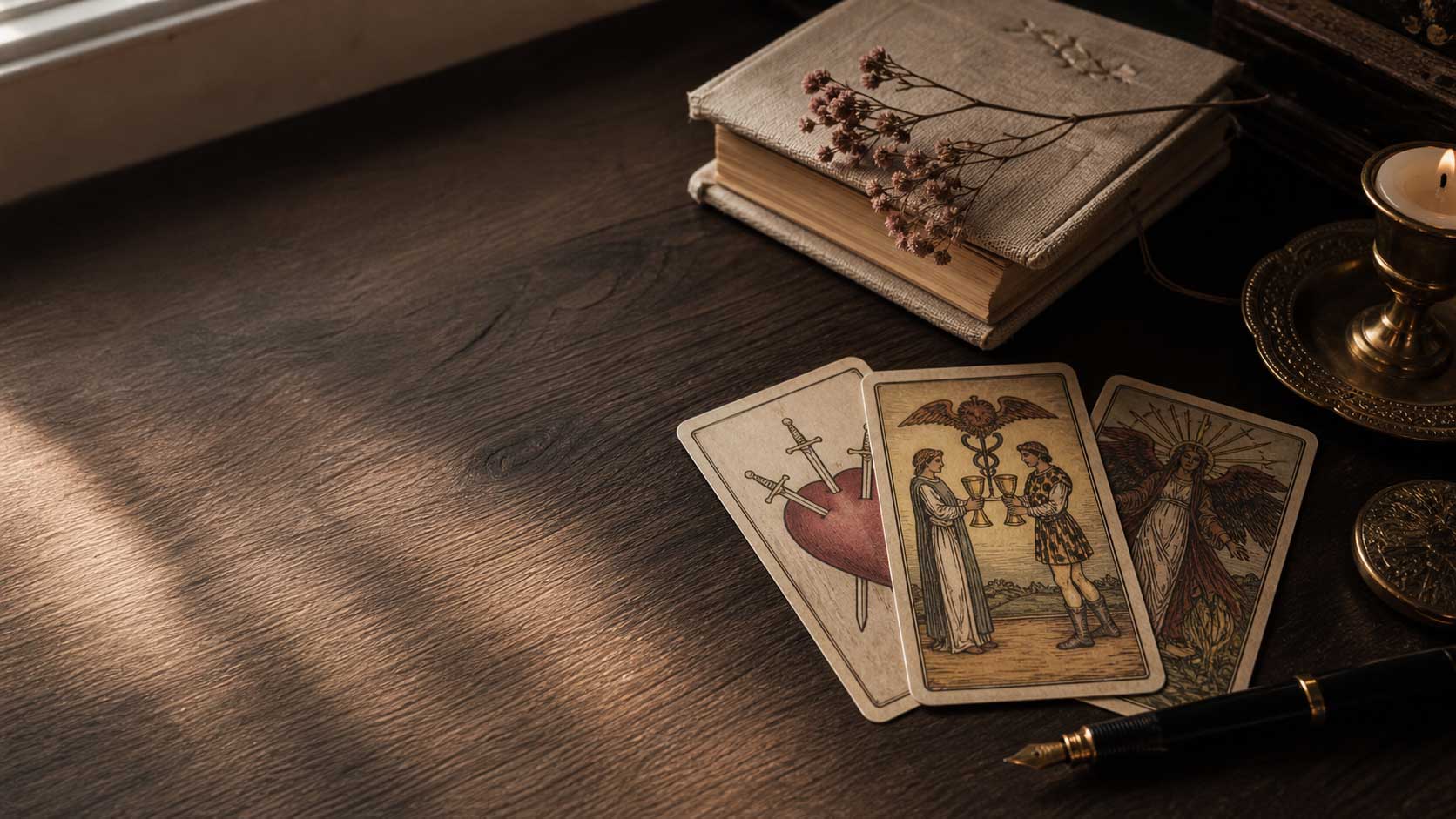
A card slides out at an angle, and suddenly a simple reading has another question attached: is this upright, reversed, or something else? You do not need to solve a hidden message in the way the card landed.
The short answer: A sideways tarot card has no single shared meaning. First check whether the spread intentionally places that card across another. If the angle was accidental, use a rule chosen before interpretation: read all cards upright, or decide how you will orient ambiguous cards when reading reversals. A horizontal landing does not by itself signal danger or a blocked future.
Check whether sideways is part of the layout
Some spreads deliberately place one card horizontally across another. In that case, the physical placement identifies the card’s job in the spread. It does not automatically create a third orientation meaning. Follow the instructions for the version of the spread you chose, including any stated reversal rule.
For example, a crossing card in a Celtic Cross layout may have a defined role even though it lies horizontally. That role and its upright-or-reversed treatment are separate decisions. If the instructions leave orientation unclear, choose a convention before laying it down.
The guide to tarot spread positions explains why the question assigned to a card matters more than a label added afterward.
For an accidental angle, choose one simple method
- If you read upright only: turn the card upright and use its image and spread position as usual.
- If you use reversals: choose a handling rule in advance. For example, treat an ambiguous sideways card as upright, while keeping clearly inverted cards reversed.
- If you want a sideways category: define what it means and when it applies before the draw. Recognize it as your chosen method, rather than a rule all readers share.
You can use a simple convention for a while and revise it between readings. The aim is to avoid changing the rules when you see which card you got. You do not need increasingly precise angle measurements to make a thoughtful interpretation.
Tarot clarity
Turn the card meaning into a useful next question
Use Eldrin to connect the symbolism to your real situation without turning one card into a fixed verdict.
Ask about your cards->Best when you want interpretation with context.
What if you already started without a rule?
You can pause and write, “I did not establish how to handle this angle.” That is an honest observation, not a failure. For this reading, use the card as an open image prompt and leave reversal-specific claims aside. Then decide what you will do next time.
Suppose the Four of Swords lands horizontally in a position called “what supports me today.” You might describe the resting figure and consider where a deliberate pause would help. You do not have to decide that a sideways card means you are “half healed” or that rest is blocked. Those stories add information the angle cannot supply.
Keep the interpretation small: “I could leave a gap between two commitments.” That is something you can test in your actual day.
A falling card raises a separate question
If the card jumped out while shuffling, decide first whether you include fallen cards at all. Its sideways landing is a second handling issue. The guide to cards falling out while shuffling covers the inclusion decision, so you do not need to invent two new rules at once.
Do not keep dropping or redrawing the card until the orientation feels reassuring. You can set it aside, continue with your planned spread, or stop reading. None of those choices requires interpreting the accident as a warning.
Record the method beside the reading
A short note is enough: “Three cards, upright only; accidental angles turned upright.” Or: “Reversals included; sideways cards treated as upright by prior agreement.” This makes a later review easier because you can see how you reached the interpretation.
The useful result is a consistent way to work with the cards. A sideways card cannot verify a prediction, reveal somebody’s hidden intentions, or tell you that you handled the deck incorrectly.
Questions people ask
Does a sideways tarot card mean blocked energy?
Some readers choose that interpretation as part of their personal method, but it is not a universal rule or a fact established by the card’s angle. Define your method before the reading rather than adding a meaning because an answer feels uncomfortable.
Should I shuffle again when a tarot card lands sideways?
You do not have to. Apply your handling rule and continue. If you had no rule, you can stop, record the ambiguity, and choose a convention for future readings instead of repeatedly pulling for a cleaner answer.