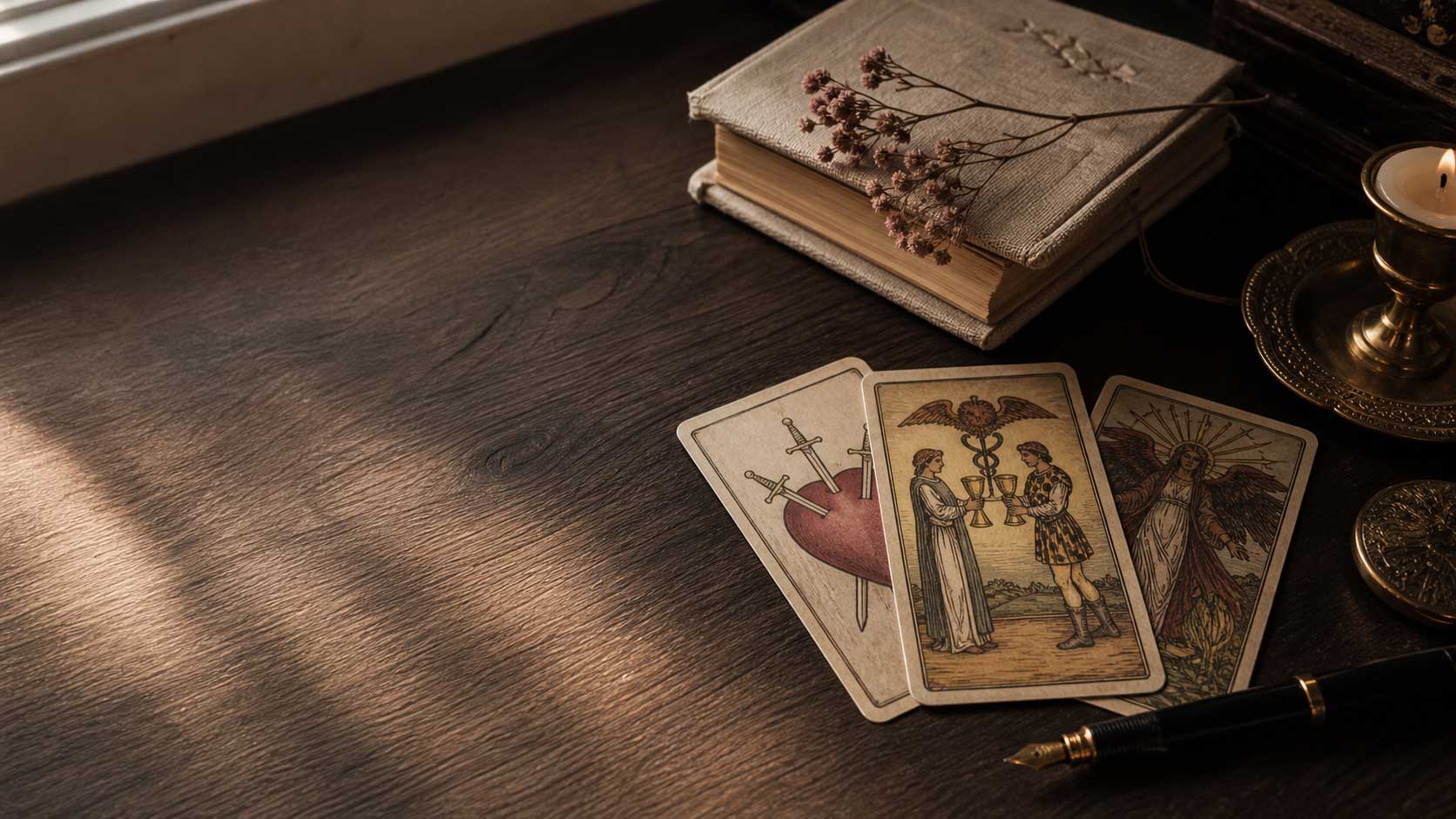
Two court cards land beside each other. One figure appears to look toward the next card; the other looks away. It is easy to turn that image into a relationship story before you have read what either position actually asks.
The short answer: the direction a figure faces can be an optional visual clue about attention, movement, or connection between cards. It should add context after the question, spread positions, and card meanings. It cannot reveal a person's private thoughts or prove rejection.
You can use the observation without making it carry the whole reading.
Tarot clarity
Turn the card meaning into a useful next question
Use Eldrin to connect the symbolism to your real situation without turning one card into a fixed verdict.
Ask about your cards->Best when you want interpretation with context.
Make an observation before making an interpretation
First describe only what is visible: “The figure's face turns toward the card on its left.” Then say what you are tentatively exploring: “Perhaps this invites me to consider where attention is going.” Keeping those sentences separate makes it easier to notice when an inference outruns the image.
Check the actual deck in front of you. A face, gaze, body, horse, or gesture may point in different directions. Some decks redraw familiar scenes; some cards have no human figure. If you cannot identify a clear cue, you do not need to invent one.
A simple order for reading directionality
- Name the question. What are you trying to understand, and what is within your knowledge?
- Read each position. A card in “my next step” does a different job from a card in “what needs attention.”
- Read the card in that position. Choose a meaning supported by the question and your chosen method.
- Notice the visual relationship. Does a clear gaze or movement add a useful question?
- Check the result. Can you explain it without claiming certainty about a hidden feeling or future?
You are allowed to reach step four and decide it adds nothing. A simpler reading is still a reading.
A worked example: rest beside a practical task
Imagine a two-card reflection with the Hermit in “what needs attention” and the Eight of Pentacles in “one useful next step.” In your deck, the Hermit's lantern appears to extend toward the second card. You might explore how quiet reflection could help you choose a smaller, more focused piece of work.
If the Hermit appears to turn away in another deck or arrangement, you might instead ask whether you need protected thinking time before practice. Neither direction tells you that work will succeed or fail. Both interpretations still need to fit the positions and your actual situation.
The useful output is something like, “I will spend ten minutes deciding which part of the task needs practice.” It is not, “The cards confirm I should withdraw from everyone.”
Toward, away, and outside the spread
- Toward another card: consider a possible exchange, shared focus, or contrast.
- Away from another card: consider separate priorities, privacy, or a shift of attention.
- Toward the edge: ask whether the image adds anything before assigning a destination outside the spread.
These are possible prompts, not a universal direction dictionary. Do not decide that left always means the past or right always means the future unless that is part of a method you deliberately chose before the reading.
Do not move the cards to make the story fit
Once the layout is set, keep it. Rearranging cards until figures face each other can quietly replace reading with answer hunting. If you read reversals, use your existing reversal method rather than rotating a card to create a preferred visual relationship.
In a relationship spread, two figures facing each other do not establish attraction, consent, or commitment. Let communication and behavior answer those questions.
For the wider method, read the guide to tarot card combinations. To keep each card's job clear, use the same card in different spread positions. You can bring the question and positions into an Eldrin reading without expecting the tool to inspect a physical deck or image.
Questions people ask
What does it mean when tarot cards face each other?
If the artwork supports it, facing figures can be an optional prompt to explore attention, exchange, or a shared focus. Start with the question, positions, and individual card meanings; the direction does not independently prove mutual feelings.
Do tarot cards facing away mean rejection?
No. A turned figure might suggest privacy, movement, or a shift of attention in one interpretation, but it cannot establish rejection. Some artwork has no useful directional cue at all.
Should I use directionality in every tarot reading?
No. It is an optional visual method. Use it consistently when it adds a clear observation, and leave it out when the deck, layout, or question does not support it.