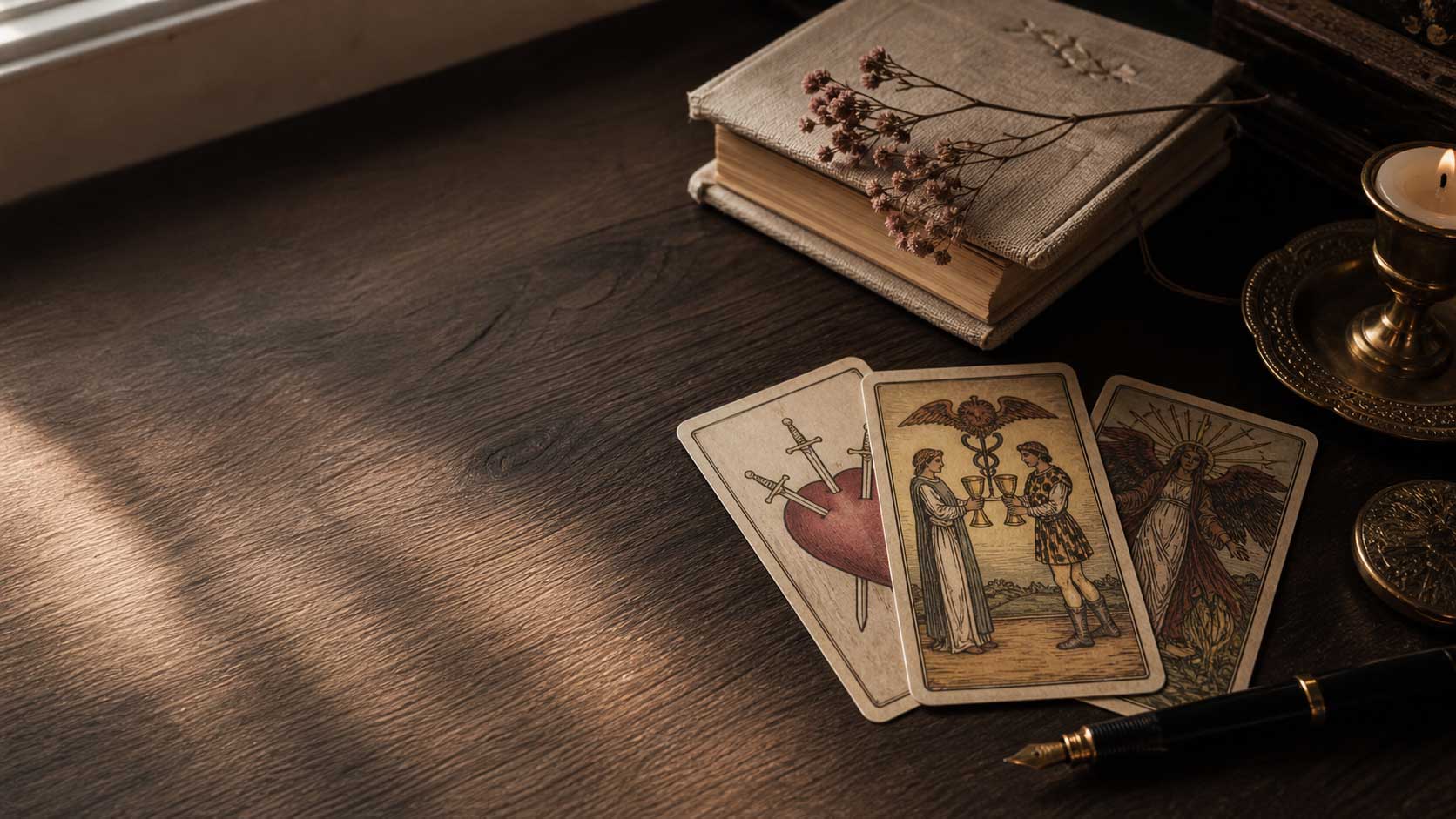
You know a card from one deck. In another, the setting has changed, a figure has disappeared, or the mood feels surprisingly different. Reaching for your familiar definition may leave you wondering whether you have identified the card correctly.
Try treating the difference as a study exercise. You can compare visual choices without asking which deck has the correct message for your life.
The short answer: The same named tarot card can emphasize different details across decks. Compare each image and its own guidebook, then read each within the same question and spread position. A visual difference offers context; it does not make one deck more truthful.
Tarot clarity
Turn the card meaning into a useful next question
Use Eldrin to connect the symbolism to your real situation without turning one card into a fixed verdict.
Ask about your cards->Best when you want interpretation with context.
Confirm that you are comparing equivalent cards
Check the printed title and the deck guide. Similar-looking pictures do not necessarily identify the same card. Renamed suits, additional cards, and a deck with its own system can make a quick comparison misleading.
Begin with two cards whose identity you can confirm. You do not need to buy a second deck; an authorized publisher preview or a deck you may borrow with permission can provide a study image. Keep any notes or copies for appropriate personal use.
Make three columns before interpreting
- Visible detail: Describe what is present without guessing a motive. “A figure sits apart from three cups” is observation; “they hate everyone” is an inference.
- Deck context: Note how that deck’s guide explains the scene. Mark what comes from the guide rather than your own association.
- Possible emphasis: Write one way the detail might matter to a question. Keep it provisional.
Do this separately for each image. One may make an offer easy to notice; another may draw your eye to the seated figure’s posture. Neither observation gives you access to a real person’s unspoken thoughts.
Try a worked comparison with the Four of Cups
Use the study question “What should I notice before deciding whether to join an activity?” and the position “What needs attention.” In a familiar Rider–Waite–Smith-style image, you may notice three cups on the ground and a fourth offered from a cloud.
One reader might emphasize overlooking an option; another might notice the need to pause before accepting it. Now inspect the actual second deck. If its artwork emphasizes a quiet indoor space, you could explore whether your capacity needs attention. If it contains no such space, do not import one to finish the exercise.
Keep the resulting action testable: check the invitation details, consider your energy, or ask about an easier way to participate. The image does not establish that an opportunity is good or that declining it would be a mistake.
Return to one working deck for a personal reading
Comparing art is useful for learning. Repeating the same question across decks until one gives a preferred answer can make it harder to finish. Record the study insight, then choose the deck and method you will use before a personal draw.
In Eldrin, include the card name and describe a relevant image detail if you want help reflecting on it. Do not assume an interpretation knows your exact edition. Ask for a possible interpretation rather than a declaration of the artist’s intent.
If the written definitions themselves conflict, see why tarot guidebooks have different meanings. This exercise concerns what you can observe in the pictures.
Questions people ask
Does different artwork change a tarot card’s meaning?
It can change which themes are emphasized. Check the deck’s own guidance and the reading position rather than assuming every edition uses exactly the same visual language.
Should I draw the same question from a second deck to check the first?
For study, you can deliberately compare equivalent cards. For a personal reading, choose a method before drawing; a second draw is not an independent verification of the first.