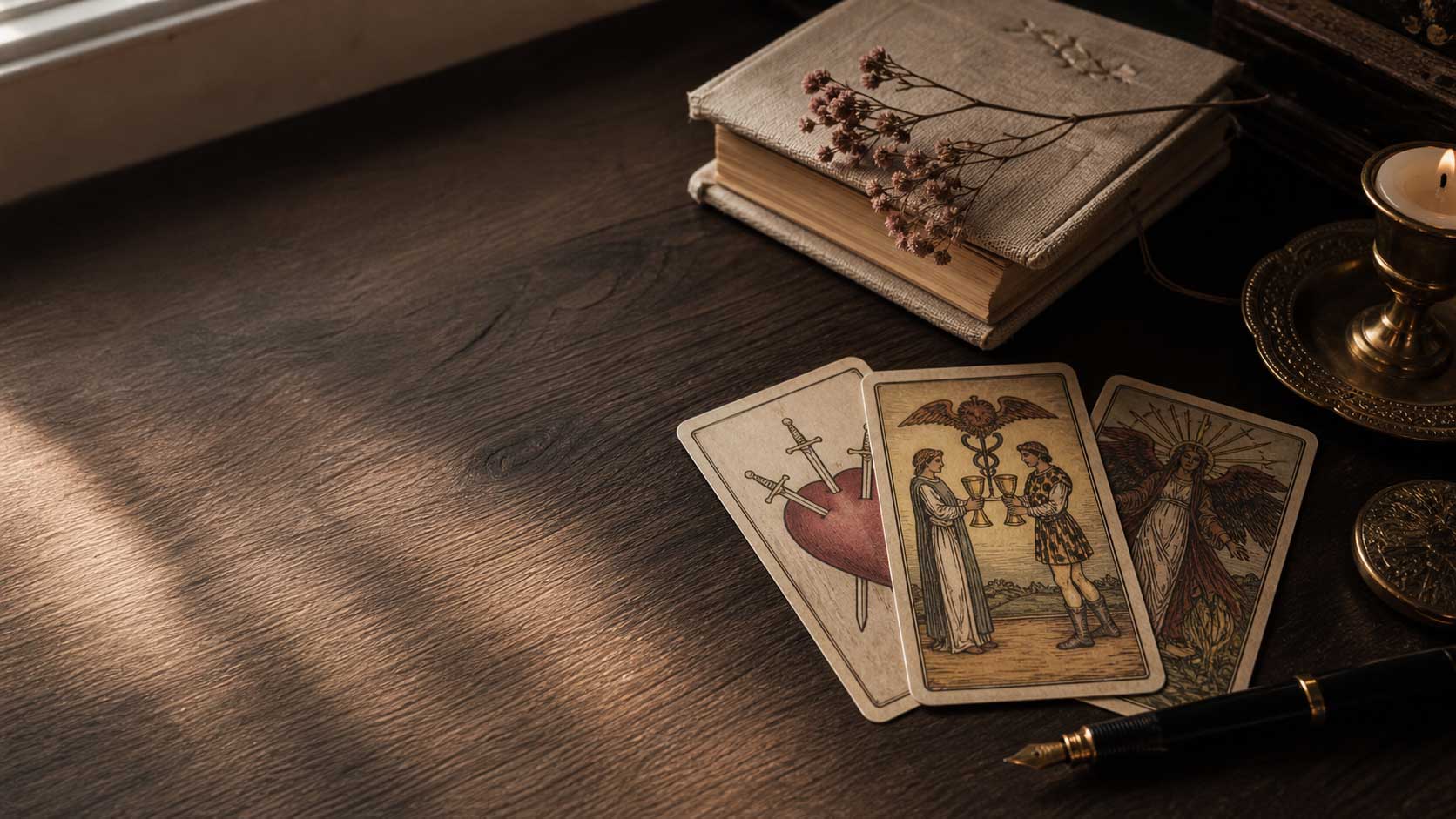
The short answer: A river in tarot can invite reflection on movement, feeling, separation, or connection, depending on the card and deck. Describe what the water is doing and where the figures stand before assigning meaning. River imagery is an optional context clue; it does not override the spread position or predict an event.
A small strip of water can be easy to overlook when a card has a striking figure in the foreground. Once you notice it, you may start seeing rivers across a deck and wonder whether they all carry the same message.
You do not need to find a hidden route connecting every card. Begin with the water you can actually see. The examples below refer to familiar Rider–Waite–Smith imagery; other decks may change or omit these details.
Describe the scene before interpreting it
Is a figure beside the water, crossing it, or separated from something by it? Is there a bridge or a boat? Is the water a small background detail or part of the main action?
Keep description and association in separate sentences. “There is a bridge across the river” describes an image. “I wonder whether there is a route I have not considered” makes a reflective association. “Someone will return over that bridge” makes a prediction the picture cannot support.
Three cards, three different jobs for the water
Five of Cups: notice what lies beyond the foreground
In familiar imagery, the cloaked figure stands near spilled cups, while a river and bridge appear behind the scene. You might explore the contrast between attention held by a loss and a route visible elsewhere in the picture. That does not make grief a mistake or require you to move on quickly.
Six of Swords: notice the act of crossing
The boat and passengers make movement part of the central scene. In an advice position, ask what support or preparation a transition needs. In a challenge position, ask what makes a transition difficult. The image alone does not tell you to leave a relationship or move house.
The Empress: notice the surrounding resources
Water is part of the fertile landscape in the familiar image. Alongside the rest of the card, it might prompt attention to nourishment and the conditions that support growth. It does not establish fertility, pregnancy, or a health outcome.
Let the spread position narrow the association
Suppose your question is, “What would help me settle into a new routine?” and the Six of Swords appears as support. Rather than predicting travel, you might write: “What would make the change easier to carry?” A ride from a friend, a clearer schedule, or fewer commitments could be relevant if they fit your actual circumstances.
If the same card appears as a difficulty, the useful question changes: “What part of this transition am I trying to manage without help?” You are applying a picture to a position, not decoding a universal river message.
Try one visual observation, then stop adding layers
Choose a card you already understand. Write its position and a basic meaning first. Add one sentence describing the water, then one question the detail raises. Keep the addition only if it makes the reading easier to explain.
A deck creator may offer a specific interpretation in the guidebook. Label that source separately from your own association. If your deck has no river on the card, work with its actual artwork rather than importing an invisible symbol.
Keep the image beside the question
For the wider method, see reading the same card in different positions. If you bring a card question to Eldrin, name the card, position, and the detail you are considering; do not assume the tool can see your physical deck.
River symbolism cannot verify another person’s feelings or forecast a journey. Its value is a more specific observation you can use, question, or set aside.
Tarot clarity
Turn the card meaning into a useful next question
Use Eldrin to connect the symbolism to your real situation without turning one card into a fixed verdict.
Ask about your cards->Best when you want interpretation with context.
Questions people ask
Does a river always mean emotions in tarot?
No. Feeling is one possible association, but the scene may also suggest distance, movement, resources, or a crossing. Check the card’s overall meaning, your deck guide, and the spread position.
Does river imagery mean I will travel or move?
No. A pictured crossing can be used as a metaphor in a reading, but it cannot establish a future journey, a move, or a date.