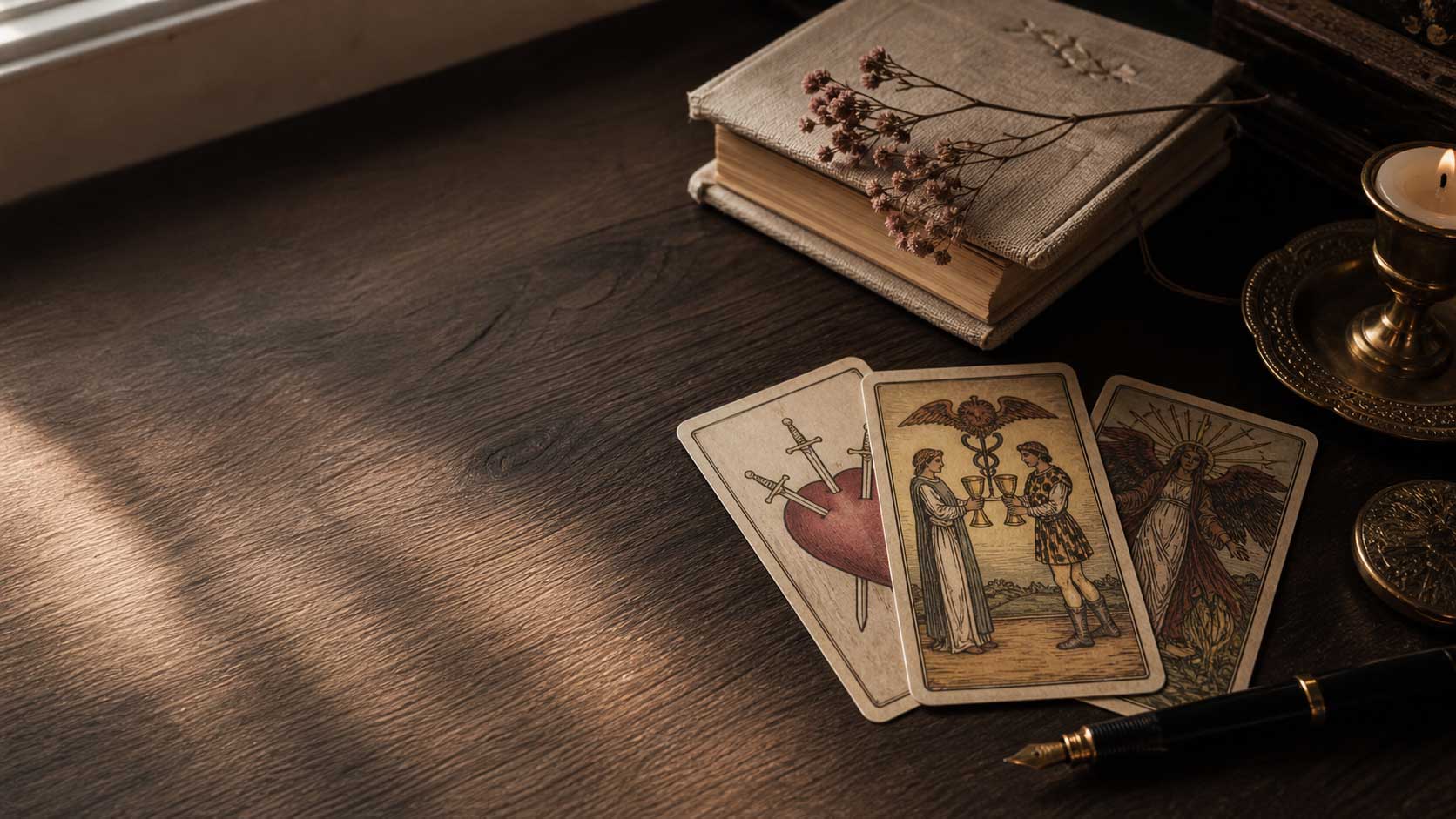
You have a deck and a few minutes, but no clear table. Perhaps your room is small, the desk is full, or you prefer to sit somewhere else. A wide arrangement of cards is one way to read; it does not have to be the condition for beginning.
The useful question is practical: how will you keep the cards secure and remember which position each one belongs to?
The short answer: You can read tarot without laying out a full spread on a table. Choose one card or reveal a small spread in sequence, record each card with its position, and keep a stable place for the deck. Physical spacing is helpful, but written order can preserve the structure.
Tarot clarity
Turn the card meaning into a useful next question
Use Eldrin to connect the symbolism to your real situation without turning one card into a fixed verdict.
Ask about your cards->Best when you want interpretation with context.
Choose a stable setup before drawing
Keep your deck in its box or on a secure, dry surface within easy reach. A tray or firm book may help if you already have one. You do not need a special cloth or an accessory purchase to make the reading valid.
If cards keep sliding or you cannot handle the deck comfortably, pause or use a digital draw. Avoid balancing loose cards near drinks, on an unstable ledge, or where you need to keep moving. A reading can wait until you are settled.
Try a one-card reading first
Write one question: “What needs my attention before I plan tomorrow?” Draw one card using a method that is comfortable for you. Look at it, write its name, and record one possible connection to the question.
Then write one small action. With the Two of Pentacles, for example, you might check two competing appointments before adding a third. You do not need to spread out extra cards to turn the reflection into a complete session.
Preserve a three-card spread as a sequence
- Write the positions before drawing: “What is taking space,” “What can wait,” and “One useful next step.”
- Reveal the first card and record its exact name beside the first position. Include orientation only if you decided to use reversals.
- Keep revealed cards separate from the remaining deck in a secure place. Repeat for the other two positions without reshuffling them into the draw pile.
- Read the three written entries together. Return to the images individually if you need another look.
For example, Ten of Wands / Seven of Cups / Page of Pentacles could become: an overloaded list, optional possibilities that can wait, and one small task to begin. Each card keeps its assigned role even though the images were not displayed side by side.
Know what the smaller setup leaves out
A written sequence preserves positions, but it may make visual relationships across cards less easy to notice. That is a reasonable trade-off. You can simply leave gaze, color echoes, and spatial patterns out of this session rather than reconstructing them from memory.
If you lose track of a position, mark it uncertain. Do not invent an order or call the confusion a hidden message. Close the reading if the setup is becoming more work than the question needs.
A digital option still needs a clear question
You can use Eldrin at the reading start page when a physical layout is inconvenient. Keep the same small question and distinguish the interpretation from factual information you need to check elsewhere. A digital reading does not make an answer certain.
If the main obstacle is interruption rather than surface space, see reading tarot in a noisy home. Choose the adaptation that solves the problem you actually have.
Questions people ask
Do tarot cards have to be laid out together?
No. You can use one card or reveal a small spread in sequence. Record each position and card so the structure stays clear.
What if I forget which card belonged to a position?
Mark the order as uncertain rather than guessing. If you cannot recover it from your notes, close that reading and use a clearer method next time.