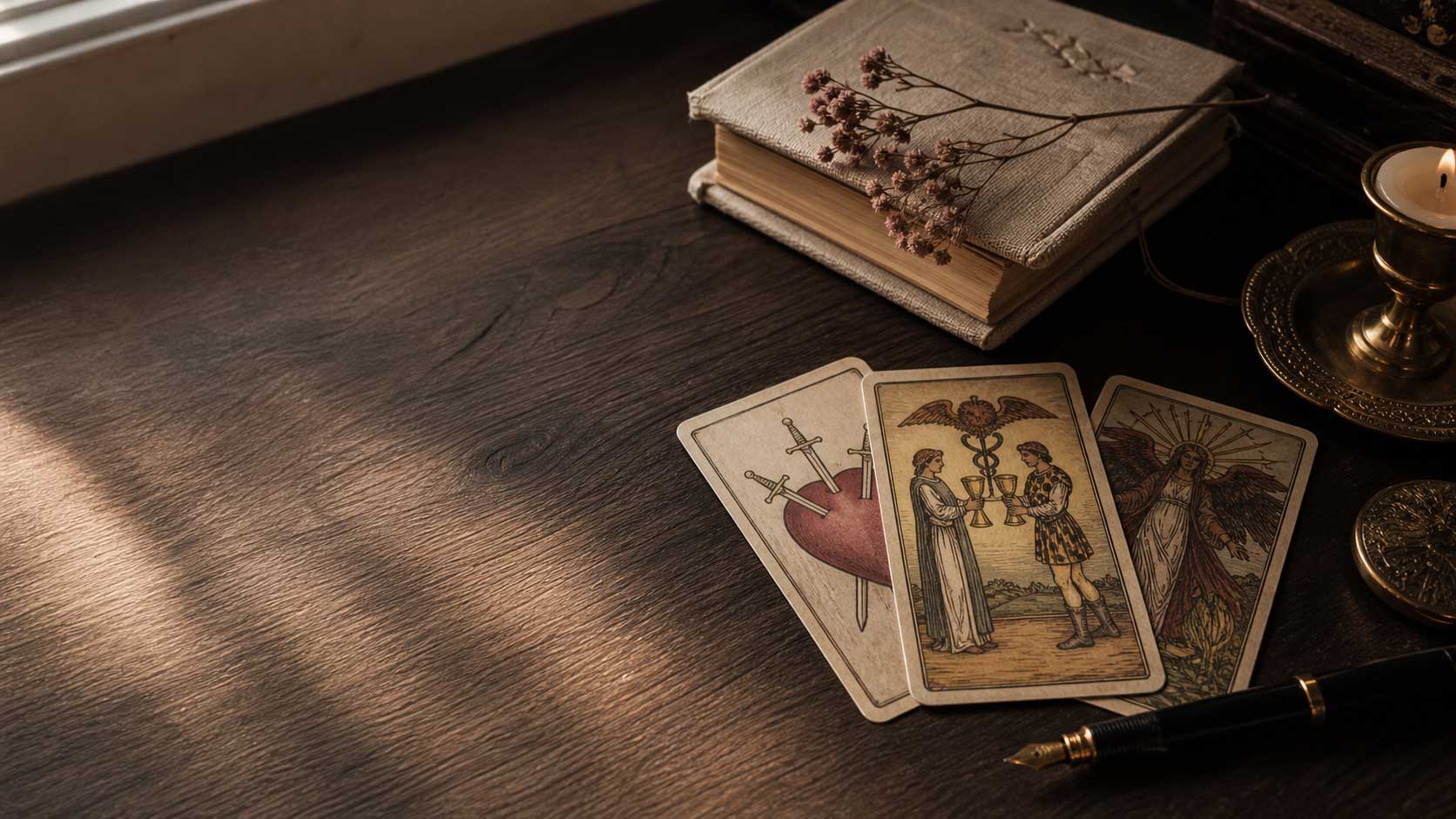
A one-card love tarot reading is appealing because it feels clean. One question. One card. One answer. When your heart is tired of overthinking, that simplicity can feel like mercy.
But love questions are rarely simple just because the spread is simple. One card can name the emotional weather, the pattern to notice, or the next grounded step. It cannot responsibly prove someone's hidden feelings, guarantee an ex will return, or replace the behavior you are already seeing.
Eldrin's rule is this: one card is enough when it helps you come back to clarity. It is not enough when you are using it to avoid context.
Tarot clarity
Turn the card meaning into a useful next question
Use Eldrin to connect the symbolism to your real situation without turning one card into a fixed verdict.
Ask about your cards->Best when you want interpretation with context.
What a One-Card Love Reading Is Good For
One card works best when the question is focused and the emotional stakes are manageable. It can help you see the tone of a situation, the part of the pattern that needs attention, or the next question worth asking.
Use it for questions like:
- What do I need to notice about this connection today?
- What is the healthiest way to respond right now?
- What feeling is shaping my interpretation?
- What next step protects my self-respect?
These questions keep the reading useful because they do not ask one card to become a private investigator. They ask it to become a mirror.
When One Card Is Not Enough
One card becomes weak when the situation needs layers. If there has been betrayal, a breakup, no contact, mixed signals, or a major decision, one card may name a theme but not the full map.
Be especially careful if you are asking:
- Is he cheating?
- Will my ex come back?
- Does he secretly love me?
- Should I end the relationship?
Those questions carry too much context for one symbol to hold cleanly. A single card may still be meaningful, but it should send you toward a better spread, a direct conversation, or a reality check, not a final verdict.
How to Read the Card Without Overloading It
Start with the plainest meaning. If you pull The Moon, do not jump straight to deception. Name uncertainty, projection, fog, timing, or incomplete information first. If you pull Two of Cups, do not jump straight to destiny. Name reciprocity, connection, or the question of mutual effort.
Then ask where the card shows up in real life. Does the behavior support the message? Does it contradict it? Are you reading the card, or reading your strongest hope into the card?
This is not less spiritual. It is more honest. Tarot becomes safer when symbolism and evidence are allowed to sit in the same room.
A Simple One-Card Love Tarot Method
- Write the question before you draw. If the question keeps changing, your nervous system may be looking for relief rather than clarity.
- Pull one card only. Decide before you start whether clarifiers are allowed. Do not add more cards just because the first one feels uncomfortable.
- Translate the card into one sentence. Keep it grounded: "This card asks me to look at avoidance," or "This card points to the need for mutual effort."
- Compare it with behavior. Texts, plans, repair, silence, affection, and follow-through all matter.
- Choose one action. Wait, ask clearly, stop checking, journal, set a boundary, or close the reading for the day.
Tarot clarity
Turn the card meaning into a useful next question
Use Eldrin to connect the symbolism to your real situation without turning one card into a fixed verdict.
Ask about your cards->Best when you want interpretation with context.
Examples of Better One-Card Questions
A good one-card question is narrow enough to answer and mature enough to leave you with agency.
- Instead of "Does he love me?" ask "What pattern should I notice in how love is being shown?"
- Instead of "Will he text?" ask "What is the healthiest way for me to handle the silence today?"
- Instead of "Is this doomed?" ask "What truth needs attention before I decide my next step?"
- Instead of "Should I wait?" ask "What would make waiting self-respecting rather than self-abandoning?"
These questions do not dodge the ache. They stop handing the whole ache to one card.
The Clarifier Trap
Clarifiers can be useful when they are planned. They become a trap when they are pulled because the first card did not soothe you.
If The Tower appears and you immediately pull three more cards to make it softer, the reading is no longer one-card clarity. It is negotiation. If Two of Cups appears and you keep pulling to prove it means commitment, the reading is drifting from insight into reassurance.
Before a clarifier, ask: am I seeking more context, or am I trying to change how the answer feels?
The Bottom Line
A one-card love tarot reading can be enough for a focused question, a daily check-in, or one honest next step. It is not enough when the question needs context, evidence, repair, safety, or a real conversation.
Let one card be a doorway, not a courtroom. If it gives you clarity, act on it gently. If it makes you more frantic, step back and ask a better question before you pull again.
If your one-card answer feels too heavy to carry alone, bring the full situation into Eldrin and ask for the pattern, the evidence, and the next grounded step.