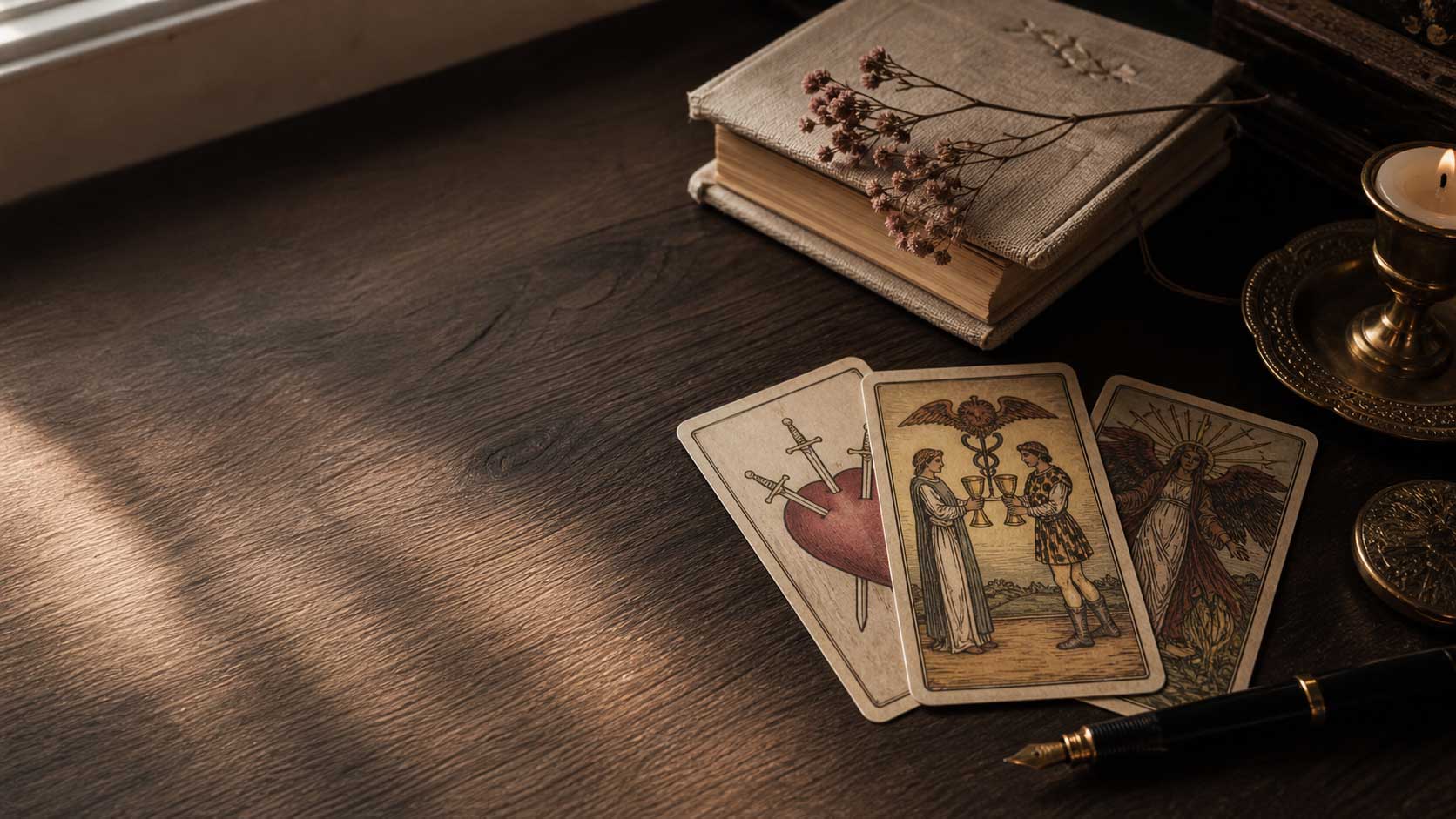
The Knight of Swords reversed in love can suggest rushed communication, scattered arguments, or an urge to act before understanding. It may also invite a pause where discussion has stalled. The card cannot diagnose a partner, prove hostility, or determine the outcome of a disagreement.
Notice the pace of the conversation
You start explaining why a cancelled plan hurt, and the discussion becomes a debate about the exact words in a message. You draft a long reply before you have finished reading theirs. The Knight of Swords reversed can be a prompt to notice what speed is doing to understanding.
In familiar Rider–Waite–Smith imagery, the Knight moves forward with a raised sword. A reversed reading can explore momentum that has become hard to direct, or energy that cannot find a useful route. Different readers use reversals differently. Context and the spread position should guide the interpretation.
Bring the argument back to one subject
Try writing the issue in a single sentence. “We agreed to tell each other when plans change.” Then name the request. “Could you message me when you know you will be late?” This gives the conversation a point of return when it starts collecting old grievances.
A hypothetical example is a couple arguing about a short text. One person means, “I need a clearer update.” The other hears, “You are always unreliable.” Before continuing, each person can say what they think the request is. If those summaries differ, there is still something to clarify.
Give a pause a return point
If you are too worked up to listen, a pause may help. Name it plainly and suggest a realistic return time, such as after dinner or tomorrow morning. Agreeing when to return can make the practical meaning of the pause clearer. You can also write down the one topic you want to resume.
A pause only works if both people are willing and able to take part. If someone repeatedly avoids the return conversation, that becomes a separate pattern to address. You can assess it through what happens, without pulling another card to explain the silence.
Read your own position first
In an advice position, the card might invite you to delay sending a message until you have a clear purpose. Read the draft once and remove any sentence whose only job is to hurt. Keep the request you are prepared to discuss. In a challenge position, consider whether urgency is making every point feel equally important.
If you are asking about someone else, avoid using the card as a personality label. You can describe interruptions, rapid messages, or unanswered questions. You cannot infer an attachment style, a diagnosis, or an intention to harm from the card.
Finish with a sentence you can use
An Eldrin question could be, “What do I need to make clearer before we return to this discussion?” Add the issue and your own goal in a few lines. A useful takeaway might be a request, a listening question, or a limit on when you can continue.
If a conversation involves threats or you feel unsafe, prioritize practical safety and trusted support. No interpretation obliges you to resume it. For an ordinary disagreement, check whether the eventual exchange leaves both people able to speak, answer, and understand the next agreement.
Tarot clarity
Turn the card meaning into a useful next question
Use Eldrin to connect the symbolism to your real situation without turning one card into a fixed verdict.
Ask about your cards->Best when you want interpretation with context.
Keep exploring
Questions people ask
Does the Knight of Swords reversed predict an argument?
No. You can use it to reflect on urgency, direction, and communication in the situation you already know. It does not establish that an argument will happen.
Can this card mean no communication?
Some readers connect the reversal with stalled or misdirected action. If communication has stopped, keep that fact separate from guesses about why. The card cannot reveal the reason.