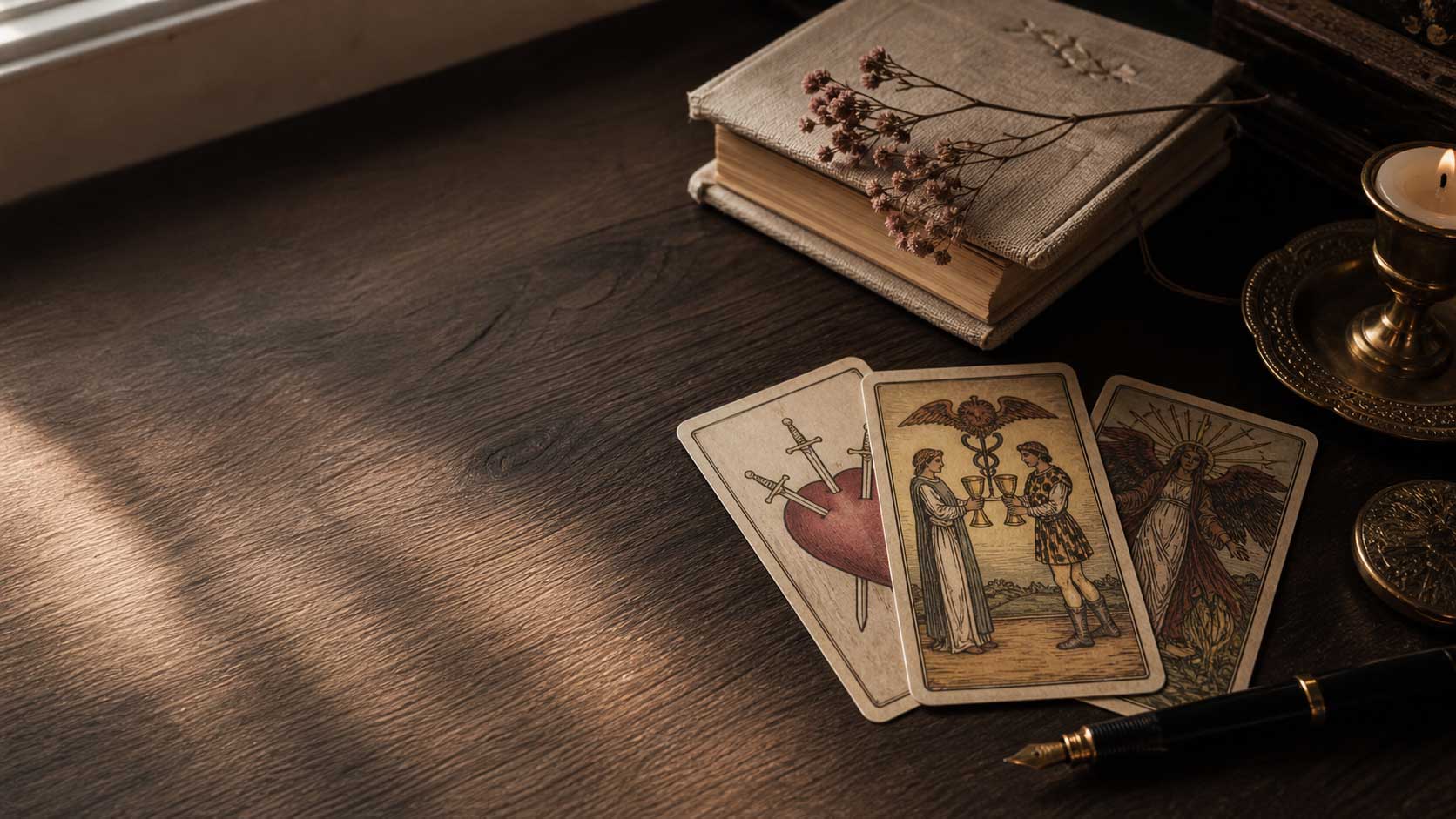
The short answer: You can read tarot without a fixed spread by setting one question, choosing a small card count before drawing, and reading the cards together without assigning separate positions afterward. Keep the interpretation tentative, record one useful reflection, and stop at the limit you chose.
Tarot clarity
Turn the card meaning into a useful next question
Use Eldrin to connect the symbolism to your real situation without turning one card into a fixed verdict.
Ask about your cards->Best when you want interpretation with context.
Keep the question even when you remove the positions
A fixed spread gives each card a job, such as context, obstacle, or advice. A freeform reading can place all the cards under the same question. You are looking at a group of images, not secretly recreating a spread after seeing which meanings you prefer.
For example, “What might help me return to my sketchbook this week?” is small enough to explore. “Tell me everything about my life” gives you little basis for deciding what belongs in the answer. If you want separate answers about money, relationships, and work, use separate questions or a defined spread.
Readers use different methods. A public discussion about reading with or without spreads illustrates that variety; it does not establish one correct system.
A five-step exercise with no assigned positions
- Write one question. Keep it close to a choice or experience you can reflect on.
- Choose two or three cards before shuffling. Decide whether you use reversals and whether left-to-right order matters. For this exercise, use the group as a whole, with no time sequence.
- Describe each image briefly. Start with what you see and one possible association. Avoid making each card a verdict.
- Offer one connection and one alternative. Ask how the symbols might answer the same question, then name what you could be overlooking.
- Write a sentence and close the reading. Keep one small action or journal prompt. Check it against your circumstances.
The stopping rule is part of the method. If the answer remains unclear, write “unclear” rather than extending the draw until a preferred story appears.
A worked example: returning to a sketchbook
Suppose you draw the Eight of Pentacles, Four of Cups, and Page of Pentacles. Using common symbolic associations, you might note practice, disengagement, and a modest learning opportunity. None of these cards has been assigned a past or future role.
One possible reading is: “A short practice session may feel more welcoming than trying to produce something impressive.” An alternative is that the routine itself has become dull, so a different subject could be more useful than more discipline.
Now add ordinary evidence. If you enjoy drawing once you start but avoid setting up, leave the sketchbook open and try ten minutes. If you have been drawing daily and feel tired, an evening away may fit better. The cards do not tell you which of those facts is true.
This is an invented example, not a reading performed for a real person or a claim that those cards prescribe a particular action.
When fixed positions would help more
If you keep moving meanings around, asking which card refers to which person, or treating the final card as a forecast, a defined layout may make the reading easier to review. You can switch methods next time without calling this attempt a failure.
Use the spread-choice guide when several parts of a question need separate space. If the cards feel disconnected, connecting cards as a story covers that interpretive skill in more detail.
Freeform does not mean factual access to the future or another person’s thoughts. If the question needs a direct conversation, a document, or professional advice, seek that information. Let the reading help you prepare a better question.
Bring one question into the reading
Try: “What is one useful next step for the situation I can describe today?” If reflection feels useful, start a reading with Eldrin. You keep the decision.
Questions people ask
Is it wrong to read tarot without a spread?
No. Fixed positions are one way to organize a reading, rather than a universal requirement. A freeform reading can still have a question, a planned card count, and a stopping point.
How many cards should I use without a spread?
For this beginner exercise, choose two or three before you draw. That is a practical limit for learning, not a rule about how many cards a freeform reading must contain.
Can I decide the card positions after I see the cards?
You can design a method that way, but it is a different exercise. To keep this method easy to review, do not retroactively assign past, present, or future roles to make an answer fit.