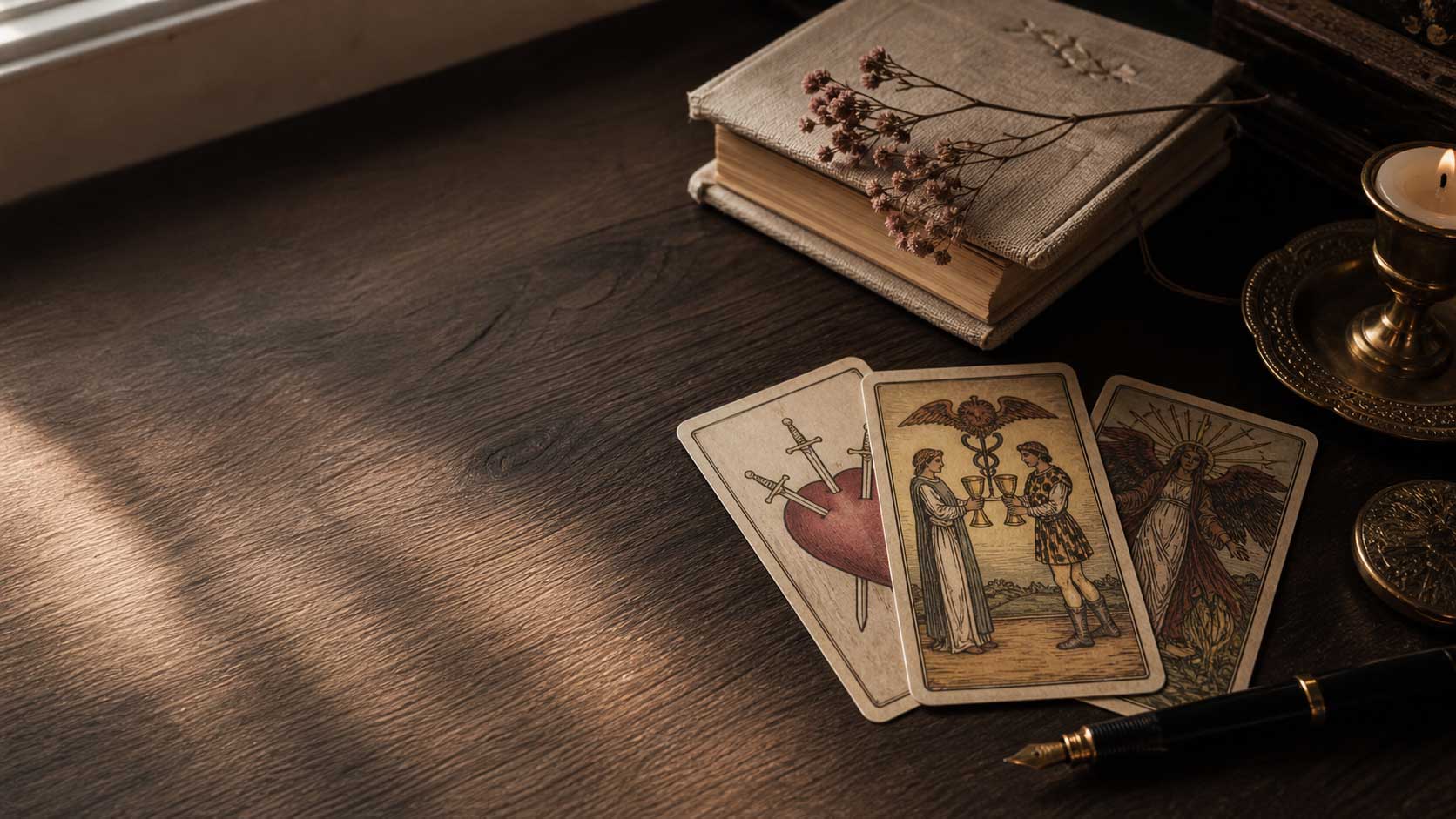
The short answer: You can use a clear photo to revisit a tarot spread, provided you know the question, card names, positions, and intended orientation. A photograph preserves the layout; it does not preserve all the context. If something is unreadable or unknown, mark it as unknown instead of filling the gap with a story.
Tarot clarity
Turn the card meaning into a useful next question
Use Eldrin to connect the symbolism to your real situation without turning one card into a fixed verdict.
Ask about your cards->Best when you want interpretation with context.
A photo is a record with missing pieces
You took a picture before clearing the table. A week later, the cards are visible but you cannot remember whether the left card meant the obstacle or the advice. Start by recovering your notes. Position changes the job a card has, so a confident interpretation built on the wrong layout can send the reflection in a different direction.
If someone else sent the picture, ask for their permission and the context they want to discuss. Avoid sharing names, private messages, or identifying details visible around the cards. A reader needs a clear question, not access to the whole private situation.
Make a simple transcript
Write the deck name if known, the original question, the position labels, and each card in order. Add upright or reversed only if orientation was part of the original method. Note whether the photo was taken from the reader’s side. A rotated photograph does not automatically reverse every card.
For instance: “Question: how can I prepare for a work conversation? Position 1, my concern: Nine of Swords upright. Position 2, a resource: Queen of Swords upright. Position 3, next step: Three of Pentacles upright.” This transcript is much easier to review than three card names without their jobs.
Read one position before linking the cards
In that example, the Nine of Swords could help name worry about the conversation. The Queen of Swords as a resource could suggest clear language and written facts. The Three of Pentacles as a next step might support asking for specific collaboration. The cards do not establish that a colleague is hostile or that the meeting will succeed.
Compare the interpretation with what you knew at the time. If you are reviewing after an event, keep “what I wrote then” separate from “what I notice now.” Otherwise it is easy to reshape a vague sentence until it appears to have predicted the result.
When the image is not enough
If glare hides a title or an unfamiliar deck changes the imagery, ask for a clearer image or the card’s name. If the original positions are lost, label any new reflection as a fresh exercise. Do not present a reconstructed layout as the original reading.
You can bring the written transcript into a text reading without relying on image recognition. For Eldrin, use the card names, positions, and question in your own words; this page does not promise a photo-upload feature. Keep the final question practical: “Which part of this interpretation gives me something useful to consider?”
Keep exploring
Read the related Eldrin guide, then keep only the part that helps with your actual question.
Questions people ask
Does a rotated tarot photo change the reversals?
Not by itself. Confirm how the original reader defined orientation and which side they were reading from.
Can I interpret a photo if I forgot the spread positions?
You can reflect on the visible cards, but label that as a new exercise. Do not claim to have recovered the original positional reading.