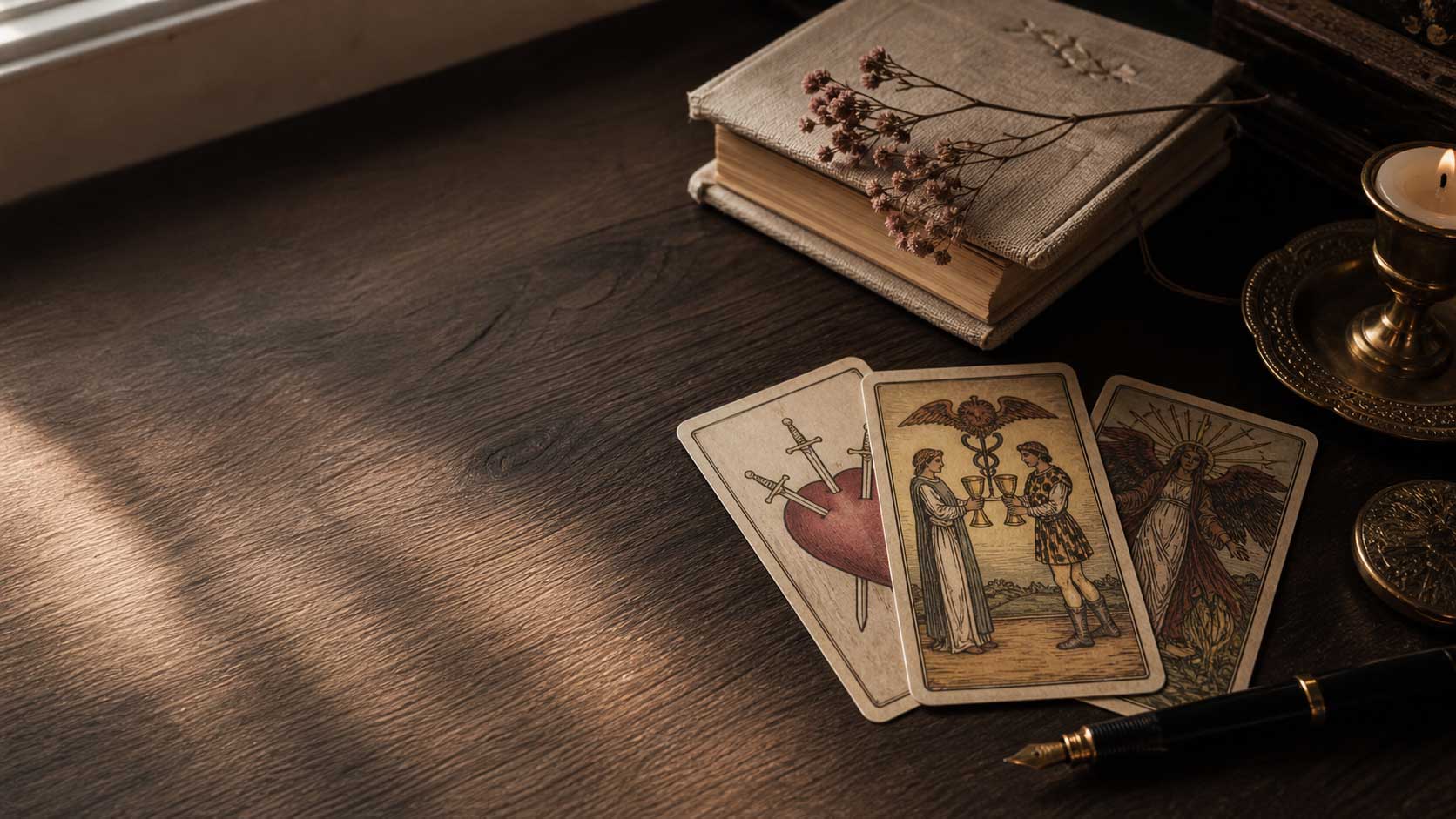
A deck can look beautiful on a screen and still be awkward on your table. Perhaps the cards are difficult to hold, or the images become too small to explore comfortably. Size is a practical part of choosing a deck you will use.
The short answer: Choose tarot card size by balancing readable artwork, comfortable handling, and the space you have for a spread. Check the actual product dimensions because deck sizes vary. A smaller or larger card does not make an interpretation more accurate.
Tarot clarity
Turn the card meaning into a useful next question
Use Eldrin to connect the symbolism to your real situation without turning one card into a fixed verdict.
Ask about your cards->Best when you want interpretation with context.
Start with how you read
If you work closely with image details, consider how easily you can see a figure’s hands, a path in the background, or a small object. If you mainly use the card name with a guidebook, different details may matter. Neither practice requires a particular size.
Look for a clear photograph of the exact edition. When possible, view a sample at its actual dimensions rather than judging from an enlarged product image. You can mark those dimensions on scrap paper to understand the footprint, though a paper rectangle will not reproduce the card stock or thickness.
Check handling without making shuffling a test
Width, thickness, finish, and the size of the full stack can all affect how a deck feels. Dimensions alone cannot tell you whether it will be easy to shuffle. If you can handle a sample, notice whether you can lift, turn, and place the cards without strain.
You can mix cards on a clean surface or use another comfortable method. A large deck does not require you to perform a difficult shuffle. For practical options, see how to shuffle tarot cards. Stop or adjust an action that hurts; tarot does not require discomfort.
Try your usual spread on the space you have
Put three paper rectangles on the table where you usually read. Leave room for a notebook or guidebook. Can you see every position? Can you reach the cards without disturbing the layout? A deck that works for a single daily card may feel crowded in a larger spread.
Storage matters too. Consider whether you read at home, carry the deck in a bag, or need a box you can open easily. These are ordinary preferences, not signs that you are more or less serious about tarot.
Measure before buying accessories
For sleeves, compare the card dimensions with the sleeve maker’s stated fit guidance. For a box, check usable interior space and the thickness of the full deck, including sleeves if you use them. An outer box measurement does not tell you what will fit inside.
Be careful with measurements in different units or product listings that refer to packaging rather than cards. If a listing is unclear, ask the seller before buying. You do not need to memorize a supposed universal tarot size.
Use one decision you can explain
Try writing: “I want readable illustrations, comfortable tabletop mixing, and room for three cards beside my notebook.” That sentence gives you criteria you can compare. You may decide the deck you already own works well enough.
If you want to practice interpretation before purchasing anything, bring a small question into Eldrin. A digital reading can help you explore reflective language; it cannot tell you how a physical deck will feel in your hands. That part needs a practical check.
Questions people ask
Is there one standard tarot card size?
Do not assume a single size fits every deck. Check the publisher’s dimensions for the edition you want, and confirm the units before choosing sleeves or storage.
Are mini tarot decks harder to read?
They can make fine details or small guide text harder to see, but comfort varies. Examine an actual card or a sample at its intended size, especially if artwork details guide your readings.