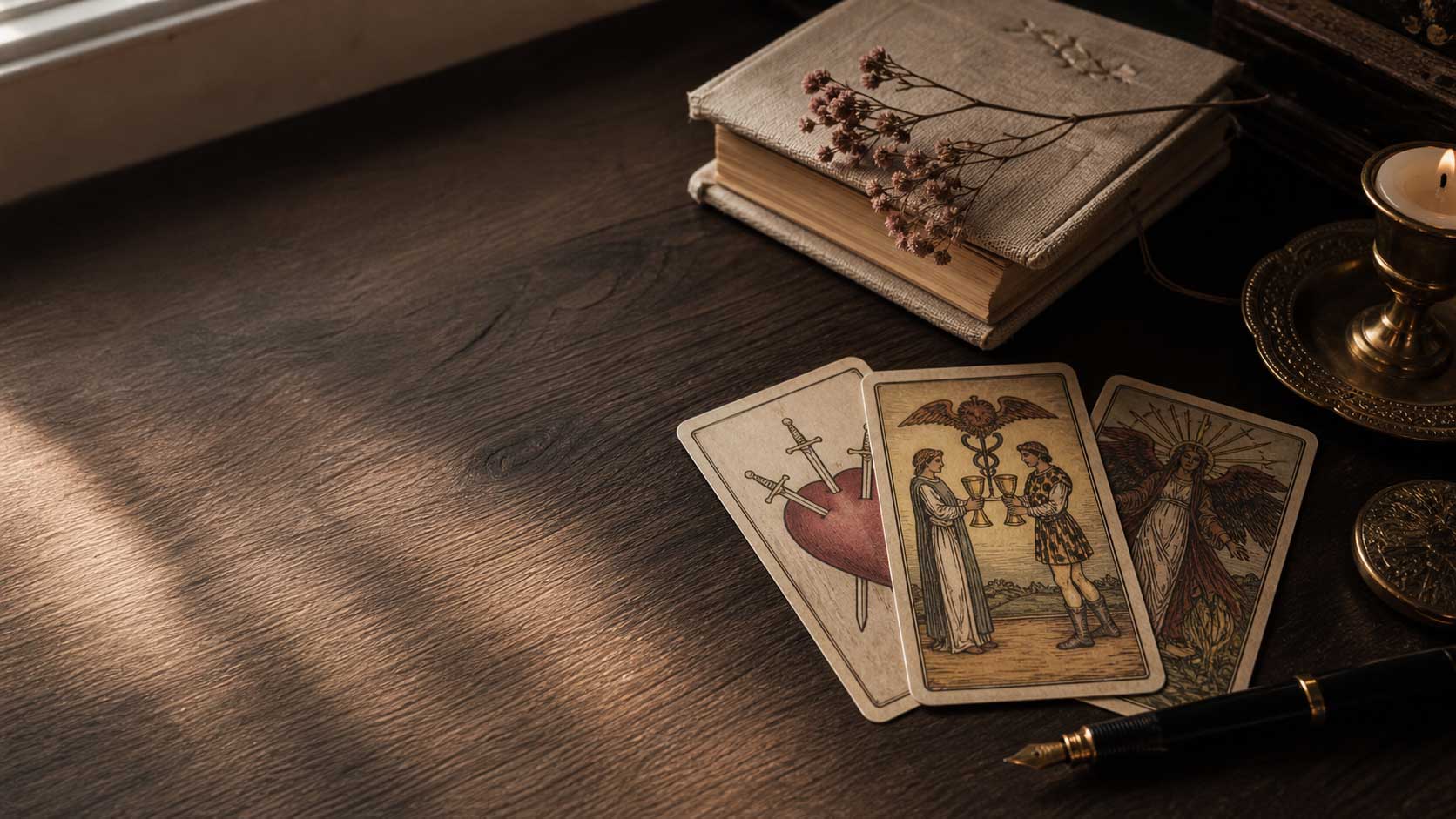
The short answer: Figures facing toward or away from each other can be an optional visual prompt in a tarot reading. Read each card in its assigned position first, describe the visible direction, and test whether the connection helps answer the question. A gaze cannot prove attraction, rejection, or hidden intentions.
Describe the picture before interpreting the relationship
Two cards land side by side. One figure seems to look toward the other; another appears to turn away. It is tempting to call this mutual interest or rejection immediately. Start with the smaller observation: a face, body, or object points in a particular direction in this deck’s artwork.
Looking direction is different from whether a card is reversed. It is also different from the reader’s seating position. You are noticing how images relate across a layout, not changing the rule for upright and reversed cards. Some artwork has no clear gaze at all, and you do not need to invent one.
Give the positions priority
Write the question and positions before drawing. In a spread for a creative project, the positions might be available resource, obstacle, and next step. A figure facing the obstacle could prompt attention to a difficulty; the same figure in the resource position could invite you to use an existing strength.
For example, suppose your deck’s Queen of Swords faces the next-step card. After reading her as a resource for clear thinking, you might ask whether stating a requirement would help with that action. That is a connection to test against your project. It does not mean the Queen is literally speaking to the adjacent figure.
Check what the artwork can support
Keep three short notes: what is visible, a possible association, and what in your situation supports it. “The figure faces an open edge” is an observation. “I might need more space to think” is an association. “I have not had uninterrupted planning time this week” is context. Keeping these apart makes an interpretation easier to revise.
Use your own deck. An animal, abstract pattern, or redesigned scene may not reproduce the direction you remember from another deck. If the guidebook gives the artist’s explanation, read it as context for that design. Do not force every leftward look to mean the past or every rightward look to mean the future.
Know when to leave the visual connection out
If gaze contradicts the card’s position or requires a complicated invented plot, leave it out. You do not need to rotate, rearrange, or redraw the cards until the figures make a satisfying scene. A useful reading can rest on card names, meanings, positions, and your question.
In a relationship spread, two figures facing away cannot establish that two people are separating. Even figures facing each other cannot verify mutual affection. Turn the image into a question about something observable: “Where are we having trouble giving each other attention?” Then use actual conversation and behavior to explore it.
Tarot clarity
Turn the card meaning into a useful next question
Use Eldrin to connect the symbolism to your real situation without turning one card into a fixed verdict.
Ask about your cards->Best when you want interpretation with context.
Questions people ask
Do figures facing each other mean two people are in love?
No. The arrangement can suggest a question about attention or exchange, but it cannot establish anyone’s feelings. Read the positions and real context first.
Should I turn cards so the figures face each other?
Keep the orientation and layout you chose before drawing. Changing the arrangement to create a story changes the exercise; it does not confirm the original interpretation.
Continue with a related Eldrin guide, or browse the Eldrin blog.