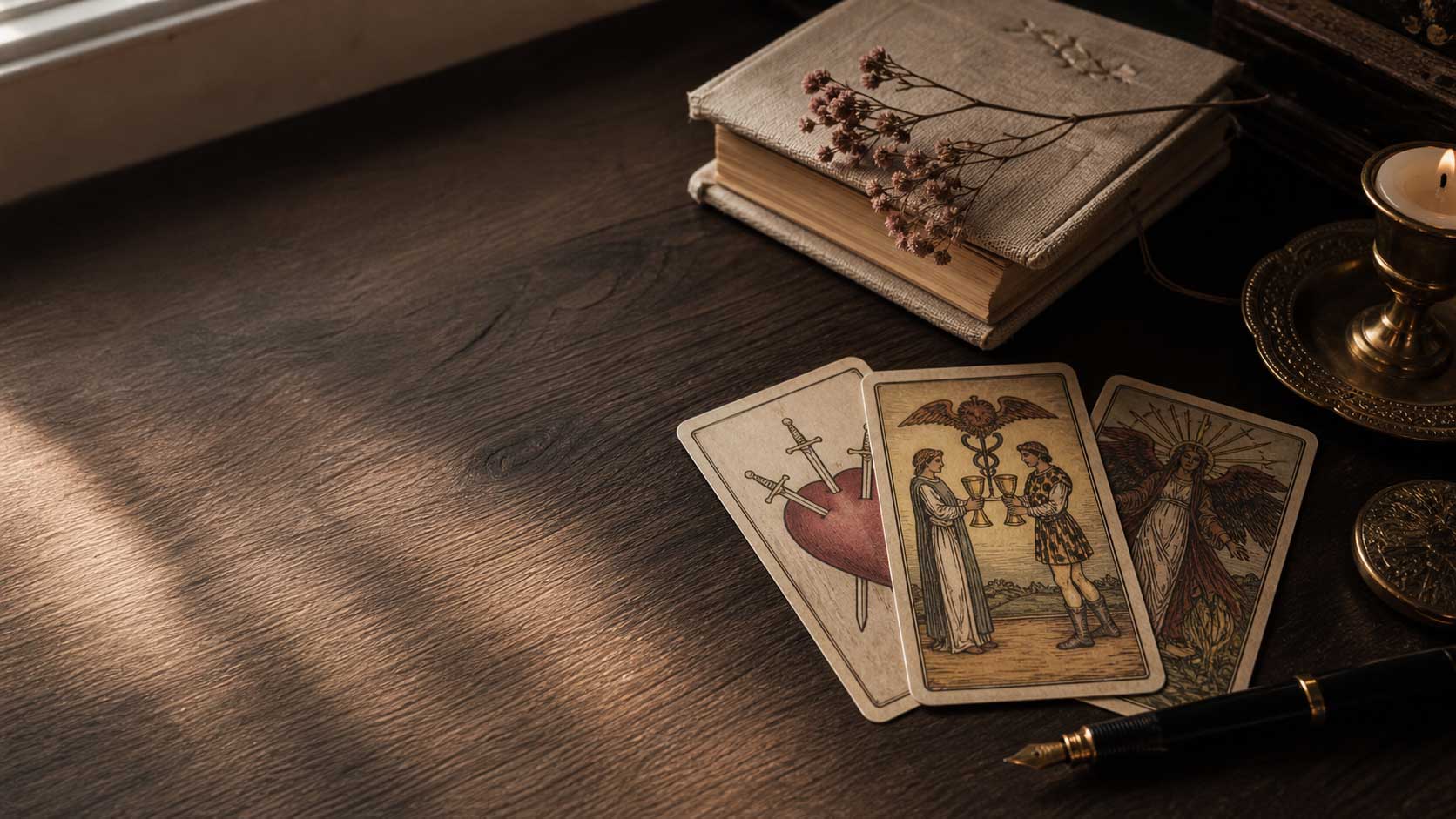
You turn over three cards, and your attention goes straight to the third. Or a guidebook numbers a spread differently from the one you learned. It can feel as though reading in the wrong direction will make the whole answer wrong.
The useful distinction is between how you deal the cards, what each position asks, and the order in which you discuss the result.
The short answer: You do not have to interpret tarot cards in one universal order. If you chose a spread with defined positions, keep each card attached to its original question even when you discuss the cards in a different sequence. In an unpositioned draw, record the order and state the reading method before building a story.
Three kinds of order that are easy to mix up
- Dealing order: the sequence in which you place cards on the table. A spread diagram may number this for you.
- Position meaning: the question assigned to a particular spot, such as “what helps” or “what needs attention.”
- Interpretation order: the route you take while thinking or speaking about the cards. You might begin with an overview and then return to position one.
Changing the third does not require changing the second. You can talk about an obstacle before a resource while leaving both cards attached to their original questions.
Tarot clarity
Turn the card meaning into a useful next question
Use Eldrin to connect the symbolism to your real situation without turning one card into a fixed verdict.
Ask about your cards->Best when you want interpretation with context.
A worked example: a striking card in the middle
Suppose you choose three positions for a creative task: what helps, what needs attention, and one next step. You draw the Eight of Pentacles, the Tower, and the Page of Pentacles.
You might notice the Tower first. In this example, it invites a question about what needs attention: is a plan resting on an assumption that no longer works? It does not automatically turn the entire spread into a prediction of disaster. Return to the first card to consider practice or steady work as a resource. Read the third as a prompt for a small learning step, such as testing one part of the plan.
You discussed the middle card first, but you did not promote it to “the future.” That is the distinction to preserve. These meanings are illustrative possibilities, not a finding about any real project.
When you did not assign positions
A freeform line of cards can be read through contrasts, repeated images, or a theme developing across the row. You still need a method clear enough to describe. You might read left to right as a sequence of ideas, or consider all three as different aspects of one question.
Do not quietly turn the same row into past-present-future halfway through because the final card looks encouraging. Write the draw down, note that positions were not assigned, and treat any timeline reading as an optional exercise. A familiar narrative can feel convincing without being evidence that events will follow it.
Try a short reading route
- Write the question and position labels before dealing.
- Record the cards in their original places, including reversals if you use them.
- Notice the card that draws your attention, but answer its assigned question.
- Read every remaining position once.
- Write a two-sentence synthesis and one practical question to carry away.
If two guidebooks use different numbering, choose one map before the draw. Consistency makes your notes easier to revisit; it does not establish one book as the only legitimate tradition.
The trust boundary
A neat story is not proof that an interpretation is true. Do not rearrange cards until they appear to grant permission for a decision. If the reading stays unclear, record that uncertainty and stop. For more context, see how position changes a card’s question and how to connect cards without forcing a prediction.
Questions people ask
Do tarot cards have to be read left to right?
No universal left-to-right rule applies to every spread. Follow the position map or method you chose. A Celtic Cross or another shaped spread can have its own numbered route.
Can I read the last card first?
You can begin discussing a card that catches your attention, including the last card. Keep its assigned position intact, then return to the other cards so that one striking image does not take over the reading.
Can I rearrange cards to make a spread make sense?
For a positioned spread, keep the original arrangement as your reading record. You can explore a different arrangement as a separate exercise, clearly labeled as a new interpretation rather than a correction that proves the preferred answer.