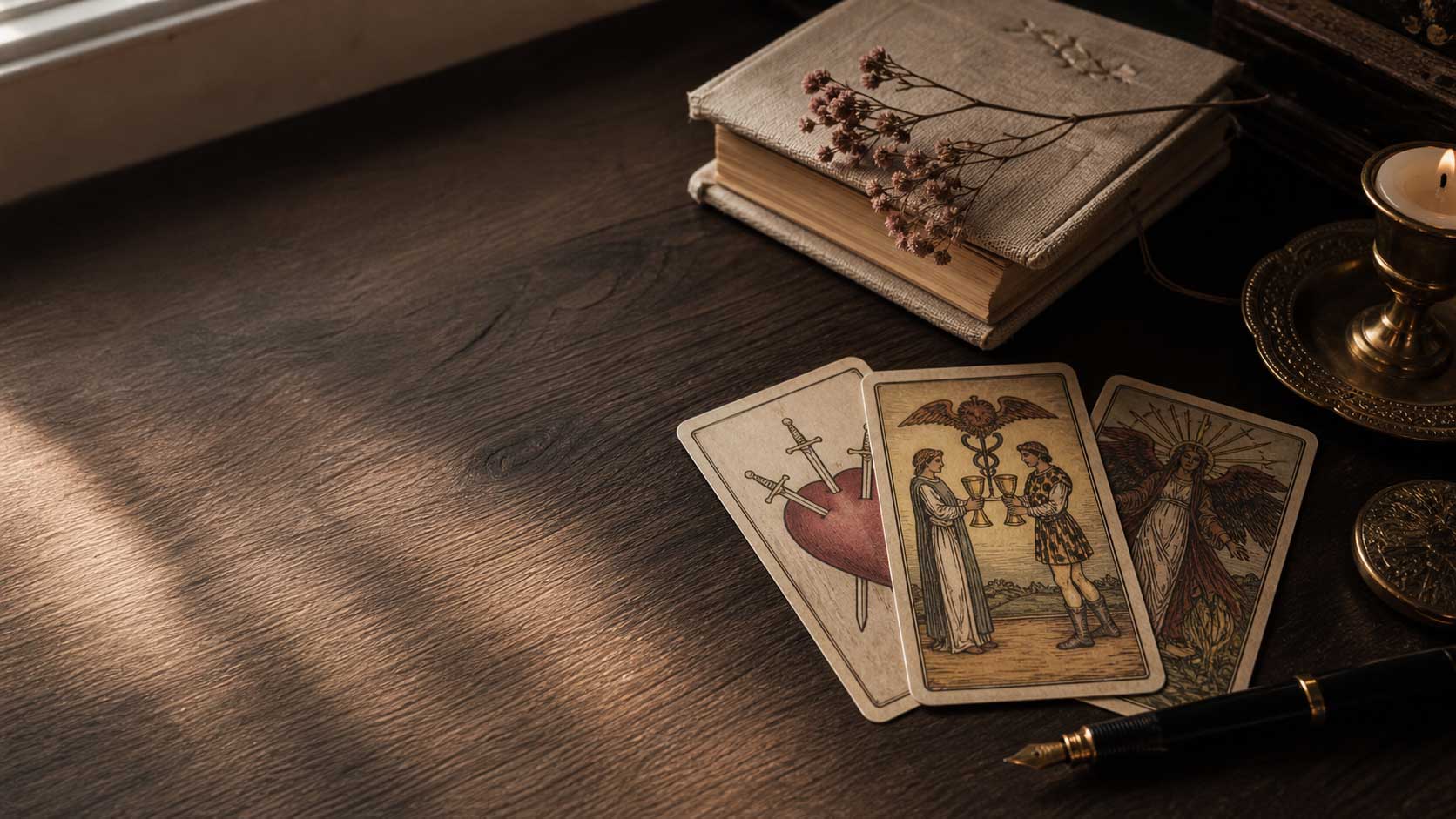
Sometimes you want to sit with your cards but cannot name a question. Nothing dramatic has happened. You might be curious, tired, or interested in a quiet check-in. That is enough of a reason to practice; you do not have to invent a problem to earn a reading.
The short answer: you can read tarot without a specific question. Choose a limited frame, such as a check-in on your current routine, and decide what each position will explore before drawing. A general reading is an invitation to reflect, not permission to predict events in every area of your life.
Give “general” an edge
Without a frame, the same card might be applied to work, romance, health, or a conversation you barely remember. That freedom can make a story feel convincing after the fact. A small boundary makes the interpretation easier to examine.
For example, choose “a check-in on this week’s everyday routine.” That describes the scope of your reflection, not a deadline for a predicted event. If you prefer no time frame, try “what has had my attention lately.” Write that sentence at the top of your notes.
This is different from keeping a question silent. A silent question can be very specific. Here you are intentionally choosing a general frame. It is also different from reading without a spread: you can have clear positions even when you have no pressing question.
Try a three-card general check-in
- Attention: what part of my current experience could use a closer look?
- Support: what resource or practice might help me meet it?
- Action: what small, realistic step could I try?
Deal once, record the cards and positions, and read them in that frame. You can also use only the first position if three cards feel like more than you need. These are optional prompts, not a requirement for a correct reading.
See how the frame keeps an example grounded
Imagine the Four of Cups in Attention, Eight of Pentacles in Support, and Page of Wands in Action. One possible reading is that your routine feels stale, familiar practice offers a foothold, and a small experiment could bring curiosity back.
In ordinary language: “I have been distracted during my evening hobby. I could return to one exercise I know, then try a different material for twenty minutes.” That is a hypothesis you can try. The same cards do not establish that a partner is bored with you or that a job offer will arrive.
If none of it fits, write that down. You can notice the artwork, look up a meaning, and finish the practice without inventing a connection. An interpretation does not become more useful because you force your day to match it.
Let a real question emerge, then stop
A general reading may help you discover a concrete question: “Why have I stopped making time for this?” Record it for later reflection. You do not have to turn the same session into several new spreads.
Finish by keeping one observation and one action. If the reading remains vague, the result can simply be “I do not have enough context today.” More cards are not a requirement. See how to choose a spread if you later have a more specific question.
Tarot clarity
Turn the card meaning into a useful next question
Use Eldrin to connect the symbolism to your real situation without turning one card into a fixed verdict.
Ask about your cards->Best when you want interpretation with context.
Using AI for a general reflection
If you want help putting the cards into words, give the tool the frame, positions, and cards you actually drew. You might write: “This is a general routine check-in, not a forecast. Offer a possible reading and tell me where more context would be needed.” Do not assume a service can accept physical card inputs unless that option is available.
For a new Eldrin session, you can instead start with a broad reflective prompt about your current routine. Keep the result beside your experience. Neither a physical draw nor an AI answer can uncover a medical problem, reveal another person’s secrets, or obligate you to act.
If your uncertainty is about speaking the question, read whether tarot questions need to be said aloud.
Questions people ask
Do I have to ask tarot a question?
No. You can choose a general reflective frame instead. Deciding the scope and any card positions before drawing makes it easier to avoid assigning a dramatic meaning after the fact.
What is a simple general tarot spread?
Try Attention, Support, and Action: something to notice in your current experience, a resource you can use, and a small step to try. Keep the interpretation within the frame you chose.
What if nothing in my general reading makes sense?
You can record that it did not fit and stop. Look at the imagery or guidebook as a study exercise without inventing an event or repeatedly drawing until something feels personal.
Bring one grounded question into an Eldrin reading, then choose a next step you can use in your own life.