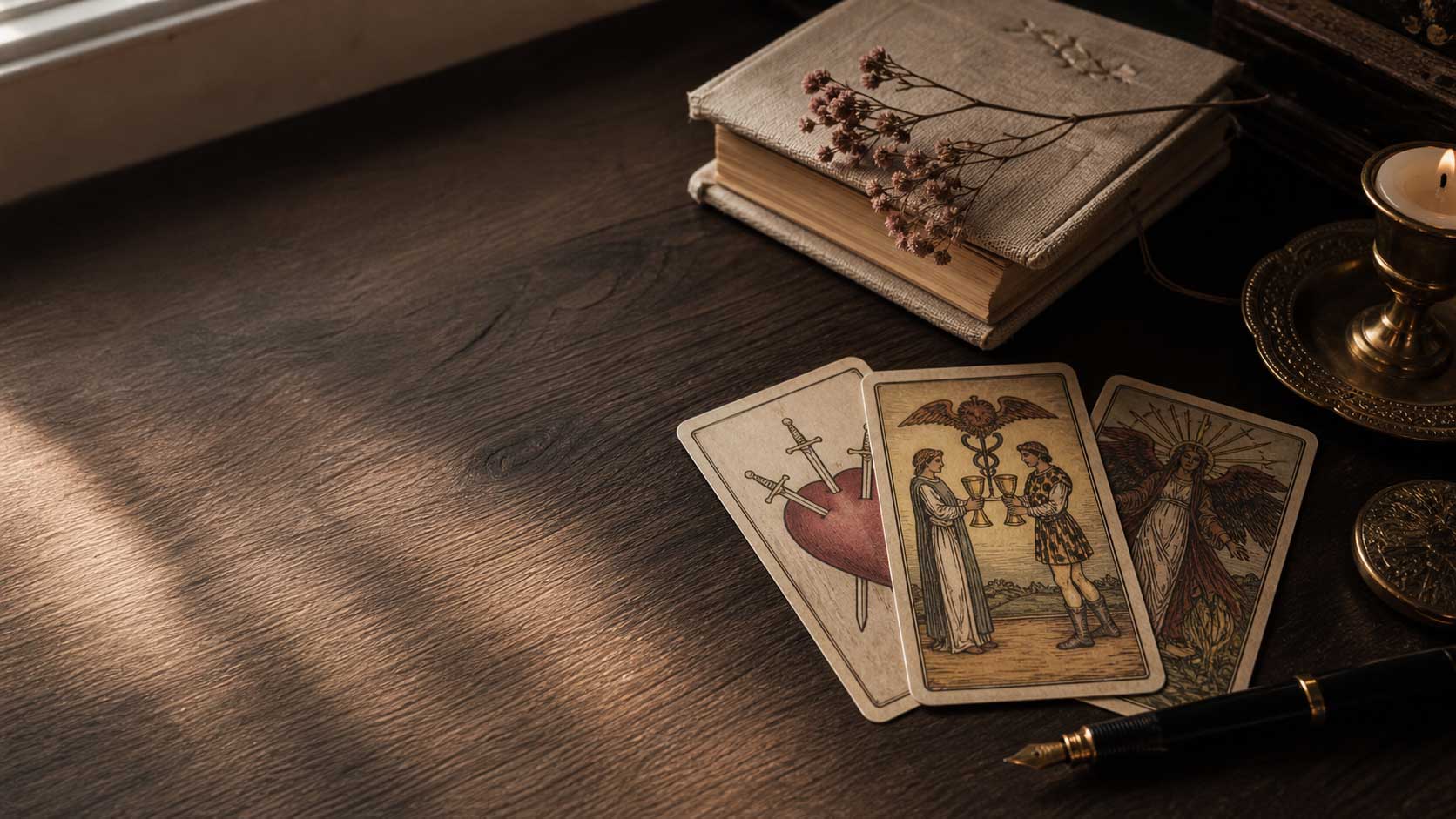
The house is finally quiet, and you have ten minutes to yourself. Or a question has followed you into bed and you want a reading before you can let it rest. Both situations happen at night, but they ask different things from a tarot practice.
The short answer: You can read tarot at night as a reflective practice. The clock does not establish that a reading is more accurate or more dangerous. Choose a time when you can see the cards, follow your question, and stop after the planned draw. If you are tired or seeking a verdict before sleep, you can leave the reading until another day.
The time can be a preference without becoming a rule
Some readers enjoy mornings; others find a quieter moment after dinner. A public discussion about preferred reading times includes people who avoid late readings because they are winding down. That tells us about individual routines, not a universal best hour.
You can choose nighttime because it fits your day. You do not need to call it more intuitive, treat a certain hour as dangerous, or wait for a special window to make the cards usable. If you follow a spiritual tradition with specific practices, those are commitments within that tradition; this page offers a flexible reflective routine.
The guide to reading without candles covers simple setup choices. Here, the main question is whether this time of day leaves you enough attention and a clear ending.
Ask what you want the reading to do tonight
A small review question might be, “What part of today would I like to acknowledge?” That is different from, “Tell me exactly what tomorrow will bring so I can stop worrying.” A spread can support the first kind of reflection. It cannot provide the certainty the second request asks for.
Before drawing, notice whether you can accept an answer you do not immediately understand. If you already expect to pull again until you feel reassured, consider writing down the question and leaving it for daylight.
You do not need to prove that you are too distressed to read. “I would rather do this when I have more attention” is a sufficient reason to wait.
A brief evening routine
- Use enough light to read the images and any guidebook text comfortably.
- Choose one question about your own experience, with no deadline for an answer.
- Decide on one card and a short amount of time before drawing.
- Write one observation and one possible action for another day.
- Put the cards away when the planned reflection is complete.
For example, you ask, “What deserves acknowledgment from today?” A card associated with effort might prompt you to note a task you finished. Your closing sentence could be, “I answered the difficult email; the next reply can wait until tomorrow.” The card did not predict the response. It helped you name something already done.
Keep the action modest. You do not need to send a message, settle a relationship question, or change tomorrow’s plans simply because you have finished the reading.
If a card unsettles you, do less with it tonight
An intense image can feel harder to hold when you are tired. You can name it as an image, note the question it belonged to, and stop. You do not need to resolve every symbolic possibility before going to bed.
A difficult card is not evidence that something bad will happen overnight. Do not add a series of clarifiers to obtain a promise of safety. If you want to return later, keep the original question and position with your notes so the interpretation has context.
If the specific pattern is repeatedly checking an ex’s feelings during a breakup, the nighttime breakup reflection addresses that loop. This guide is about choosing a workable reading time, rather than reading someone else from bed.
Notice what the routine does to the rest of the evening
Over a few separate sessions, ask whether the practice stayed brief and whether you could put the cards away. Did it help you articulate one thought, or did it lead into more searching, more readings, and a later bedtime than you wanted?
Use that observation to change the routine. You might read earlier in the evening, choose a written check-in without cards, or take a break. There is no score for maintaining a nightly reading streak, and missing a session does not create a debt to your deck.
This is a practice check, not a sleep treatment. If disrupted sleep is an ongoing concern, a tarot interpretation cannot assess its cause or provide the care you may need.
The same stopping point applies on a screen
If you choose an Eldrin reading, bring one question such as, “What could help me acknowledge today without planning the whole week tonight?” Start a short reflection only if it fits the evening you want to have.
Read the response as a perspective you can consider later. A digital reading does not need a final follow-up before you can close it. You are allowed to leave the question unfinished and return to the rest of your night.
Tarot clarity
Turn the card meaning into a useful next question
Use Eldrin to connect the symbolism to your real situation without turning one card into a fixed verdict.
Ask about your cards->Best when you want interpretation with context.
Questions people ask
Is it bad luck to read tarot after midnight?
This reflective approach gives the hour no authority to predict harm. Choose a time and setting that work for you rather than treating midnight as evidence of danger.
Are nighttime readings more accurate?
A quieter setting may suit your attention, but it does not verify an interpretation or prediction. There is no accuracy guarantee attached to the time on the clock.
Should I draw another card if I am worried before bed?
You can stop instead. Keep the original question in your notes and return another day if useful. Repeated draws cannot establish that you or someone else will be safe.