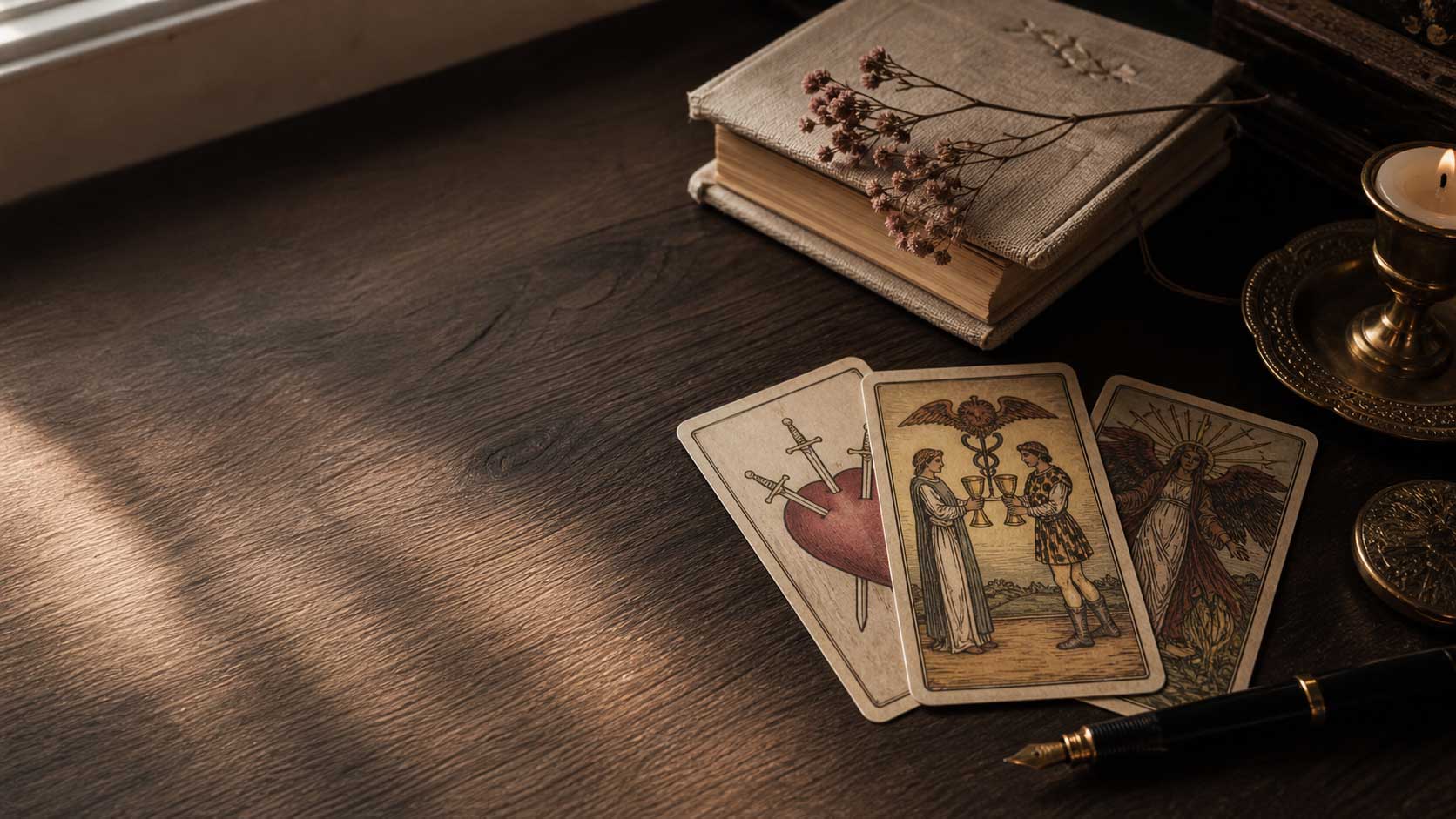
You buy a deck because the artwork catches your eye. Later, a strange detail makes you wonder how it was made. Before deciding what that detail proves, separate two questions: what has the creator disclosed, and can you comfortably read the deck?
The short answer: When checking whether a tarot deck uses AI-generated art, start with the creator’s disclosure and ask about the illustration process. Inspect the deck list, sample cards, and guidebook separately for usability. Visual oddities may justify a question, but they do not by themselves prove how an image was made.
Your preferences about art and authorship can matter even when the cards are readable. You do not need to turn that preference into a claim about spiritual danger.
Ask about the process directly
Look for an artist credit and an explanation on the product listing, box, guidebook, or creator’s own page. “Designed by” alone may not explain who illustrated the images or which tools were used. An unclear statement is a reason to ask, rather than evidence of deception.
A simple question is: “Were any of the card illustrations or backs made with generative AI? If so, which parts, and what human illustration or editing was involved?” A seller may not have a complete answer. You can choose to wait or pass on a purchase when information you value is missing.
Use odd details as questions, not verdicts
Look closely at symbols, lettering, hands, and repeated objects if they affect your reading. An unreadable title or confusing suit count is worth noticing regardless of how it happened. It may be a design choice, a reproduction problem, an editing error, or something else.
Color, polish, or unusual anatomy alone does not prove AI use. Human work can be stylized, and generated work can be edited. Avoid identifying an artist’s process from a single screenshot or passing on an accusation as fact.
Check whether the deck works for your practice
- Compare the contents with the deck list. Check renamed suits and any intentional extra cards.
- Read several sample cards beside their guidebook entries. Does the imagery give you something understandable to work with?
- Check that labels are legible and that the backs do not unintentionally reveal individual cards.
- Decide whether you want a familiar symbolic system or are willing to learn the creator’s system.
These checks assess usability, not authorship. A complete deck can still conflict with your values; a handmade deck can still be hard for you to read. Keep both judgments available.
Separate image generation from interpretation
An AI-written reading and AI-generated artwork are different uses of a technology. Disclosure about one does not answer questions about the other. If you want to know how a particular service’s artwork or interpretation is produced, look for that service’s explanation rather than generalizing from a deck listing.
This article does not establish the origin of Eldrin’s artwork. It offers questions you can ask about any product. A fluent interpretation also cannot authenticate a physical deck or establish the provenance of its images.
Make the decision in ordinary terms
If the deck is already yours, check applicable return terms and decide whether you want to keep using it. You do not need to cleanse away a manufacturing concern or pull cards to learn whether the deck forgives your hesitation.
If you keep it, an optional deck interview can help you explore its visual language. If you want to reflect on one card’s meaning through Eldrin, describe the card and your question. Keep the buying decision grounded in disclosure, your preferences, and what the seller actually offers.
Tarot clarity
Turn the card meaning into a useful next question
Use Eldrin to connect the symbolism to your real situation without turning one card into a fixed verdict.
Ask about your cards->Best when you want interpretation with context.
Questions people ask
Can I prove a tarot deck is AI-generated by looking at the hands?
No. Odd anatomy, lettering, or repeated details can prompt questions, but visual style alone does not establish the production process. Look for disclosure or a direct explanation from the creator.
Is AI-generated deck art the same as an AI tarot reading?
No. One concerns how images were produced; the other concerns generated interpretation text. A service can involve one, both, or neither. Check the specific product’s disclosures.
Can I still use a deck if I dislike how it was made?
You can decide based on your values, the deck’s readability, and any available return terms. You do not need a card reading to authorize keeping it, returning it, or setting it aside.